Tehran draws a new line at Hormuz, and Washington has to decide whether to sign
Iran's foreign minister says a 14-point memorandum with Washington is near finalised, and that the Strait of Hormuz will no longer be run as before. The deal, if it holds, redraws who collects the tolls on a fifth of the world's oil.
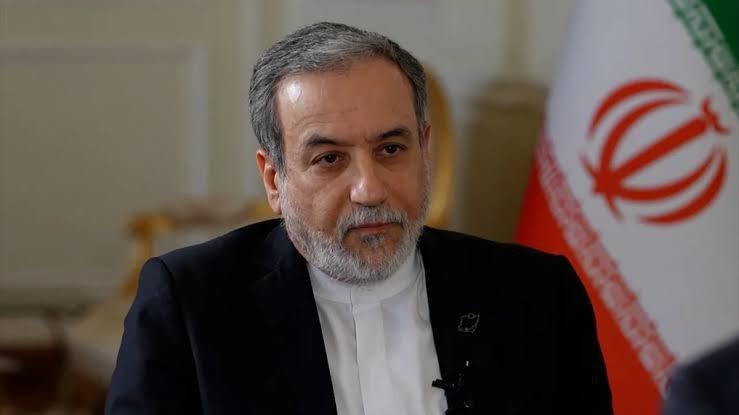
At just after 19:30 UTC on 12 June 2026, Iran's Foreign Minister Abbas Araghchi stood before cameras and confirmed what had been rumoured for weeks: a fourteen-point memorandum of understanding between Tehran and Washington is close to finalisation. Hours later, in a series of remarks captured by the open-source channel DDGeopolitics, he sketched what that document actually does. A first-stage "Islamabad Memorandum of Understanding," signed between the two governments, sets the political terms. A second-stage agreement covers the nuclear file proper. If the first stage is not honoured, Araghchi said, there will be no second stage — a sequencing he presented as the deal's own guarantee.
This is not a routine diplomatic communiqué. Araghchi used the same platform to announce that the Strait of Hormuz "will no longer be run as before." The legal regime Tehran has in mind, he said, would not be the old multilateral framework, and would not involve levying tolls on transit shipping. It would, in his telling, recognise that the entire strait sits within the territorial waters of Iran and Oman, with no international waters in between. The implication is that any future security architecture for the world's most sensitive energy chokepoint is now to be negotiated bilaterally with Tehran, on terms Tehran is prepared to defend.
What Araghchi actually said
The public statements, taken together, break into four distinct claims. First, on the deal itself: a fourteen-point MOU is "drawing close to its end," with an "Islamabad Memorandum of Understanding" already signed and a final agreement to follow. Second, on Hormuz: the strait lies inside Iranian and Omani territorial waters; no international waters separate them; the regime to come will be a legal one, in line with international law, and tolls are off the table. Third, on enforcement: if the first-stage commitments are not honoured, the second stage does not happen — sequencing is the security. Fourth, on the wider posture: "for our security we rely on no one — not the Security Council, not coalitions or alliances. Only God, our own people, and our own armed forces."
That last line is the one Western desks are least likely to print, and the one that does the most work. It is a public assertion of strategic autonomy, aimed as much at domestic audiences as at Washington. It tells Iranians that whatever is signed will not be signed away under pressure, and it tells the Americans that the deal is not a surrender document on either side.
The counter-narrative from Washington
The American line, where it has surfaced in parallel reporting, is more cautious. Officials in Washington have stressed that the existing sanctions architecture remains in place until the second-stage agreement is reached, and that any change to the Hormuz regime requires a multilateral conversation, not a bilateral one. The implicit counter to Araghchi's framing is straightforward: a sovereign claim over a transit corridor used by the entire global economy cannot be settled by two of its three riparian states, and the United States Navy's continued presence in the Gulf is not a negotiation chip to be traded against nuclear concessions.
There is a second, less diplomatic counter-narrative, more common among Gulf analysts than in official statements: that Tehran is overplaying its hand by tying an unrelated sovereignty claim to a nuclear file that the United States is otherwise prepared to close. The argument runs that any American president will struggle to defend a treaty that hands Iran effective veto power over a fifth of seaborne oil, regardless of what is conceded on enrichment. On that read, the MOU as described is a political artefact for Tehran's hardliners as much as a working diplomatic document.
Why the structural frame matters
Strip the rhetoric away and what is being negotiated is the management layer of an energy corridor that carries roughly a fifth of global oil shipments and a significant share of liquefied natural gas. For four decades that layer has been contested, but contested within a roughly stable architecture: US Fifth Fleet presence, Omani-Iranian bilateral arrangements, and a tacit understanding that the strait is internationalised in practice even where its legal status is disputed. Araghchi's announcement is an attempt to formalise the bilateral track and downgrade the multilateral one. If it holds, the practical effect is that any future disruption to shipping becomes a Tehran-Washington question first, and a global market question second.
The economic stakes are concrete. A sustained disruption scenario at Hormuz moves Brent crude by tens of dollars a barrel within hours, with downstream effects on shipping insurance, refining margins and Asian import bills that far exceed the value of the underlying cargo. The countries most exposed are not the United States, which is a net exporter of refined product, but the large Asian importers — China, India, Japan, South Korea — for whom Hormuz is a single point of failure. Their silence on the announcement, or their quiet encouragement of it, will tell observers as much as anything Araghchi or his American counterpart say.
The part that remains uncertain
Several things are not yet clear, and the open record should be read with that in mind. The first is the text of the MOU itself. Araghchi is describing a document; the document has not been published. The second is the scope of the Hormuz regime. The claim that the entire strait lies within Iranian and Omani territorial waters is contestable under the United Nations Convention on the Law of the Sea, which treats transit passage through straits used for international navigation as a separate legal category. Tehran is not the only party with a legal position. The third is the meaning of "not honouring" the first stage. Sequencing is a guarantee only if both sides accept the same definition of compliance, and the history of US-Iran negotiations suggests that is the part most likely to break.
What this publication is willing to say with confidence is narrower than the headlines. A diplomatic process is genuinely close to producing a signed text. That text is paired, by Iran's own framing, with a redesign of the security regime around a chokepoint the world cannot do without. The deal is real, even if its durability is not yet proven. The next seventy-two hours — the usual window for hardline pushback in Tehran and for Senate signalling in Washington — will tell us whether what Araghchi is selling survives contact with the politics on both ends of the line.
Desk note: Monexus is leading on the Iranian foreign minister's own statements, sourced to the open-source DDGeopolitics channel that captured the remarks on 12 June 2026, rather than to Western-wire paraphrase, so that the precise language of the Hormuz claim and the two-stage sequencing is on the record.
Wire provenance
This editorial synthesis draws on the following public wire/social posts:
- https://t.me/DDGeopolitics
- https://t.me/DDGeopolitics
- https://t.me/DDGeopolitics
- https://t.me/DDGeopolitics
- https://t.me/DDGeopolitics
- https://t.me/DDGeopolitics
- https://t.me/DDGeopolitics