Flags Over Ruins: Reading Israel's Southern Lebanon Operation Through the Pictures It Broadcasts
As a US-Iran deal ends the wider war on paper, Israel's cameras kept filming in southern Lebanon: a flag on a hilltop, strikes on three towns, and a Lebanese complaint at the UN no one is reading.
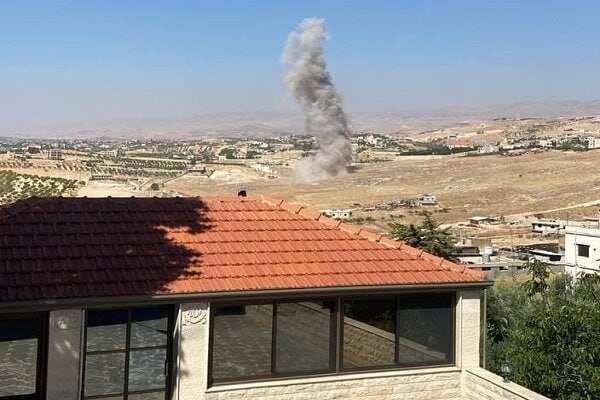
On the morning of 12 June 2026, the Israeli army's southern Lebanon operation produced two distinct visual products for public consumption: an Israeli flag planted beside a ruined hilltop structure, and a rolling sequence of strike footage from three towns along the Litani. The pictures travelled faster than any communique. By the time analysts had begun to ask whether the operation was winding down or gearing up, the imagery had already set the frame. What follows is a reading of those broadcasts, not as a substitute for ground truth, but as the language the campaign is choosing to speak in.
The simultaneity is the story. A symbolic act on a hilltop and a kinetic pattern in three towns ran on the same news cycle, and together they suggest a campaign being communicated rather than merely executed. The hilltop image is designed to read as conclusion: a flag raised where Hezbollah infrastructure once stood, a still photograph standing in for closure. The strike footage is designed to read as continuation: jets over southern Lebanon, secondary explosions in residential neighbourhoods, and what one open-source monitor described as intense air activity logged on the same morning. The two feeds do not contradict each other. They braid.
The imagery also functions as message-sending toward audiences Israel does not control. Tehran's Supreme National Security Council, in statements released after the MoU announcement, framed Israel's continued Lebanon strikes as proof that the Iranian delegation had extracted concessions from Washington, with Iranian Foreign Ministry messaging publicly crediting the Lebanon campaign for pressuring the United States into an "immediate lifting" of certain restrictions. Whether or not that reading is accurate, the Israeli feed is plainly aware that it will be consumed in that frame, and that awareness is shaping what gets broadcast and in what order. Photography in this theatre is now a third negotiator.
Then there is the question of what the pictures leave out. International wire reporting on the same day describes an Israel-Hezbollah front that, until the MoU was concluded in Islamabad, remained active despite a declared ceasefire architecture. Lebanese authorities filed two separate complaints with the United Nations Security Council and the Secretary-General over Israeli attacks on Lebanese territory during this period. Human-weight reporting on civilian harm has not kept pace with the strike footage, and the asymmetry is itself a fact about the campaign: the platforms carrying the flag-raiser's video carry far less of the corresponding ambulances and damaged schools. The reader assembles the operation from one half of the visual record.
The diplomatic backdrop compounds the confusion. On 14 June, Pakistan announced that the United States and Iran had reached a peace agreement brokered in Islamabad, with the two sides declaring an immediate, complete and permanent end to military operations on all fronts, including Lebanon. Prime Minister Shahbaz Sharif publicly claimed credit for the mediation, the E3 (France, Britain, Germany, Italy) issued a joint statement expressing readiness to lift sanctions in response to verifiable Iranian steps, and Iran's SNSC published a fourteen-clause memorandum under the signature of its secretariat. The agreement is structured in phases, with the first phase taking effect immediately upon announcement. None of that stopped the southern Lebanon feed. The headline that matters for Beirut on the morning the pictures went out is not the MoU's text but its execution on the ground, and on that score the visual record keeps moving.
So the right question is not whether Israel is winning the picture war or losing it. It is what the picture war is for. The flag tells one audience that the campaign has reached its symbol and can be paused without loss. The strikes tell another audience, including Tehran, that pause and withdrawal are not the same word. The Lebanese state, filing at the UN while its towns appear in strike clips, is being read out of the script. Until the ground truth catches up with the imagery, southern Lebanon will continue to be a place that is narrated more than it is reported, and the narrator will be the side with the camera.
Follow the event.
These dated source records provide context. They do not retrospectively verify this archive article.
Separate what the nuclear watchdog reported from what it could not determine after the June 2025 strikes.