SpaceX closes debut at $2.11 trillion as AI pitch propels the largest listing in history
The shares closed up roughly 19% on day one, valuing Elon Musk's space and AI group at $2.11 trillion — and turning roughly 400 staff into centi-millionaires on the first trade.
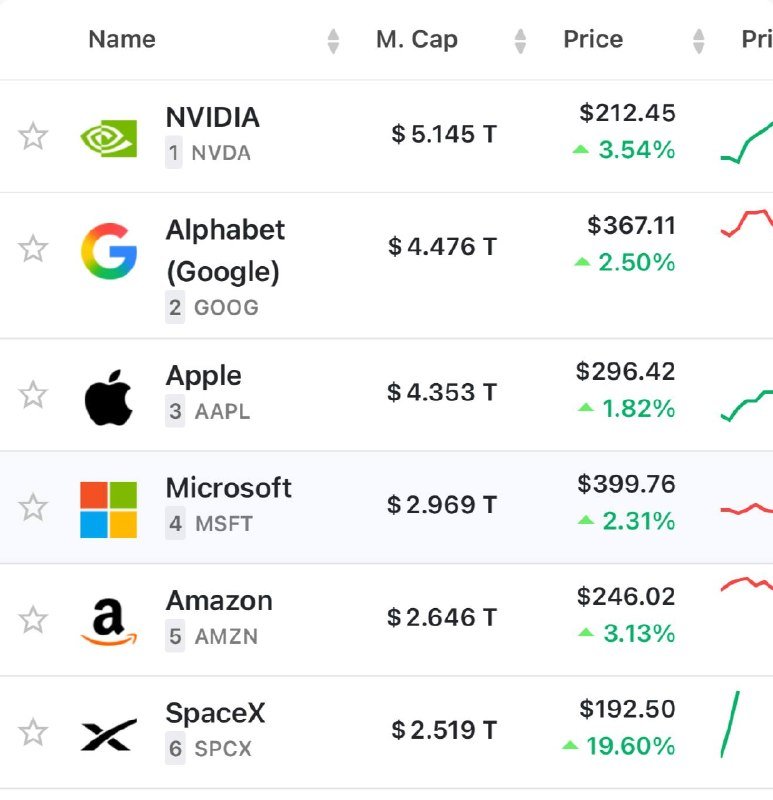
SpaceX closed its first day as a public company on 12 June 2026 worth roughly $2.11 trillion, the largest opening-day market capitalisation on record, after shares priced the previous evening at $135 and were indicated at $171 at the open, up 26.7% on the offer. By the close the gain had narrowed but stretched to 19% on the day, with the order book reportedly oversubscribed to the tune of more than $350 billion.
The size of the print, on any honest accounting, is the headline. A private company that a decade ago carried a valuation measured in single-digit billions has entered the public market in the same league as Saudi Aramco, Apple and Microsoft, and above every industrial conglomerate outside a handful of Asian state-linked groups. The market is being asked to underwrite not just a launch business but a thesis: that the same firm which puts payloads in orbit can also build the orbital data-centre infrastructure the AI industry is desperate for.
A debut priced for a different company
The mechanics of the listing read like a stress test of investor demand. According to Bloomberg reporting carried by Unusual Whales, shares were indicated to open at $171 against the $135 offer, with more than $350 billion in orders chasing the float, and trading scheduled to begin at 10:00 ET. The ticker, $SPCX, is listed on Nasdaq. By the close, market capitalisation stood at approximately $2.11 trillion, a touch below the intraday mark of $1.96 trillion at the open and the $2.4 trillion level that some shadow markets and crypto perpetuals had been implying earlier in the week.
The listing is unusual in two respects. First, the lead product the company is selling to public investors is not a constellation, a rocket or a satellite-internet subscription. It is a $28.5 trillion "total addressable market" figure in which, the company says, AI "makes up nearly all" of the value. That is a remarkable claim from a firm whose core 2026 revenue still derives from launch services, Starlink broadband, and a small but growing share of US government space and defence work. Second, the company has used the public market to crystallise an extraordinary amount of internal wealth in one day: roughly 400 current and former employees are positioned to cross the $100 million threshold on the back of the IPO, including, per Bloomberg, cafeteria workers — a detail that captures the breadth of the equity programme but also, frankly, the lottery-ticket character of the underlying instruments.
What the SEC pause tells us
Beneath the celebration, the regulator pushed the brakes on the most aggressive derivative packaging. The SEC delayed the launch of leveraged SpaceX ETFs until Monday, a decision that removes a class of products designed to deliver 1.5x or 2x daily exposure to a name whose underlying float, market structure and after-hours behaviour are still being mapped by the Street. The delay is not a verdict on the equity itself; it is a recognition that the secondary apparatus around a $2 trillion listing needs more time to settle than the equity tape has been given.
Prediction markets are tracking the early volatility with calibrated scepticism. A Polymarket contract on whether $SPCX opens higher on its second session is sitting at 53%, a coin-flip that reflects the absence of a settled fair value rather than a clear directional view. Perpetual contracts on Hyperliquid, which had briefly printed an implied first-day gain of more than 35% on the back of the Bloomberg news flow, have since retraced toward the realised close. In other words, the marginal trader is no longer certain that the listing is mispriced upward; they are simply uncertain.
The AI pitch, taken seriously
The company is not wrong to lean on AI. The same orbital real estate that lets Starlink deliver low-latency broadband also lets a future fleet of data centres sit closer to users than any terrestrial campus, an architectural bet that is structurally interesting regardless of whether SpaceX is the operator. The bear case is that the $28.5 trillion TAM is, at best, a 2035+ optionality claim dressed up as a 2026 valuation input, and that the gap between the two will be filled with multiple expansion rather than realised cash flow. The bull case is that this is the same company that took reusable launch from a punchline to a unit-economics story in a decade, and that the public market is being asked to repeat the bet on orbital compute.
There is a third, more uncomfortable read. The bulk of US hyperscaler AI capex is currently being absorbed by Nvidia, the US utility grid, and a small number of neocloud operators. A $2.11 trillion capitalisation on day one of trading is, in part, a vote that SpaceX can capture a meaningful share of that stack without yet having to show the revenue line that would justify the multiple in conventional terms. If that bet is right, the closing print is cheap. If it is wrong, this is the most expensive single trade in market history and the unwind will take years to play out.
Stakes and what to watch
The straightforward winners are the employees, the venture holders who sold into the offer, and the institutional allocators who received their pro-rata on a heavily oversubscribed book. The straightforward losers, in the short run, are the funds that did not get allocation and are now deciding whether to chase a 19% gap or wait for a pullback. Over a longer horizon, the question is whether the AI-tied TAM figure translates into a revenue line that compounds at the rate the multiple assumes. The leveraged-ETF delay, the Polymarket coin-flip, and the gap between the implied crypto-market valuation and the realised close all point to one thing: the market is not yet sure what it just bought.
The next two sessions, and the regulator's decision on the leveraged products, will set the tone. A hold of the $2 trillion line into the second-day open would confirm the bid. A retest of the $1.96 trillion opening level would invite a more sceptical read of the AI thesis. Either way, the public market has now priced a space company as a peer of the largest technology platforms on earth, and the burden of proof has shifted decisively to the operating reports.