SpaceX's $1.75 trillion IPO tests how much private value public markets will swallow
SpaceX priced above its $1.75 trillion mark and opened 29% higher in debut trading on 12 June 2026, prompting Jim Cramer to float a $2.5 trillion follow-on valuation — and reviving an old question about whether public capital is the right yardstick for private empires.
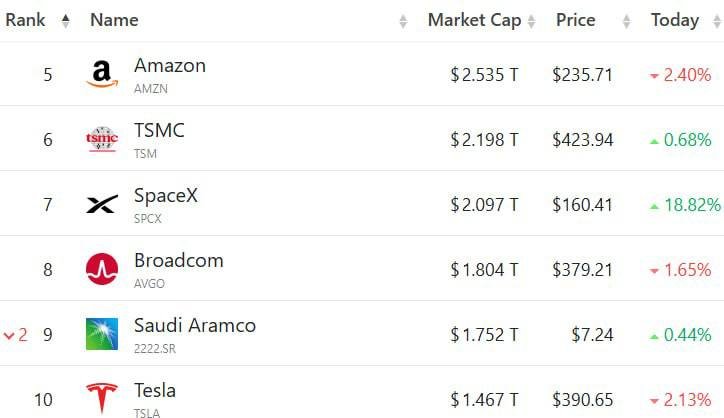
The opening print on 12 June 2026 made the scale of the bet plain. SpaceX, the privately held launch and satellite operator run by Elon Musk, priced its initial public offering at $135 a share, valuing the company at roughly $1.75 trillion, and was indicated to open about 29% above that price in debut trading, according to market data circulated on Polymarket and referenced by CoinDesk the same morning. By mid-afternoon UTC, CNBC's Jim Cramer told viewers he was "thinking $2.5 trillion" for the stock's near-term mark, a figure that would put SpaceX among the five most valuable listed companies in the world on its first day as a public enterprise.
For a listing that began life as a private project bankrolled by a small circle of patient capital, the size of the jump is itself the story. It suggests that the question facing the market is no longer whether private space and satellite broadband are investable categories — that argument was settled by years of Starlink revenue and Falcon 9 cadence — but how much public equity is willing to underwrite a business whose cash flows, customer base, and launch manifest are all controlled by a single founder with voting control. The debut will be read as a verdict on private-versus-public capital more than on rockets.
A market that has stopped arguing about whether space is investable
The path to a $1.75 trillion print was not a straight line. LiveMint's coverage, circulated via Telegram at 08:38 UTC, framed the listing as a high-demand, high-debt event: shares priced at $135 with the company carrying obligations that analysts flagged as the chief risk factor, alongside concentration in government and large enterprise customers. The detail matters because it draws the bull and bear cases at the same time. Bulls point to Starlink's recurring-revenue base and to the operational leverage of a reusable launch fleet; bears point to leverage, to a single point of managerial failure, and to the long-tail exposure of Starship development costs.
Cramer's $2.5 trillion framing pushes the bull case to its outer edge. It implies that public investors will treat SpaceX not as a launch-services company that happens to own a satellite constellation, but as a platform on the model of the most valuable internet franchises — a business whose revenue compounds with broadband subscribers, government launch contracts, and eventually lunar and Mars programmes. The implied multiple on a $2.5 trillion valuation is the kind of number normally reserved for installed-base software businesses, not hardware-heavy industrial operators. That is the bet Cramer is asking the market to underwrite in real time.
Why this listing is different from the unicorns that came before it
The 2010s and early 2020s produced a generation of large private companies — Stripe, ByteDance, SpaceX itself, OpenAI, Anthropic — that raised capital at valuations once reserved for public markets while remaining private. The argument for staying private was always control: founders wanted to invest for decades, and the public markets, the story went, were not built to value patience. SpaceX's debut punctures that argument in a particular way. It does not say that the private route failed; the company arrived at the public market at a size most listed industrials never reach. What it shows is that there is a ceiling on what private markets can absorb without the secondary-market liquidity and price discovery that a listing provides.
The CoinDesk morning note, sent at 11:23 UTC, captured the ambivalence: the debut "could go either way" for adjacent crypto exposures, and the article walked through how SpaceX's print might move sentiment around tokenised private-equity vehicles and the small cluster of listed proxies that track private space and satellite names. The frame is not that SpaceX is a crypto story; it is that a $1.75 trillion private company becoming a public one in a single session is the kind of liquidity event that touches every adjacent corner of risk pricing.
The regulatory window, and what almost didn't close
The third current running through the listing is regulatory timing. Unusual Whales reported, in a post circulated at 01:58 UTC and linked to a longer write-up on its news vertical, that Senator Elizabeth Warren had raised concerns about the IPO in the days before the debut, and that the trading calendar left regulators "almost no time to act." The piece's underlying point was procedural rather than substantive: the Securities and Exchange Commission could not realistically pause a listing whose pricing window and debut had already been set, and Warren's office was effectively on the record rather than on the throttle. Whether that kind of timing pressure is a feature or a bug of the US listing system is a debate the debut will not settle, but it does clarify who is on the hook for the next round of disclosures.
The unstated stake is governance. A $1.75 trillion private company entering the public market with a dual-class share structure and a single controlling shareholder is, structurally, a different kind of listed asset from a similarly capitalised peer with dispersed ownership. Public-market investors get liquidity and disclosure; they do not, in this structure, get the ability to redirect capital allocation. That trade-off is not new — it is the same trade-off that defined Google's IPO, Facebook's, and Snap's — but the dollar amounts here reset the calibration of what the trade is worth.
Stakes, and what remains contested
The winners from a sustained $2.5 trillion mark are obvious: existing private shareholders who tender into the listing, the underwriters who priced the deal, and the long-only funds that get allocation in the primary. The losers, in the short run, are the public investors who buy the first-day pop without underwriting the long-duration assumptions baked into the multiple; the longer-run question is whether Starlink's unit economics, Starship's development cost curve, and the launch-cadence story can support the figure Cramer floated at 14:36 UTC.
Three things remain genuinely unsettled in the source material. First, the precise opening print: Polymarket data indicated a 29% premium at 14:15 UTC, but debut prints move in the first hours and the final close is not in the thread. Second, the regulatory follow-through: Warren's stated concerns were noted, but the SEC's posture after the listing is not on the record in any of the items reviewed. Third, the actual free float. A high opening print against a thin float looks like a strong market; a high opening print against a wide float would be a different signal. The thread does not specify the float.
The framing the wires will probably settle on is the obvious one: SpaceX is now the world's most valuable listed industrial, and a $1.5 trillion-plus jump from private round to public market is itself a story about how much capital the system is willing to concentrate in a single name. The less obvious framing, which this publication finds more useful, is that the listing is a stress test of a specific theory of corporate governance — that durable private ownership can be carried into public markets without dilution of control. SpaceX's first hundred trading days will be read as the answer.
This publication read the 12 June 2026 SpaceX debut through the four inputs available: Polymarket's live price and Cramer data points, CoinDesk's morning-brief framing, LiveMint's pre-open coverage of price and debt, and Unusual Whales' note on the regulatory window. Where a claim could not be traced to one of those items — final closing print, precise free float, post-listing SEC posture — it has been left out rather than estimated.
Wire provenance
This editorial synthesis draws on the following public wire/social posts:
- https://x.com/polymarket/status/2065150906900127744
- https://t.me/LiveMint/