The uranium raid that wasn't, and the limits of brinkmanship
CNN reports US commanders war-gamed a ground seizure of Iran's enriched uranium in mid-May before Trump pulled the plug. The plan's existence, more than its cancellation, is the story.
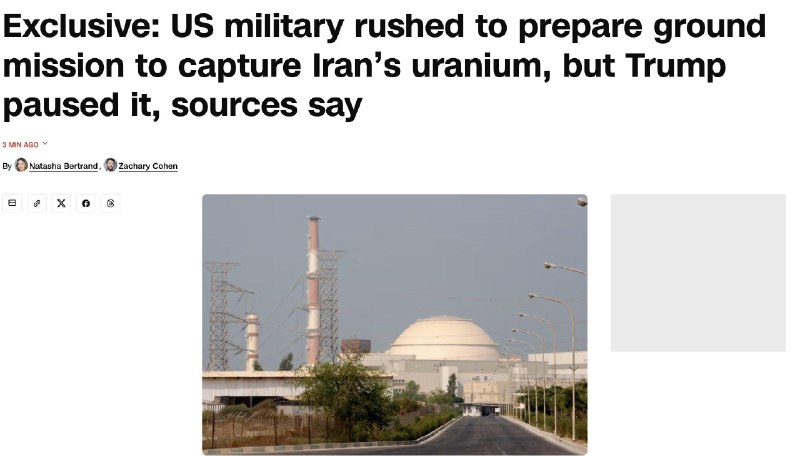
The most consequential thing the Pentagon did in May was the operation it didn't run. According to a CNN report on 12 June 2026 citing two sources familiar with the matter, US military commanders advanced planning for a ground operation whose target was Iran's stockpile of highly enriched uranium. The Chairman of the Joint Chiefs was reportedly pulled out of NATO meetings in Europe and flown to Central Command headquarters in Florida for urgent briefings on a mission that, on paper, would have meant American soldiers seizing fissile material from a foreign state's nuclear infrastructure. President Donald Trump paused the plan over concerns about the casualty bill. That, at least, is the framing on the public record.
The point is not the cancellation. The point is that the option was on the table at all, that it travelled from wargame to chairman-of-the-joint-chiefs briefing in days, and that a sitting US president looked at the casualty estimate and decided the price of the uranium was higher than the uranium. That is a more honest read of American nuclear posture toward Iran than either the hawks or the diplomats usually admit.
What the reporting actually says
Strip the cable-news packaging away and the disclosed facts are narrow. There was planning. There was urgency: a flag officer left a NATO gathering for CENTCOM. There was a target: Iran's highly enriched uranium, the stockpile the International Atomic Energy Agency has spent two years trying to keep account of and that Israel struck at in 2024. There was a decision-maker who said no, and his stated reason was troops, not geopolitics. That is almost everything the public has.
Iranian state-aligned outlets framed the news as confirmation of intent. Tasnim, citing the CNN report, characterised the plan as a US military adventure aborted for fear of mass US losses, and used language that flattered Tehran's own deterrence posture. The Iranian framing should be read for what it is: a victory lap from a regime that has spent decades advertising that the cost of striking it is prohibitive. The reporting does not actually establish that deterrence in this instance — only that one president, in one meeting, looked at the body-bag math and flinched. Those are different things.
The case the hawks will make
The hawks will argue that the raid was a good idea, badly timed, and that pulling the chairman out of NATO was the easy part. The harder part — making a decision of that magnitude under a media cycle that punishes every American casualty — is what an administration elected to break the nuclear deadlock would have done. From this view, the uranium is the only thing that matters. A clean seizure, however many helicopters it took, would have ended a 25-year proliferation saga in a weekend. The costs would have been front-loaded, the benefits permanent. The fact that the plan got as far as it did is, in this telling, evidence that the policy was serious. The fact that it was paused is evidence of weakness that Tehran will now test.
This is a coherent argument, but it is also a one-line argument. It assumes the uranium would have been secured before a regional war started. It assumes Iran's air defences, missile forces, and proxy network would have reacted in slow motion. It assumes an administration willing to accept dozens — by some wargame conventions, hundreds — of American casualties for an act that the world would read as armed robbery of a sovereign state's nuclear facility. The hawks may still be right that the plan should have run. They should be required to say out loud what would have happened on the second day, when the retaliation was no longer a question but an inbound trajectory.
The case the diplomats will make
The diplomats will read the same reporting and conclude the opposite. The fact that a ground seizure was even on the table is a confession that the sanctions-and-strike cycle has failed. Years of maximum pressure, an Israeli covert campaign against Iranian nuclear scientists and centrifuge halls, and the occasional exchange of fire have left the highly enriched uranium in roughly the same place it has always been: under IAEA monitoring that Tehran periodically restricts, in facilities the world knows the coordinates of, in quantities that change by tens of kilograms depending on whose inspector you believe. If the answer to that problem is a US special operations raid, the diplomats will say, then the question was framed wrong from the start. The right answer is the deal nobody has yet had the political nerve to close.
The diplomat case is also coherent. It also depends on assumptions. It assumes the Iranian negotiating position is actually a negotiating position and not a posture designed to run the clock toward breakout. It assumes the domestic politics in Washington, Jerusalem, and Tehran will permit a deal that gives the mullahs sanctions relief in exchange for caps that, by the time the next administration arrives, will look like the deal that lost the Middle East. The diplomatic critique of the raid is right that the raid is not a strategy. It is wrong to imply that the alternative is.
What the episode actually shows
What the public has learned, beneath the political theatre, is that the United States treats the Iranian nuclear file as a military problem that occasionally pretends to be a diplomatic one. A ground seizure is the bluntest instrument in the toolkit. That it was seriously planned says the policy spectrum has narrowed, not widened. The question of whether Iran can enrich, how much, and under whose cameras is now being answered in the vocabulary of airborne operations, special operations forces, and casualty estimates — the vocabulary of states that have run out of the other kind.
The Trump administration's restraint, in this reading, is not a posture. It is a logistical reality: the plan was too expensive in blood to run, and the alternative — the diplomatic version, the inspection regime, the long dull monitoring arrangement — is politically impossible to sell. So the uranium stays where it is. The IAEA inspectors stay where they are. The next leak, the next sabotage, the next exchange of fire stays on the schedule. The raid that wasn't is the war that also wasn't, and the deal that also wasn't, and the inspection regime that, in a quieter world, would have been the actual answer.
What we don't know, and what it would take to know it
The sources on the public record are anonymous officials described as familiar with the planning. They have not been named. The casualty estimate the president reportedly weighed has not been disclosed. The size and location of the uranium stockpile the operation targeted has not been confirmed by the IAEA in this reporting. The Iranian counter-claim that the plan was deterrence-proof rests on state-aligned channels whose editorial line is set by the office of the Supreme Leader. None of that is a reason to dismiss the reporting; it is a reason to read it for what it is — a single window into deliberations that, in a healthier system, would have been confirmed or denied by officials on the record.
What would settle the question is straightforward and unlikely. A congressional hearing in which the Chairman of the Joint Chiefs or the Secretary of Defense describes the operation in unclassified terms. An IAEA special report confirming or refuting the location and quantity of the uranium the raid was meant to seize. Or, eventually, a leak of the wargame itself: the body-count estimate, the ingress routes, the Iranian response vectors, the air-defence picture. Until one of those lands, the public is reading a single set of anonymous hands moving pieces on a board that nobody outside the room is allowed to see clearly.
Stakes
If the trajectory continues — a US that treats the Iranian nuclear file as a kinetic problem, an Iran that treats the IAEA as an instrument of pressure, an Israel that treats every delay as the last delay — the next disclosure will not be a CNN report about a plan. It will be a strike. Or a seizure of the kind almost described above, run by someone less squeamish about the casualty bill. Or a Hezbollah rocket on a city that gets framed as Iranian retaliation. The raid that wasn't bought time. Time, in this region, is the only thing the diplomatic track has ever had to work with. The reporting on 12 June is a reminder that the diplomatic track is still the one nobody in uniform wants to admit is doing the work.
This publication treats the CNN sourcing on this story as credible but partial. The Iranian state-aligned read is presented in full for fairness, and the structural point — that the operation was planned at all — does not depend on which side of the briefing room is talking.
Wire provenance
This editorial synthesis draws on the following public wire/social posts:
- https://t.me/GeoPWatch
- https://t.me/JahanTasnim
- https://t.me/ClashReport
- https://t.me/wfwitness
Follow the event.
These dated source records provide context. They do not retrospectively verify this archive article.
Separate what the nuclear watchdog reported from what it could not determine after the June 2025 strikes.