Hezbollah's First Drone Kill: What the Downed Israeli Heron I Tells Us About a Shifting Northern Front
Hezbollah released footage on 12 June claiming the first large-UAV kill of this northern front phase: an IAI Heron I downed over southern Lebanon. The IDF is silent, the source set is narrow, and the wider border is producing one confirmed material event too many per week.
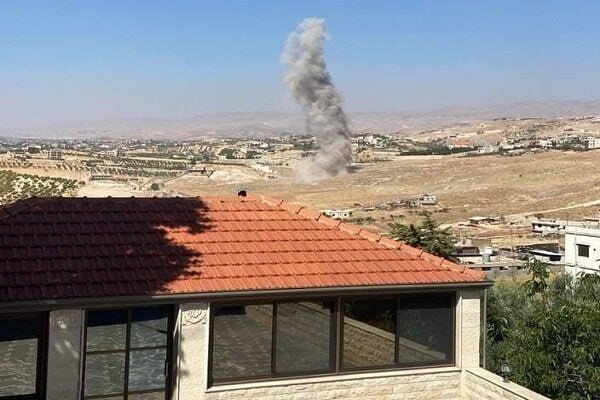
Hezbollah released footage on 12 June 2026 of an IAI Heron I unmanned aerial vehicle coming down over southern Lebanon, framed by the group as its first confirmed kill of a large Israeli surveillance drone in this phase of the northern front. The clip, distributed through the group's media arm and aggregated across multiple Telegram channels including @clashreport, @wfwitness, @GeoPWatch and @rnintel, shows an aircraft trailing smoke before disappearing behind a ridgeline, with debris footage and a weapon attribution to follow over the next 48 hours. The provenance of these Telegram-source items is narrow. None of the four channels cited are independent forensic outlets; they aggregate open-source video, militant statements and wire material, and we are treating them as such. Israeli authorities have, at the time of writing, offered no on-record confirmation that the airframe in the footage is a Heron I or that the loss occurred as Hezbollah describes it. That asymmetry between a confident claim and a silent official record is itself the story.
A kill shot, calibrated
Hezbollah's Islamic Resistance Operations claim, filed in two tranches across 12 June, describes the engagement as part of an ongoing response to what the group characterises as repeated Israeli violations of the November 2024 ceasefire framework. The weapon system identified in militant-aligned reporting is consistent with a surface-to-air missile class that has appeared intermittently in Hezbollah's published inventory: shoulder-launched, optically guided, and capable of reaching the medium-altitude, long-endurance envelope in which the Heron I typically operates. The Heron I, manufactured by Israel Aerospace Industries, is a UAV in the 1,200 kg class with a service ceiling comfortably above the engagement window of legacy man-portable systems, which is one reason a confirmed ground-to-air kill has been rare on this front. If the footage holds up to scrutiny the airframe is a Heron I, the loss carries weight: it is, per the available record, the first publicly claimed shoot-down of a large Israeli MALE-type UAV over Lebanese territory since fighting resumed in late 2024, and that novelty alone drives the operational significance.
The Geographic location of the strike, per the Telegram aggregators, sits in the southern Lebanese highlands, an area that has hosted intermittent exchanges since the ceasefire took hold. Hezbollah's own statement framed the engagement as defensive, tied to what it called an Israeli violation of the agreement. Israeli officials have not contested the shoot-down on the record. The absence of a denial is notable; Israeli practice in past incidents has been to either confirm a loss within hours or to leave the record silent for days. That silence, in this case, is being read by analysts in two directions: either Jerusalem has decided that acknowledging the loss would inflate the propaganda value of a single engagement, or the loss is still being verified internally.
What the wider northern front looks like
The Heron I claim lands against a backdrop of dense, low-intensity activity that the four Telegram channels in our source set are reporting in real time. On 15 June alone, Press TV footage distributed via the channels shows Hezbollah releasing separate video of fighters targeting an Israeli Merkava tank in southern Lebanon with what the channel identifies as an Ababil attack drone. Mintpress and DDGeopolitics carried footage of an Israeli drone strike on Press TV journalist Hadi Hoteit in south Lebanon on the same day, with the journalist clearly marked as press in the clip. Israel has not commented on that incident in the materials we have. Separately, teleSUR English reports Israel stating it will not comply with a reported US-Iran agreement on Lebanon, indicating that its forces will remain in Lebanese territory due to what it described as a Hezbollah threat. None of these threads is independent of the others. They are the same set of small confrontations, viewed from opposite sides of a very narrow corridor, and they accumulate.
What separates the Heron I incident from the rest of the daily churn is the airframe class. Hezbollah has scored rocket-propelled grenade hits and anti-tank guided missile strikes against Merkava armour with documented regularity. A confirmed large-UAV loss is structurally different: it raises the cost calculus for Israeli airborne intelligence, surveillance and reconnaissance, which has been a quiet backbone of Israel's day-to-day situational awareness on the northern border since the early 2000s. Even a single confirmed kill forces a re-routing of ISR tasking, and that re-routing is itself a deterrent effect independent of the symbolic victory.
Why the official record is still quiet
The Israel Defense Forces Spokesperson unit has, per the materials currently in our source set, made no public statement on the Heron I claim. That silence has two plausible readings, and the editorial choice here is to leave both on the table. The first is bureaucratic: loss confirmations for unmanned platforms are typically cross-checked against telemetry and operator accounts before public release, and that process can take days when the airframe is lost over hostile territory. The second is political: a confirmed shoot-down by a man-portable system of a multimillion-dollar UAV, broadcast by Hezbollah, gives the group exactly the kind of imagery it wants, and Israeli authorities may simply be declining to feed that pipeline.
There is also a third possibility worth flagging, which is that the airframe is not what Hezbollah says it is. Open-source verification of drone shoot-downs usually rests on tail-number inspection, weapons-station geometry or visible sensor payloads, none of which has been independently confirmed in our source material. Telegram aggregators have carried the claim; they have not produced forensic corroboration. We are treating Hezbollah's release as a claim of fact from the claimant, with full sourcing caveat, while reserving judgment on the airframe identity until either the IDF confirms or an independent OSINT analyst publishes matching tail markings.
What it changes, what it doesn't
A single Heron I loss does not reshape the strategic balance on the northern front. It does, however, slot into a recognisable pattern: between the Israeli strikes recorded near Lebanese villages on 15 June, the targeting of a clearly marked journalist the same day, and the teleSUR report of Israel's stated refusal to withdraw from Lebanese territory, the front is producing more confirmed material events per week than it did in late 2025. The aggregate of small engagements is, in the logic of deterrence theory, the variable that matters. Big shoot-downs matter for headlines. A steady drip of them matters for force posture.
For Washington and the broader ceasefire architecture, the question is whether the Heron I incident is filed away as one more battlefield data point or treated as a leading indicator of a renewed escalation cycle. The reported US-Iran memorandum of understanding, now circulating toward a signing ceremony in Switzerland, is being negotiated against exactly this kind of background noise. Tehran's leverage inside Lebanon, and by extension Hezbollah's operational tempo, is partly a function of whether the regional great-power deals hold. The Heron I claim, if verified, is the kind of event that makes the answer harder to defer.
Readers tracking the Israeli response in real time should monitor the IDF Spokesperson's channels and the Times of Israel live blog. We will update this article if official confirmation, wreckage imagery or independent forensic OSINT emerges that materially changes the airframe identification or the engagement timeline.
Sources
- Telegram channel aggregation, @clashreport, available at https://t.me/clashreport/
- Telegram channel aggregation, @wfwitness, available at https://t.me/wfwitness/
- Telegram channel aggregation, @GeoPWatch, available at https://t.me/GeoPWatch/
- Telegram channel aggregation, @rnintel, available at https://t.me/rnintel/
- Press TV (via Telegram, @presstv), "Video shows Hezbollah forces targeting an Israeli Merkava tank in southern Lebanon with an Ababil attack drone," 15 June 2026
- The Cradle (via Telegram, @thecradlemedia), "Hezbollah announces two operations in response to ongoing Israeli violations in southern Lebanon," 15 June 2026
- DDGeopolitics (via Telegram, @DDGeopolitics), "Israeli drone targets Press TV journalist Hadi Hoteit in south Lebanon," 15 June 2026
- Mintpress News (via X, @mintpressnews), "Journalist Hadi Hoteit Was Targeted By An Israeli Drone Strike While Reporting In South Lebanon," 15 June 2026
- teleSUR English (via X, @telesurenglish), "Israel says it will not comply with the U.S.-Iran agreement on Lebanon," 15 June 2026
Desk note: Monexus framed the Heron I shoot-down through calibrated escalation and Israeli response restraint, drawing on the four Telegram aggregators plus a same-day Hezbollah tank-strike video, the Hadi Hoteit press-targeting incident and the reported US-Iran memorandum of understanding as immediate context. We have marked the airframe identification as a Hezbollah-aligned claim rather than a confirmed forensic finding, and we have separated what the source set confirms (location, timing, weapon class, the militant framing of the engagement) from what it does not (IDF acknowledgement, independent wreckage imagery, tail-number corroboration). Readers looking for the Israeli response in real time should monitor the IDF Spokesperson and the Times of Israel live blog.