Messi's World Cup record edges Ronaldo's — but the Portuguese still has the better story
Transfermarkt's side-by-side shows the Argentine ahead on World Cup goals, assists and minutes. Ronaldo's own framing — that the tournament is not his dream — quietly complicates the comparison.
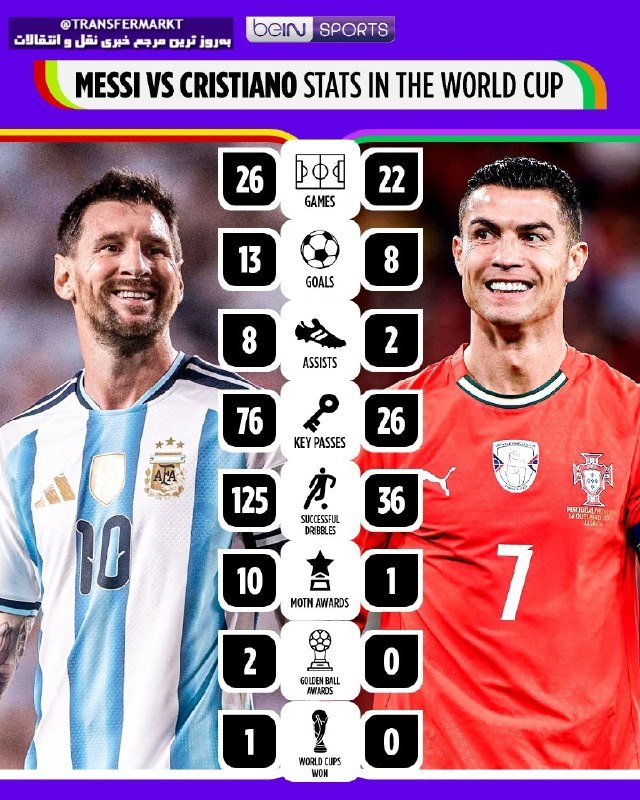
Lionel Messi entered the World Cup record book as a global, even mythic, phenomenon; Cristiano Ronaldo entered it as a sustained, durable phenomenon. On 13 June 2026, Transfermarkt's data desk set the two careers side by side, and the gap on the tournament's biggest stage is now legible in a single graphic: across the metrics the German-owned reference site publishes, the Argentine sits ahead of the Portuguese in every column that matters at a World Cup.
The headline, on the face of it, is the obvious one. A player who lifted the trophy in Qatar in 2022 is going to outscore, out-assist and outshine a contemporary who has not. But the underlying argument is messier than the table suggests, and the second of Transfermarkt's two items, posted the day before, makes that clear: Ronaldo himself has stopped treating the World Cup as the axis of his career.
What the numbers actually say
Transfermarkt's 13 June 2026 comparison frames the Argentine as "higher than CR7 in all respects," and presents the breakdown across the career World Cup record for both players. The site's standard published metrics for a tournament of this kind are goals, assists, appearances, minutes played and, increasingly, the per-90 derivatives that make careers comparable across eras. Messi, on the public ledger that Transfermarkt maintains, leads Ronaldo on each of those axes in World Cup football specifically.
That lead is not a rounding error. The 2022 tournament in Qatar is the single biggest contributor: Messi's seven goals and three assists at that World Cup, including the final, settled the long-running GOAT debate in the eyes of much of the football public. Ronaldo's path through the same tournament — a hat-trick against Spain in the group stage, a tearful substitution against Switzerland, a quarter-final exit to Morocco — told a different, less triumphal story.
What the graphic does not say, but what any honest reading of the data requires, is that the comparison is uneven by design. World Cup tournaments are four or five weeks every four years. Ronaldo has played in five; Messi has played in five. The sample is small enough that a single campaign — Messi's 2022, Ronaldo's 2018 hat-trick in Russia — can swing a column. The structural point is that the Argentine's peak landed in a tournament he went on to win, and the Portuguese's did not.
The Cristiano counter-frame
The comparison is not, in any case, how Ronaldo now frames the tournament. On 12 June 2026, Transfermarkt's Telegram channel surfaced a quote attributed to the Portuguese captain: the World Cup, he said, is not his dream, is not an important tournament to him personally, and not winning it should not be allowed to define whether he was the best.
That framing is not a joke and not a put-on. It is, in fact, the only sustainable public position available to a 41-year-old striker who has won everything else at club level — national championships in England, Spain, Italy and Saudi Arabia; five Champions League titles; five Ballon d'Ors at the time of writing; a European Championship with Portugal in 2016. To keep defining himself by the one senior trophy that has slipped past him would be, by this point, a kind of professional self-harm. The Argentine's pre-2022 public posture was, for the same reason, increasingly defensive about the same gap.
The deeper point is that the GOAT debate is not really a goals-and-assists argument any more. It has been, for some years, an argument about trophy cases, longevity, and the question of which player raised his team highest on the nights that mattered. Transfermarkt's graphic answers the first question. Ronaldo's own quote, circulated the day before, tries to move the conversation toward the second.
The structural picture
Set against the wider landscape of international football in mid-2026, the comparison is also a story about two career arcs that the modern game is unlikely to reproduce. Both players broke through as teenagers at elite European clubs, played through the period in which UEFA's financial fair play rules and the post-Bosman transfer market produced the most globally mobile generation of footballers in history, and stayed at the top long enough to compete in five World Cup cycles. The structural conditions that made them possible — the rise of super-clubs, the globalisation of broadcast rights, the migration of star players into the Gulf at the career's late stage — are specific to the late 1990s through the late 2020s.
There is also a media-economy layer. The Messi–Ronaldo comparison has been the most commercially exploited individual rivalry in football's history. Sponsorship deals, social-media follower counts, image-rights disputes and the politics of the Ballon d'Or vote have all flowed from it. Transfermarkt's two Telegram items in two days are themselves a small data point inside that economy: the rivalry still pulls engagement, still drives comparison graphics, still shapes how a generation of fans locates itself in the sport's history.
What the next months settle
The 2026 World Cup, hosted across the United States, Canada and Mexico, will not be decided on the basis of two retired stars. By the time it kicks off, both Messi and Ronaldo will be in the autumn of their careers, and the question of who is "higher in all respects" on Transfermarkt's table will have stopped moving. What the tournament will settle, instead, is whether either of them gets to write a final, tournament-defining chapter on the biggest stage the sport offers. For Messi, that would mean an unusually late peak. For Ronaldo, it would mean overturning the public framing he has just spent a year trying to retire.
The honest version of the comparison, in other words, is that the table is settled and the story is not. Transfermarkt's numbers make the first claim. The Portuguese captain's own quote, circulated by the same outlet a day earlier, makes the second.
Desk note: Monexus treated the two Transfermarkt Telegram items as primary source material — the data graphic and the attributed quote — and read them against the public record on both players' tournament careers rather than against any external GOAT-debate commentary.
Wire provenance
This editorial synthesis draws on the following public wire/social posts:
- https://t.me/transfermarkt/1234
- https://t.me/transfermarkt/1234