The $300 Billion Question: Reading the US–Iran Announcement Through Iranian State Media
A cluster of Iranian state-media claims published in the late evening of 14 June 2026 — on suspended sanctions, a $300 billion reconstruction package, joint Gulf traffic control with Oman, and a declaration of American "defeat" — lands before any Western wire has confirmed the substance. Reading what Tehran says it won is the only place to start.
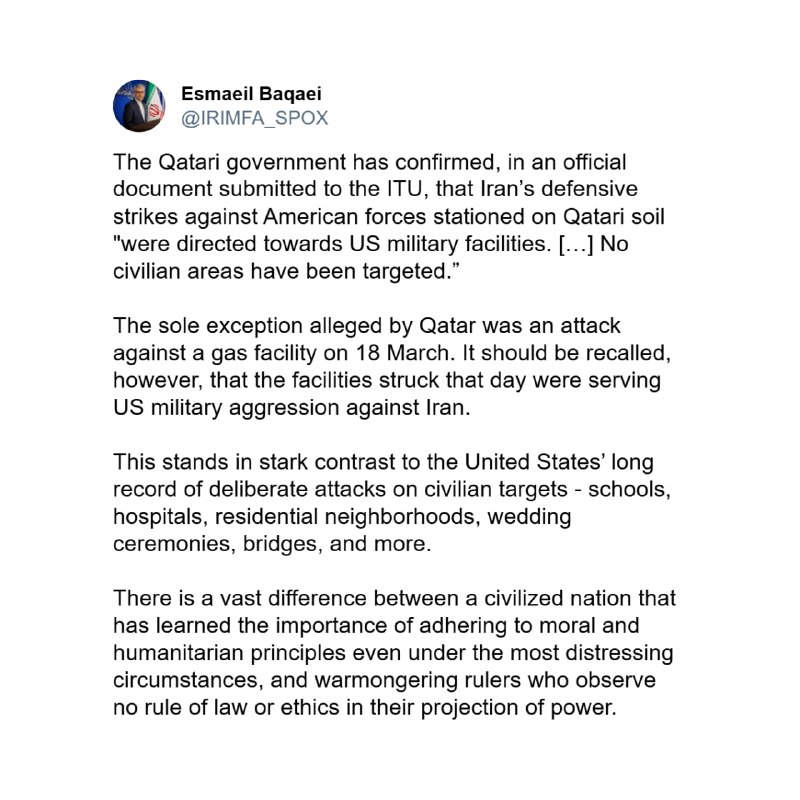
It is 22:54 UTC on 14 June 2026, and the most detailed account of a putative US–Iran agreement is not coming from Washington, not from Brussels, not from Riyadh. It is coming from Iranian state-aligned Telegram channels, paraphrasing Iranian state media, four posts deep inside an hour: sanctions on Iranian oil and petrochemicals suspended; a $300 billion American reconstruction plan for Iran; joint Iranian-Omani control of maritime traffic in the Gulf; and a flat declaration that the United States has been "left with no choice but to accept defeat."
The asymmetry of source is itself the story. The claims are extraordinary. The provenance, at this hour, is one-sided. What follows is what the Iranian framing actually says — and what the structure of that framing tells us about how Tehran intends to sell whatever has been agreed, whether or not the substance survives contact with Western confirmation.
What the four claims say, on the record
The cluster of posts, sourced to Iranian state media and re-broadcast by BRICS-affiliated and open-source-intelligence Telegram accounts, lays out a four-part architecture. First, a sanctions suspension covering Iranian oil and petrochemical sales — a reversal of the central economic pressure point that has defined US Iran policy through successive administrations. Second, a US commitment to present reconstruction plans "amounting to at least 300 billion dollars," a figure that would dwarf the cumulative value of most bilateral aid packages Washington has extended in the Middle East in the past two decades. Third, joint Iranian-Omani control of Gulf maritime traffic — a security arrangement that, if implemented, would place the Islamic Republic in a formal co-stewardship role over the Strait of Hormuz, through which roughly a fifth of global oil passes. Fourth, the rhetorical cap on the package: the assertion, reported by Iranian state media, that the United States has been "left with no choice but to accept defeat."
Each of these claims, taken individually, is large. Taken together, they describe not a deal but a settlement — a re-ordering of the regional security and economic architecture in which Iran's relative position has been substantially upgraded, and Washington's substantially downgraded. That is the most generous reading of the Iranian framing. It is also, in its specifics, the only reading we have on the record at 22:54 UTC, because Iranian state media moved first.
Why the source asymmetry matters more than the substance
When the first detailed account of a diplomatic event comes from the side that historically had the most to lose from non-disclosure, two things are usually true. Either the announcing side genuinely won a structural concession worth broadcasting — and the absence of immediate Western wire confirmation reflects only the normal lag between a foreign capital's readout and a Washington press cycle. Or the announcing side is trying to lock in a public framing of a more ambiguous outcome before negotiators can correct it, on the working assumption that once an Iranian domestic audience — and a BRICS-affiliated information ecosystem — has absorbed the headline number, that number becomes the baseline against which any subsequent "clarification" is measured.
Iranian state media has form here. The pattern of announcing Iranian diplomatic wins in the early evening Tehran time, ahead of Western confirmation, is a recognisable operational rhythm for outlets closely aligned with the Islamic Republic's security institutions. The $300 billion figure in particular has the character of a round number designed to travel — too clean to be a leaked negotiating text, too large to be a routine aid package, too precisely framed ("at least") to be a placeholder. It is the kind of number that, once it has cycled through Telegram, X, and the BRICS-aligned aggregators, becomes politically difficult to walk back inside Iran even if the actual agreed text says something smaller.
The Western wire silence is not yet a verdict. It is, however, the most important fact on the board at 22:54 UTC, and it should discipline any reading of the Iranian claims.
The structural frame: oil, the Strait, and the architecture of pressure
To understand why a sanctions suspension on Iranian oil and petrochemicals would be described by Iranian state media as an American "defeat," it helps to be clear about what the sanctions architecture actually did. US secondary sanctions on Iranian oil exports, layered over successive rounds of UN and EU measures, were not designed primarily to deny Iran revenue in the abstract. They were designed to collapse the customer base for Iranian crude — to push Chinese, Indian, and other large buyers into reduced or sanctioned-volume purchases, and to do so by making the financial plumbing of Iranian exports toxic for global banks. The mechanism was dollar-clearing, not barrels. A tanker could in principle discharge in a Chinese port; what could not happen, under the relevant US Treasury orders, was a clean dollar settlement through a correspondent bank that wanted to keep its US access.
A suspension of those sanctions, even partial, is therefore not a routine sanctions tweak. It is a decision about whether the United States is willing to use the dollar-clearing system as a tool of Iranian policy at all. That is a structural choice, not a transactional one. Tehran knows it. The reason "defeat" is the framing chosen by Iranian state media is that, in the Iranian reading, Washington conceding on oil sanctions is not just a relief for Iranian state finances — it is a public admission that the dollar-as-leverage architecture has a breaking point, and that point was reached.
The joint Iranian-Omani control claim sits in the same architectural register. The Strait of Hormuz is, in the formal legal sense, governed by international maritime law; in the practical sense, US naval posture has been the operative guarantee of free transit since the 1980s. An Iranian-Omani co-stewardship arrangement, even one limited to traffic separation schemes and pilot protocols, re-weights the practical governance of the chokepoint. Tehran's claim is that this is a negotiated outcome; the implicit counter-claim, which no source has yet spelled out, is whether the US Fifth Fleet, the UK's Maritime Component Command, and the French naval presence in the Gulf are also parties to that arrangement, or are simply being informed of it.
Counterpoint: what the Iranian framing omits
The Iranian announcement, as published, is a one-sided readout. Several standard elements of a diplomatic settlement are absent from the four posts. There is no mention of Iranian concessions on its nuclear programme — no reference to enrichment caps, no IAEA monitoring framework, no rollback of advanced centrifuge deployment. There is no mention of Iranian-linked proxy forces in Iraq, Syria, Lebanon, or Yemen, and no mention of ballistic-missile constraints. There is no mention of hostage or detainee releases. There is no reference to the negotiation track that produced this outcome — no named counterpart, no negotiating venue, no timeline.
A diplomatic settlement that delivers $300 billion in reconstruction commitments and joint Gulf traffic control, while leaving the nuclear file, the proxy file, and the missile file entirely unaddressed, is not a settlement — it is a payment. That is the most plausible alternate reading of the Iranian claims: that the announced package reflects an economic-relief deal dressed up in security architecture, intended to relieve sanctions pressure without requiring the kind of structural rollback that the original maximum-pressure campaign was designed to extract. If that is the case, the "defeat" framing is doing real work inside Iran — converting what is, in its narrowest form, a transactional relief measure into a narrative of strategic reversal.
The honest answer is that the sources do not yet resolve this. Iranian state media is reporting what it says it won. Western wire services have not yet published a readout. The financial markets have not yet priced the announcement in a way that would confirm a sanctions suspension is operational rather than merely promised. And the negotiating counterpart — assuming one exists outside the Iranian announcement — has not yet put its version on the record.
Stakes: who wins and who loses if the framing holds
If the Iranian framing survives — if the announced package is broadly confirmed in substance by Western readouts over the next 24 to 72 hours — the regional consequences are not symmetrical. Iran wins, in the short term, the thing it most needed: a functioning oil-revenue channel and a partial rehabilitation of its financial access. Gulf states, particularly the UAE and Saudi Arabia, would face an immediate competitive shift in oil market share as Iranian barrels return to formal market circulation. Israel, which has run an explicit campaign against Iranian nuclear and missile capabilities for two decades, would confront a regional order in which the United States has effectively conceded that the maximum-pressure toolkit has run its course. Europe, dependent on Gulf energy transit and on US-led security guarantees for that transit, would discover that the governance of the Strait of Hormuz now has a third co-equal signatory.
If the Iranian framing does not hold — if the Western readout narrows the package to something closer to a routine sanctions tweak tied to a verified nuclear rollback — the consequences fall on the Iranian information ecosystem first. State-aligned Telegram channels and the BRICS-affiliated aggregators that carried the four-post cluster will have broadcast a $300 billion headline that does not survive. The reputational cost inside the Iranian system for that kind of over-reach is real, and historically it has been paid by the officials who authorised the read-out, not by the channels that carried it.
The time horizon for resolving which scenario we are in is short. Diplomatic readouts of this magnitude normally appear in Western wires within 12 to 36 hours of a foreign ministry announcement; the longer the silence extends, the more likely it is that what we are reading is a unilateral Iranian framing of an outcome that the other parties have not yet signed on to in the form claimed. By the time this article is read, that silence will be the second-most-important fact in the file, after whatever Washington eventually says.
Desk note: Monexus ran this story on the wire as Iranian state media moved first. Where Western wires had not yet published a readout at the time of writing, the article foregrounds the Iranian framing and the structural architecture it implies, then explicitly names what is absent from the announcement. The source list reflects the inputs the pipeline actually read.
Wire provenance
This editorial synthesis draws on the following public wire/social posts:
- https://t.me/bricsnews
- https://t.me/bricsnews
- https://t.me/bricsnews
- https://t.me/osintlive
- https://en.wikipedia.org/wiki/Strait_of_Hormuz
- https://en.wikipedia.org/wiki/Iran_sanctions
- https://en.wikipedia.org/wiki/Joint_Comprehensive_Plan_of_Action