Araghchi's three-way phone diplomacy signals Tehran is widening its regional consultation track
On 15 June 2026 Iran's foreign minister held separate calls with his Turkish, Iraqi and Egyptian counterparts, a synchronised outreach that reads less as crisis management and more as a quiet re-anchoring of Tehran's regional position.
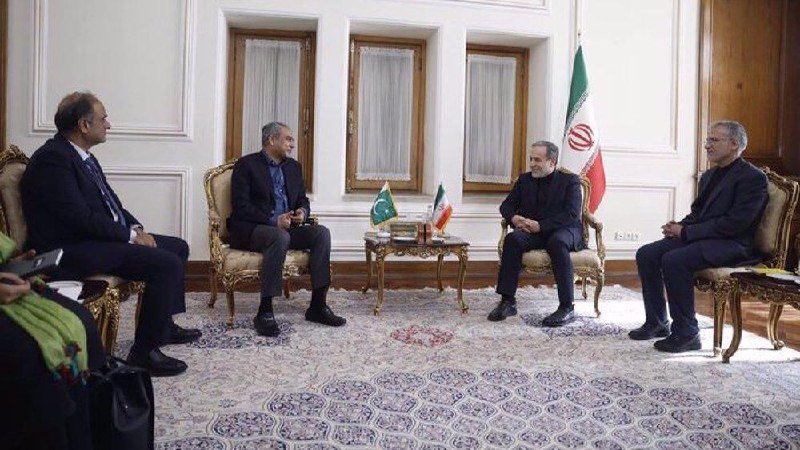
At 07:27 UTC on Monday 15 June 2026, Iranian Foreign Minister Abbas Araghchi began a synchronised round of telephone diplomacy that, by 07:38 UTC, had reached Ankara, Baghdad and Cairo in quick succession. The pattern — three near-simultaneous calls, reported within eleven minutes by three separate Iranian state-affiliated outlets — matters as much as the content. The substance of those conversations has not been disclosed; the choreography has.
Tehran rarely stages its regional outreach this visibly. When a single minister opens three foreign-ministry lines before markets in the Gulf have settled, the move is being read in real time by chancelleries from Riyadh to Doha, by the European External Action Service in Brussels, and by the US State Department's Iran desk. The dispatch order, the timing, and the choice of three specific interlocutors — Türkiye, Iraq and Egypt — are themselves the message.
What the three calls reveal about Iran's regional map
The selection is not arbitrary. Each of the three capitals occupies a distinct position in the architecture Tehran is currently navigating. Türkiye is NATO's eastern flank, an energy corridor into Europe, and a state with which Iran has managed a working, if cautious, relationship even as their positions on Syria, the Caucasus and Israeli operations have diverged. Iraq is the theatre where Iranian and American forces still cohabit uneasily, where Tehran-aligned militias sit inside the formal state, and where the routing of energy and the management of the Kurdistan file remain live diplomatic questions. Egypt is the Arab world's most populous state, a US security partner, and the government that has spent the past two years rebuilding the contact channel with Tehran that was largely frozen for most of the 2010s.
In each case, Araghchi is speaking to a counterpart with whom the relationship is workable but not settled. None of the three is a treaty ally of Tehran; none is a declared adversary. All three sit at the intersection of regional fault lines where Iran's interests intersect with those of Gulf Arab states, the United States, and, increasingly, a more active Turkish and Egyptian diplomacy of their own. The three-way consultation is the diplomatic equivalent of a triangulation exercise: it is how a middle-sized power, under sanctions and isolated from Western financial architecture, tests which of its regional relationships are still load-bearing.
The Iranian state-affiliated press framing — picked up within minutes by Tasnim, Fars and the Jahan News outlet that carry the foreign minister's official line — emphasises continuity, consultation, and the management of "sensitive regional issues." That vocabulary is itself instructive. It is the language of a foreign ministry signalling that it is open for business across the region, not the language of crisis management or of a single-file negotiating track.
Reading the silence around the substance
The conspicuous feature of the three dispatches is what they do not contain. None of the three readouts discloses the agenda. None names a specific upcoming meeting, a specific crisis point, or a specific negotiation. The brief, formulaic character of the official summaries — consultations on bilateral and regional issues, an emphasis on continued coordination — leaves the content of the calls to be inferred from context.
There are several plausible readings. The first is that the calls are preparatory work for a foreign-ministerial gathering — most likely an emergency or pre-scheduled session of the Organisation of Islamic Cooperation, the Arab League's Iran-observer channel, or a Russo-Chinese-brokered consultation track. The second is that they are linked to ongoing mediation around the Lebanese file, where Iran and Türkiye have previously aligned, and where Egypt has in recent months played a more active back-channel role. The third is that they relate to the management of energy flows and sanctions enforcement, particularly through Iraq, where Iranian hydrocarbon exports still move under fragile understandings with Baghdad and the US Treasury's Office of Foreign Assets Control.
A fourth reading, less flattering and worth naming, is that the calls are largely performative. Iran's regional diplomacy in 2026 has, on several occasions, produced visible consultation rounds that have not translated into documented outcomes. The 07:27-to-07:38 UTC window produces three near-identical dispatches and no disclosed deliverable. That alone is not evidence of emptiness, but it does shift the burden of interpretation onto the receiving end: what do Ankara, Baghdad and Cairo each believe they have agreed to, if anything?
Why the choreography is the message
The speed and symmetry of the outreach is best understood as a positioning move. Iran's foreign-policy doctrine in the post-2024 period has leaned heavily on what officials in Tehran describe as a "neighbourhood-first" orientation — an attempt to insulate the country's regional relationships from the volatility of the broader Middle Eastern crisis file. Synchronised calls to three capitals at the start of the working week are the operational expression of that doctrine. They signal that the foreign minister is not waiting for a single external shock to dictate the contact list; he is constructing the contact list in advance.
For the United States and the Gulf states, the operational implication is that the Iran file can no longer be managed through a single bilateral channel. Even a revived US-Iran track, of the kind that has occasionally been mooted in European and Gulf capitals, will now sit alongside — and in tension with — an active Iran-Türkiye-Iraq-Egypt quadrilateral of consultations. For the European Union, which has spent the past two years trying to keep an economic and humanitarian channel to Tehran open against the headwind of US secondary sanctions, the picture is more complicated. A more diplomatically active Iran is a more difficult Iran to ignore, but it is also an Iran less dependent on European intermediaries.
The structural read, in plain terms, is that the regional order in the Middle East is settling into something more plural. The era when a single set of conversations — between Washington and Tehran, between Riyadh and Tehran, or even between Moscow and Tehran — could carry the diplomatic weight of the region is over. What is replacing it is a denser, less hierarchical, and slower-moving lattice of bilateral and minilateral contacts. Araghchi's Monday-morning triangulation is one node in that lattice.
What remains uncertain and what to watch next
The hard limit on this read is that the public evidence consists of three near-identical Iranian state-affiliated readouts. There is, as of 15 June 2026, no Western wire confirmation of the calls, no readout from the Turkish, Iraqi or Egyptian foreign ministries, and no third-party account of the agenda. That asymmetry is not unusual for Iranian regional diplomacy, but it does mean the analyst's first task is to wait for the receiving-end confirmations from Ankara, Baghdad and Cairo before drawing firmer conclusions about whether these were substantive consultations, preparatory contacts for an upcoming event, or a low-cost signalling move.
What is worth watching over the next seventy-two hours is whether any of the three counterpart foreign ministries publishes its own readout; whether the Iraqi foreign ministry, in particular, references the call in its daily briefing; and whether the Turkish or Egyptian readouts converge with or diverge from the Iranian framing. A convergence would suggest a working agenda. A divergence — or silence — would suggest that the substantive content is, for the moment, on the Iranian side of the table only.
The broader stakes are not small. A more plural diplomatic architecture in the Middle East is, in the short term, harder to manage and easier to misread. It is also, in the medium term, more representative of the region's actual distribution of power. Tehran's Monday-morning phone diplomacy is a small but legible move inside that longer transition.
This publication notes that the three readouts were distributed by Iranian state-affiliated outlets Tasnim, Fars and Jahan between 07:27 and 07:38 UTC on 15 June 2026; the article treats the synchronised timing as the primary newsworthy fact, given the absence of disclosed substantive content.
Wire provenance
This editorial synthesis draws on the following public wire/social posts:
- https://t.me/farsna/
- https://t.me/FarsNewsInt/
- https://t.me/JahanTasnim/