A viral photo, a deleted post, and the cost of trusting the frame
When a Telegram mapper posted what looked like wreckage of FP-1 drones at the historic Dovzhenko studio in Kyiv, the image travelled fast. Then the author admitted it had been AI-upscaled and pulled the post. The episode is a small case study in how conflict imagery is vetted, amplified, and corrected.
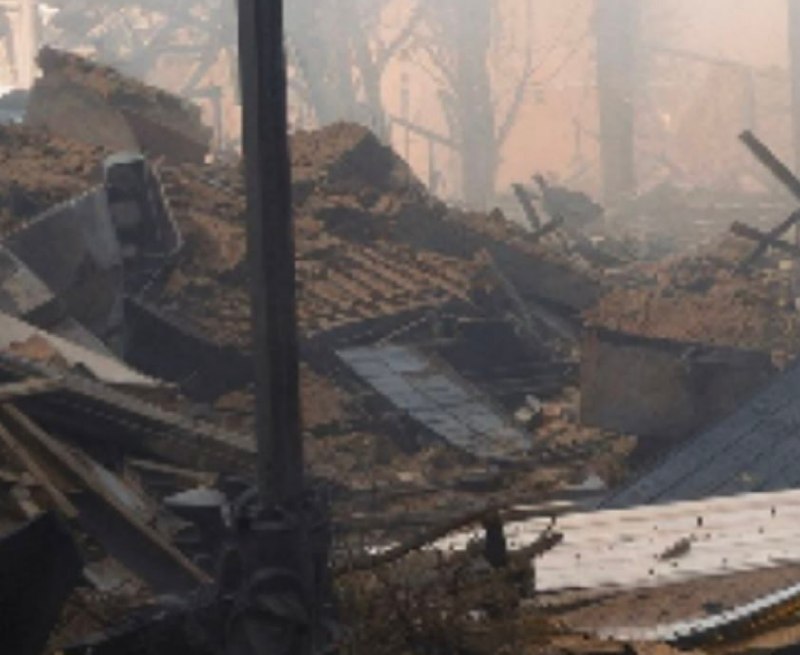
At 21:19 UTC on 15 June 2026, the open-source-intelligence channel AMK_Mapping posted a photograph purporting to show the wings of destroyed FP-1 long-range drones amid the rubble of the Dovzhenko Film Studio in Kyiv. The implied reading was pointed: a heritage civilian site, the studio that safeguards a national film archive, had been used to store long-range strike assets. The post travelled. Within forty minutes a second version followed, then a third, each tightening the language. By 22:34 UTC the same channel had deleted the original and replaced it with a correction: the image had been AI-upscaled, and the underlying source was Ukrainian media, including NVUA, which had carried similar framing.
The episode is small. It is also a useful lens on how conflict imagery is vetted, amplified, and undone in real time, and on what the public record absorbs in the ninety minutes before a correction lands.
The Dovzhenko Film Studio, founded in 1928 and named after the Soviet-Ukrainian director Alexander Dovzhenko, is not a neutral building in Ukrainian cultural memory. It is the custodian of one of the largest film archives in Eastern Europe, a working studio through the Soviet decades, and a property that has cycled between state control and private management since independence. Damage to the site during Russia's full-scale invasion has been a recurrent theme in Ukrainian cultural reporting; claims about its use during the war carry weight precisely because the building's symbolism is loaded.
FP-1 is the export designation for the Furia, a Ukrainian-made long-range piston-driven unmanned aerial vehicle produced by the domestic firm Skyassist. It is one of several Ukrainian long-range strike platforms that have featured in coverage of attacks on Russian territory. The mapping claim — that wings of such drones were recovered at a civilian film studio — would, if accurate, tell a story about dispersal of strike assets into built-up areas.
The original post framed the image and the inference together, with the author flagging the source as Ukrainian media. The correction twelve minutes before midnight UTC acknowledged that the photograph had been processed with AI upscaling, a technique that adds resolution but also fabricates detail that the sensor never captured. The author explicitly attributed the framing to NVUA and said the Ukrainian outlet had done the same.
The mechanics of the failure are worth spelling out. AI upscaling is not the same as fabrication from scratch; it starts with a real image. But it generates pixels that the camera did not record, and the technique is known to alter fine textures in ways that change what a viewer infers. For a photograph whose entire evidentiary value rests on the recognisability of small structural elements — the planform of a wing, the joinery of a fuselage component — that is a serious methodological concession. The image was not, in the strict sense, a deepfake. It was also not, in the honest sense, a photograph of what it purported to show.
This is the second-order problem. Open-source investigators operate on the assumption that their readers will treat the post as a pointer to evidence, not as evidence itself. The chain is: image, source, claim. When the image has been algorithmically enhanced in a way that may have altered the very details being pointed to, the chain bends. The correction is also a signal: the author caught the issue, disclosed it, and pulled the post, which is more than most accounts of contested conflict imagery manage.
Counter-narrative is essential here, and it cuts two ways. From a pro-Ukrainian vantage, the worry is the inverse: that the AI-upscaling disclosure hands a talking point to Russian-aligned channels, which have spent years claiming that Ukrainian documentation of strikes is staged. A single correction becomes grist for a much broader claim about Ukrainian image-handling. From a pro-Russian vantage, the episode is small comfort — the underlying claim, that long-range drones are launched from dispersed sites, is not in serious dispute; what is contested is the venue and the specific evidentiary record.
Neither reading is fully right. The honest summary is narrower: a single post on a Telegram channel circulated an enhanced image, made an inference about a heritage site being used for military storage, sourced the framing to Ukrainian media, and was withdrawn after the author disclosed the upscaling. The inference is neither confirmed nor refuted by the photo. The photo itself, as a photograph, is no longer a reliable piece of evidence about the specific scene it depicted.
There is a structural pattern worth naming plainly. Conflict coverage in 2026 runs on a pipeline: a Telegram or X post, screenshots into secondary channels, screenshots of those into tertiary ones, an English-language aggregator reposts, a wire picks up the framing, and only then does anyone with editorial process look at the original. The pipeline is fast, global, and ruthlessly efficient at amplification. It is slow and uneven at retraction. Corrections travel in the same channels but to a fraction of the audience, and they do not undo the cached copies on the way to a server in another jurisdiction.
That is the general problem; the Dovzhenko post is a particular instance of it. The piece of evidence most cited in the first ninety minutes was the least reliable version of itself, and the version that travelled furthest was the one that arrived with the most confident framing. This is not an argument for paralysis in conflict reporting. It is an argument for sequencing: image, source, claim, in that order, with the strength of the inference tied to the strength of the underlying image rather than to the speed of the channel.
What remains uncertain. The author of the post has not, in the visible thread, published the original unenhanced image; the underlying claim about FP-1 wings at the studio therefore stands or falls on sources outside this thread. Ukrainian outlet NVUA is named as the originating framing, but the specific NVUA item is not linked in the thread items available to this publication. Russian-aligned channels have, predictably, treated the correction as confirmation of broader allegations; that framing is not corroborated by the post itself, which is a methodological disclosure rather than a confession of fabrication. The mapping channel's willingness to issue the correction is, in the small, a counter-data point to the assumption that open-source accounts always harden in their first framing.
The stakes are not just this studio. The Dovzhenko archive survived the Holodomor, the Second World War, and the Soviet collapse; what survives a missile strike is a question of salvage, not sentiment. The harder question is whether the public record of what happened to it survives the next ninety minutes of any given news cycle. The AMK_Mapping post will be in that record, in one form or another, long after the correction is forgotten.
Desk note: This publication is treating the AMK_Mapping thread as a primary source, supplemented by the post's own disclosure of Ukrainian media sourcing. The image is not republished here as evidentiary material; the hero is the circulated image with explicit credit, and the article's analytical focus is on the verification chain rather than the underlying claim about the studio.
Wire provenance
This editorial synthesis draws on the following public wire/social posts:
- https://t.me/AMK_Mapping
- https://t.me/AMK_Mapping
- https://t.me/AMK_Mapping
- https://t.me/AMK_Mapping
Follow the event.
These dated source records provide context. They do not retrospectively verify this archive article.
A dated voting record is evidence of one decision. Use the original UN record before turning it into an alignment label.
Visual explainer · historical vote of 2022-03-02 →