Hormuz opens, Tehran funds flow, and Washington's AI order goes dark: a single Sunday
A peace deal, a $300bn reconstruction fund, a reopened chokepoint, and an AI model pullback all arrived in 24 hours. The pattern is the message.
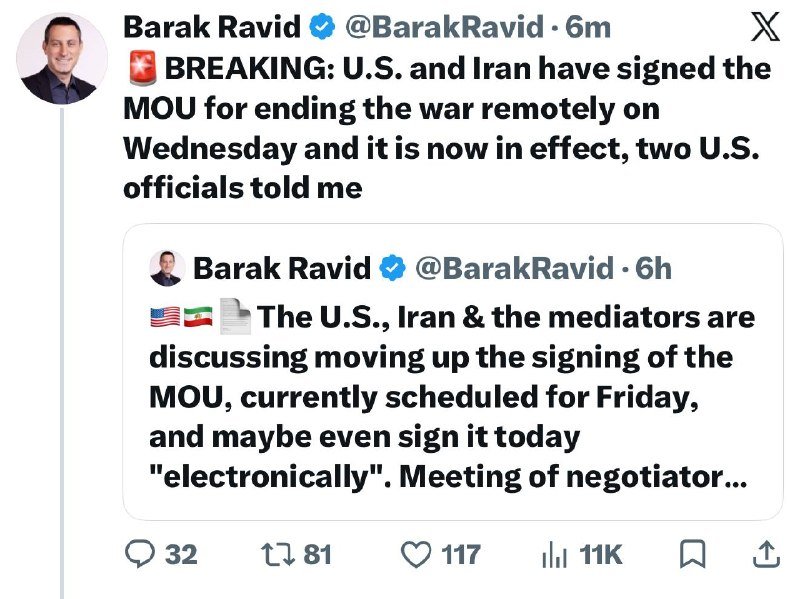
At 13:39 UTC on 15 June 2026, Donald Trump told reporters that oil tankers were once again moving through the Strait of Hormuz, a stretch of water through which roughly a fifth of the world's seaborne crude normally transits. By 15:57 UTC, Iran's envoy had confirmed the waterway would reopen fully by Friday. By 17:32 UTC, the same hour in which Trump said the United States would take possession of Iran's enriched uranium "over the next month or two," markets were also digesting a reported $300bn reconstruction package for Tehran. By 21:50 UTC, in a story published the same Sunday afternoon, TechCrunch was already asking whether the Trump administration's quiet move forcing Anthropic to withdraw its latest cybersecurity models was related, retaliatory, or merely coincidental.
The clustering is striking. Four distinct policy decisions — a regional security settlement, a sovereign wealth transfer on a scale not attempted in two decades, an AI export-control action, and a market-moving commodities signal — landed in the space of a working day. Each is being reported as its own story. Read together, they sketch a doctrine: the United States is increasingly willing to convert geopolitical leverage into financial, technological, and security concessions in a single transaction, and to calibrate domestic industrial policy in the same news cycle.
The Hormuz sequence and the $300bn fund
The Hormuz announcement was the most concrete. Trump, speaking at the G7 summit in France, said ships were "starting to move, many loaded up with oil," and described the route as "totally safe, secure, and pristine" — a phrase that did double duty as a market reassurance and a claim of victory. He conceded one operational caveat: there may still be "a couple of mines" in the waterway, the kind of detail that, in other months, would have been a headline in its own right.
The financial terms of the underlying deal are the part that will outlast the photo opportunity. According to a Financial Times report summarised at 21:11 UTC, the Trump administration is considering a roughly $300bn fund for Iran conditional on the accord holding. A separate market-data post at 17:32 UTC described the package in starker terms: "the U.S.-Iran deal could reportedly include a $300,000,000,000.00 reconstruction fund for Iran." Neither figure has been confirmed by Treasury or the Office of the Iranian President, but the order of magnitude is consistent with what regional analysts have privately modelled since the negotiations began. A fund of that size, denominated in dollars and disbursed against compliance milestones, would effectively make Tehran a managed counter-party to the US Treasury rather than a sanctioned outlier.
The market response was immediate. Bitcoin pushed toward $66,000 after Trump's announcement, a two-week high, with Cointelegraph attributing the move to a "toll-free opening of the Strait of Hormuz" risk premium collapsing.
The uranium question
Sitting underneath the Hormuz news is the nuclear-file subtext that determines whether any of this is durable. Trump told reporters the US would obtain Iran's enriched uranium "over the next month or two," language that points to a physical handover rather than a verification regime. Polymarket's contract on whether the US obtains Iran's enriched uranium by year-end sat at 14% in the early evening — a number that, on a Sunday afternoon before any text has been published, is a measure of public scepticism rather than a forecast.
The gap between the announced deal and the verified deal is the gap between a peace ceremony and a non-proliferation outcome. The G7 framework Trump referenced — a Friday ceremony, text forthcoming, "all signed" — is diplomatic scaffolding. The actual transfer of several hundred kilograms of 60%-enriched material, much of it buried or dispersed across facilities that have been struck but not inventoried, is an industrial-logistics problem that does not resolve in eight weeks. A US administration that announces an imminent handover in mid-June and stages the political ceremony first has chosen the optics over the inventory. That is a defensible choice, but it is a choice, and a future administration will inherit whatever uranium turns out to be missing.
Anthropic, AI, and the message in the model withdrawal
The most under-reported item in the cluster is also the most interpretively open. TechCrunch reported on 15 June that the US government had moved to force Anthropic to pull its latest cybersecurity models, an action framed publicly as a response to an AI jailbreak but described in the publication's analysis as "reactionary, retaliatory, or both."
The action is unusual in form. AI models have been the subject of export controls, procurement restrictions, and compute-allocation rules. They have not typically been summarily withdrawn from commercial release by a national-security directive, particularly for a frontier model developer that maintains a compliance posture toward Washington. The framing the administration chose — a jailbreak justification — is the kind of technical pretext that, in other regulatory contexts, gets paired with a longer policy paper. The fact that no such paper has surfaced suggests the move is being read as discretionary, not doctrinal.
The most plausible non-charitable reading is that it is a leverage demonstration. A frontier AI lab that was, six months ago, treated as a strategic asset is now being treated as a controllable input. The same administration that wants Iran to release uranium wants a domestic AI champion to release, or withhold, its models on cue. Both moves expand the surface area of state direction over private technical capacity. Both are easier to execute when the counter-party is in a permissioning relationship with the US government — sanctioned and seeking relief, in Iran's case; licensed and seeking compute, in Anthropic's.
The charitable reading is that the jailbreak was genuinely consequential, and the administration is using the incident to draw a line on offensive-cyber tooling that it could not draw through normal rulemaking. That is also plausible. It is, however, the less interesting story, and it is the one that a Sunday-evening news cycle will not tell.
The single-day pattern
Read sequentially, the 15 June cluster describes a US policy posture that is more transactional and more openly coercive than the one that defined 2024. A regional adversary is converted into a fund recipient. A chokepoint is converted into a managed corridor. A frontier laboratory is converted into a release-valve. Each move is legally defensible in isolation. The aggregate is an executive branch asserting discretionary authority across the diplomatic, financial, and technological domains on the same day, against counterparties with very different levels of bargaining power.
The Iran deal in particular will draw the most scrutiny, because the precedent it sets is the most consequential. A $300bn reconstruction fund tied to compliance milestones is a model that can be offered, in principle, to any sanctioned state with which Washington wishes to re-engage. It is also a model that the US Congress has not authorised, that the Treasury's sanctions architecture is not currently structured to administer, and that will require a new generation of compliance contractors to monitor. The $300bn figure should be read as a starting negotiation position, not a settled number. The shape of the instrument matters more than the headline.
What we do not know
The sources for this article do not specify the text of the agreement, the mechanism of the fund, the verification regime for the uranium transfer, or the legal authority for the Anthropic withdrawal. Iran has not, in the material reviewed, confirmed the $300bn figure on the record. The Polymarket contract gives a 14% probability of the uranium transfer happening by year-end, which is a low number and a Sunday-afternoon number, and should be treated as a sentiment indicator rather than a forecast. The Strait of Hormuz has been declared safe; it has not, in the material reviewed, been declared cleared.
What is verifiable is the cluster itself: a peace deal, a reconstruction fund, a reopened waterway, and an AI model pulled — all in the same news cycle, all from a single podium, all addressed to a public that has been told to expect a Friday ceremony. The next 72 hours will tell us whether the text matches the headlines.
This article cites Telegram channels, Polymarket contracts, and a TechCrunch analysis as primary inputs. Monexus will update when the deal text is published and when independent verification of the uranium transfer begins.
Wire provenance
This editorial synthesis draws on the following public wire/social posts:
- https://x.com/unusual_whales/status/
- https://x.com/polymarket/status/
- https://x.com/polymarket/status/
- https://x.com/polymarket/status/
- https://x.com/unusual_whales/status/
- https://x.com/polymarket/status/
- https://x.com/unusual_whales/status/
- https://t.me/OANNTV/