Kyiv comes under heaviest barrage in weeks as Russian cruise and hypersonic missiles hit the capital
A coordinated overnight Russian strike on Kyiv killed at least four and damaged more than 40 sites across the capital, with footage reviewed by Monexus showing Kh-101 cruise missiles and Zircon hypersonic weapons penetrating air defences.
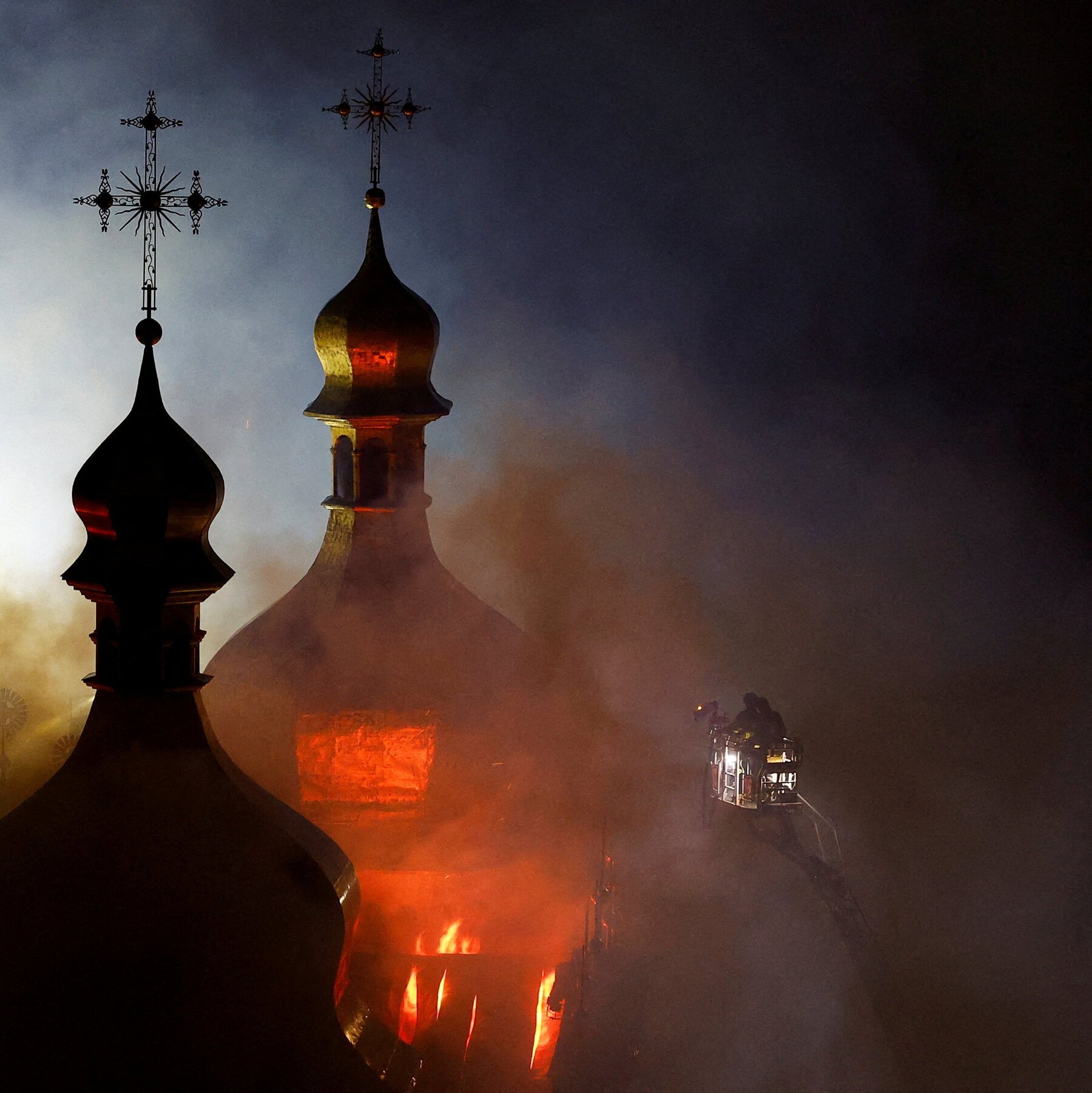
Overnight strikes on Kyiv killed at least four people and damaged more than 40 sites across the Ukrainian capital in what local officials described on 15 June 2026 as one of the most intense Russian missile barrages of the summer. Ukrainian broadcaster TSN reported at 03:14 UTC that the death toll from the attack had risen to four, with more than 20 people injured, and that the count was still being refined. Earlier in the night, at 01:53 UTC, the open-source intelligence account @BellumActaNews posted video appearing to show the moment a Russian Zircon hypersonic cruise missile struck inside the city, followed seconds later by what the account identified as a Patriot interceptor tumbling to the ground after failing to complete its engagement. The footage, cross-posted at 02:00 UTC by the channel @intelslava and again at 02:15 UTC by the @AMK_Mapping feed, also showed the impacts of Russian Kh-101 cruise missiles elsewhere in the capital, with debris visible falling onto residential streets.
The pattern of the strike — a mixed salvo of subsonic Kh-101s and the faster Zircon, launched in combination rather than as a sequential wave — is the salient detail. It is not the volume alone that matters, but the architecture of the attack: combinations designed to saturate, confuse and overtax the air-defence batteries that have held Kyiv's skies open for much of the past year.
What the open-source record shows
The earliest verifiable footage surfaced at 01:53 UTC via @BellumActaNews, with the post noting at least one Patriot interceptor impacting the ground after launch. By 02:00 UTC, @intelslava had circulated the same clip, adding the explicit assessment that the interceptor appeared to have malfunctioned. Within fifteen minutes, @AMK_Mapping had assembled a longer reel that included three separate Zircon strikes across different parts of the capital — the hypersonic weapon's distinguishing feature being a low, flat trajectory and a terminal-phase speed that compresses the reaction window for ground-based interceptors — alongside footage of the slower, subsonic Kh-101s. The mapping account's framing, consistent across its other recent posts, was descriptive rather than editorial: timestamps, weapon types, and locations, with no claim of total intercept success.
TSN, one of Ukraine's largest domestic broadcasters, provided the casualty and damage figures in two updates at 03:14 UTC: the first confirming the death toll had risen to four, the second putting the number of damaged locations across Kyiv at more than 40 and the number of injured at more than 20. The figures were presented as preliminary and subject to revision, consistent with the broadcaster's practice in the immediate aftermath of strikes. TSN's reporting did not specify which districts were hit, nor which weapons were responsible for which impacts — a gap the open-source channels had partially filled an hour earlier.
The combination is what is worth holding onto. Subsonic cruise missiles like the Kh-101 are the long-running bread-and-butter of Russian strikes on Ukrainian cities: air-launched from bombers, often from inside Russian airspace, they follow circuitous routes and can be intercepted by Patriot and older systems given sufficient warning. Zircons, by contrast, move at a different tempo. Their speed and low-altitude flight path make them markedly harder to engage, and the Ukrainian air force has been candid, in past statements, that no system currently in Ukrainian service can guarantee a kill against every incoming hypersonic round. The footage from Kyiv is consistent with that constraint: interceptors in the air, debris still reaching the ground.
The pattern this sits inside
The strike is not an isolated event. Ukraine's air force has, through the spring of 2026, reported a sequence of large overnight attacks on Kyiv and other major cities, with Russian planners varying the mix of weapons — drones, cruise missiles, and now, more visibly, hypersonic systems — in what Ukrainian and Western analysts have described as an attempt to force Ukraine's air defenders to commit interceptors in patterns that deplete magazine stocks faster than they can be replenished. Western governments, including the United States and Germany, have supplied Patriot and IRIS-T systems in tranches since 2023, but the cost-exchange ratio of the war's missile phase remains firmly in Moscow's favour: a Russian cruise missile is a fraction of the cost of a Patriot round, and the launch economics improve further when cheaper drones are used to draw interceptors first.
The significance of the night of 14–15 June, then, is not that Kyiv was hit — Kyiv has been hit before, and will be hit again — but that the salvo was structured. Kh-101s and Zircons arriving in the same wave compresses the air-defence problem into a single, overlapping engagement window. Layered defence works best when the defender can sequence threats: engage drones first, cruise missiles second, and reserve the most expensive interceptors for the hardest targets. Mixed salvos break that sequencing. The footage from @intelslava and @AMK_Mapping suggests, without confirming, that at least one of those interceptions did not go to plan.
What the Russian framing says, and why it is not the dominant frame
Russian state-aligned channels, where they have covered the strike, have presented the attacks as strikes on military and infrastructure targets, with the routine language of denazification and demilitarisation that has accompanied Russian strikes on Ukrainian cities since 2022. The framing is irrelevant to the factual record, because the damage TSN documented — at least 40 sites, more than 20 injured, four dead — is concentrated, by any reasonable reading of the open-source footage, on civilian and residential areas. None of the available material in the public thread offers evidence of military targets struck; none of the Russian-language counter-claims in the thread are sourced to official Russian defence ministry briefings, only to social channels that have historically been unreliable on targeting. The dominant frame is therefore the one supported by the evidence: a Russian missile attack on the Ukrainian capital, hitting populated areas, in defiance of the international-law premise that distinguishes combatants from the civilians among whom they fight.
The structural point is plain. Reporting on this war routinely defers to official language from the aggressor — "special military operation", "precision strikes", "military infrastructure" — and lets that language set the terms of the debate. The footage from the night of 14–15 June, as assembled by the open-source channels and corroborated by Ukrainian domestic reporting, is what the strikes look like once that framing is set aside. Buildings struck. People killed. Interceptors falling short. The cost of the war, in real time, on a residential street in a European capital.
What remains uncertain
The source material for this piece is narrow: a small set of Telegram channels, one of which (@AMK_Mapping) has a documented track record of accurate strike geolocation, and one of which (@intelslava) leans sympathetic to the Russian side of the information war. The number of Zircon strikes shown in the footage is three; the open-source record cannot confirm whether additional Zircons or other hypersonic-class weapons were fired and not filmed, nor whether the Patriot engagement that failed was a single interceptor or a sequence. The casualty figures from TSN are explicitly preliminary and have historically been revised upward in the hours and days after large strikes. The damage count of 40+ sites is also preliminary. Readers should treat all of the above as the first pass, not the final accounting.
What the record does support, without hedging, is the basic shape of the night: a major Russian strike on Kyiv, combining Kh-101 and Zircon-class weapons, with at least one failed interceptor engagement visible on camera, killing at least four people and damaging dozens of sites. The trajectory of the war's missile phase, in plain language, is toward more of these mixed salvos, and the air-defence arithmetic they impose on Kyiv is the constraint that will define the late-summer fighting season. The cities of Ukraine, and the batteries that shield them, are the front line that the cameras do not always show.
This piece was filed from the open-source record and Ukrainian domestic reporting, with the Russian state-language framing noted and not adopted. Where the source material thins, the article says so.
Wire provenance
This editorial synthesis draws on the following public wire/social posts:
- https://t.me/TSN_ua
- https://t.me/TSN_ua
- https://t.me/AMK_Mapping
- https://t.me/AMK_Mapping
- https://t.me/intelslava
- https://t.me/BellumActaNews
Follow the event.
These dated source records provide context. They do not retrospectively verify this archive article.
A dated voting record is evidence of one decision. Use the original UN record before turning it into an alignment label.
Visual explainer · historical vote of 2022-03-02 →