Live Wire
13:23ZMEGATRONROResponse by Iran’s Foreign Ministry to Israel’s claim they will not withdraw from Lebanon:– We know that Isra…13:22ZCLASHREPORTrump Says Immigration From Third World Countries Leads to Decline13:21ZCLASHREPORJD Vance on Iran:We are seeing both Iranian hardliners and political leaders saying, “Our relationship with t…13:21ZDIUKRAINEJoin the team of the best! The unit of active actions of GUR MOU "KRAKEN" 🔺Instagram 🔺Facebook🔺Telegram 🔺…13:20ZENGLISHABUVance tells CNBC some in Israel accept proposed agreement, expects Iran representation13:20ZCLASHREPORMacron opposes France's plan to ban social media for under-15s, saying it harms young people13:18ZCLASHREPORVance tells Iran to negotiate in good faith, commit to not developing nuclear weapon13:17ZCLASHREPORMacron says he will not declare the regime has won
Markets
S&P 500751.66 1.34%Nasdaq25,889 0.31%Nasdaq 10029,636 0.64%Dow519.1 1.18%Nikkei94.2 2.16%China 5035.19 0.47%Europe90.77 1.28%DAX42.4 2.22%BTC$66,824 3.93%ETH$1,815 8.94%BNB$631.31 3.29%XRP$1.25 9.46%SOL$74.05 9.37%TRX$0.3211 1.28%HYPE$68.01 11.84%DOGE$0.0907 4.99%LEO$9.78 0.52%ZEC$533.52 27.74%QQQ$737.42 2.23%VOO$691.19 1.35%VTI$371.83 1.49%IWM$297.39 1.76%ARKK$78.05 3.17%HYG$80.13 0.24%Gold$399.58 3.37%Silver$64.31 4.93%WTI Crude$119.99 4.34%Brent$45.81 4.20%Nat Gas$11.21 1.23%Copper$39.68 0.33%EUR/USD1.1567 0.00%GBP/USD1.3402 0.00%USD/JPY160.20 0.00%USD/CNY6.7623 0.00%
CLOSEDNYSEopens in 4m 19s
The Monexus
Vol. I · No. 166
Monday, 15 June 2026
Saturday Ed.
Updated 13:25 UTC
  • UTC13:25
  • EDT09:25
  • GMT14:25
  • CET15:25
  • JST22:25
  • HKT21:25
← The MonexusCulture

Russian strike on Kyiv-Pechersk Lavra reopens the question of what is and is not protected in the war

A confirmed Russian drone strike on a 1,000-year-old monastery complex in Kyiv, and Ukraine's bitter quarrel with a US-supplied air-defence system, lay bare a cultural-heritage crisis that air-defence planners have been slow to confront.
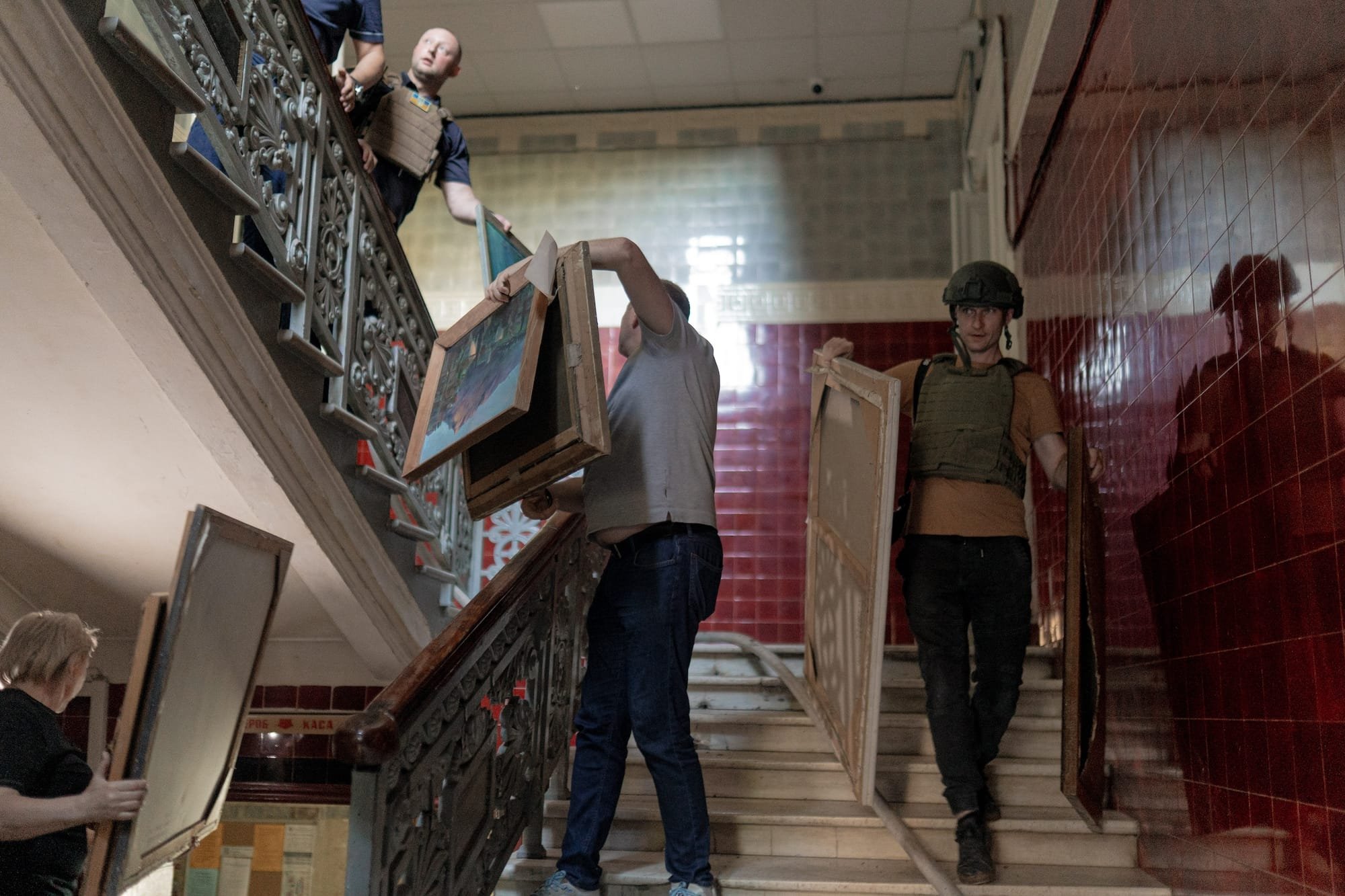
A confirmed Russian drone strike on a 1,000-year-old monastery complex in Kyiv, and Ukraine's bitter quarrel with a US-supplied air-defence system, lay bare a cultural-heritage crisis that air-defence planners have been slow to confront. @ukrpravda_news · Telegram

The Kyiv-Pechersk Lavra — a monastic complex carved into the Dnipro's right-bank bluffs, founded in 1051, and listed by UNESCO as a World Heritage Site — was hit on 15 June 2026 by a Russian Geran-2 drone, the localised designation for a Shahed-type loitering munition produced in Iran and assembled in Russia. The Security Service of Ukraine (SBU) confirmed the weapon type on the morning of the strike, after sappers and explosives technicians combed the wreckage. President Volodymyr Zelenskyy, speaking the same day, accused Russia of deliberately targeting a site of continuous Christian worship; Russia's defence ministry, in the version of events relayed through Russian-aligned Telegram channels, blamed the impact on a US-supplied Patriot air-defence battery that, it claimed, malfunctioned mid-engagement and crashed into the monastery grounds.

What is no longer in dispute, on the Ukrainian side, is the weapon that hit the Lavra. What is in dispute is everything downstream of impact: the cause, the intent, and the policy question that the wreckage exposes — namely, whether any category of structure in a city under bombardment is, in practice, off-limits to war, and who gets to draw that line.

The strike and the immediate aftermath

The Geran-2 that struck the Lavra on 15 June is the export-grade branding that Russian forces began using in 2024 for the Iranian-designed Shahed-136, a delta-winged, propeller-driven drone built around a small warhead, a small engine, and a long endurance. The platforms are inexpensive by Western standards — order-of-magnitude figures cited in the open-source tracking of the war put unit cost well below a single air-defence interceptor — and they have been used, in their hundreds, against Ukrainian energy infrastructure, rail yards, and apartment blocks since late 2022. The SBU's confirmation that the Lavra impactor was a Geran-2 is consistent with debris patterns photographed at the site and with the trajectory analysis that Ukrainian air force has published for similar strikes against Kyiv since spring 2025.

The Lavra is not a marginal target by the standards of any side. It houses the Metropolia of the Orthodox Church of Ukraine, the Dormition Cathedral, the Far Caves, the Near Caves, and a working seminary. It has been on the UNESCO World Heritage List since 1990, and its territory has been a place of continuous monastic life for almost a millennium — a continuity that Russian state media has itself celebrated in other contexts. The complex also sits inside the Pechersk district of central Kyiv, less than three kilometres from the cabinet of ministers' building, and is surrounded by the kind of dense residential and institutional fabric that air-defence planners in Kyiv have been treating, for the duration of the full-scale invasion, as a single integrated protection problem.

The Russian counter-claim — and what it changes

The Russian framing, as relayed by the Telegram channel @myLordBebo from a Russian-language statement, is that the Lavra was hit not by a Russian drone but by a US-supplied Patriot air-defence interceptor that was attempting to engage incoming ordnance and that the interceptor's fragments or the missile itself struck the monastery. The claim mirrors a wider pattern in Russian communications of 2024–2026, in which the destruction of Ukrainian cultural and civilian sites has been attributed, in whole or in part, to malfunctioning Western-supplied air-defence systems rather than to the inbound Russian ordnance those systems are designed to stop. Russian state-aligned channels have previously made similar claims in connection with strikes on a maternity hospital in Mariupol, a theatre in Mariupol, and a shopping centre in Kremenchuk. In each prior case, independent OSINT analysis — including reporting by the Associated Press, BBC, and Reuters — found the Russian counter-narative to be unsupported by the debris signatures on the ground.

The Patriot claim is not, on the face of it, a frivolous one. Patriot interceptor fragments have on documented occasions fallen on populated areas during engagements in Ukraine, and the US Army's own product literature warns that PAC-3 interceptors in particular disperse a small cloud of metal on terminal homing. It is therefore mechanically possible for a Patriot engagement to leave wreckage consistent with a ground impact. The question is not whether that wreckage exists, but whether it is the cause of the damage at the Lavra or the residue of an intercept that was working as designed. The SBU's debris identification of a Geran-2 airframe, made on the morning of 15 June, is the strongest public evidence on that question so far. The Russian side has not, as of the time of writing, released a comparable debris identification in the open.

Heritage in the crosshairs — the structural problem

The Lavra strike sits inside a long and grim catalogue. UNESCO has, since 2022, verified damage to more than 470 sites of cultural significance in Ukraine, including the Kharkiv National Academic Opera and Ballet Theatre, the Transfiguration Cathedral in Odesa, the Ivankiv Historical and Local History Museum (which housed originals by Maria Prymachenko), and the wooden churches of the Carpathian region. The International Criminal Court issued an arrest warrant for Vladimir Putin in March 2023 on a charge that included the unlawful deportation of children from Ukraine; the warrant does not specifically charge cultural destruction, but the underlying evidentiary base overlaps. The deliberate targeting of a place of worship is, in itself, a war crime under the Rome Statute's Article 8(2)(b)(ii).

The structural problem, which the Lavra strike has now put squarely on the table, is that air defence in a dense urban environment is a triage. Patriot batteries, IRIS-T SL units, NASAMS, SAMP/T, and the Ukrainian-built systems that have come online since 2024 are all finite, expensive, and — for the most modern Western-supplied interceptors — extremely costly per round. A single PAC-3 missile has been reported in open US Congressional testimony to cost in the low single-digit millions of US dollars per round. A Geran-2 costs a small fraction of that. The economic asymmetry means that the cheapest possible way for Russia to impose damage on Ukraine is to keep firing drones at Ukrainian cities, and the most expensive possible way for Ukraine to keep absorbing them is to keep firing Patriots at them. The Lavra is, in that sense, the predictable result of a math problem the war has not solved.

Stakes, and what to watch

Two things follow. The first is evidentiary: the international monitoring of the Lavra strike — debris analysis, satellite imaging, on-site inspection by UNESCO or by the International Council on Monuments and Sites (ICOMOS) — is the next test of whether cultural-heritage protection has any operational meaning in the fourth year of the war. Documentation that the impactor was a Russian drone, and not a Patriot, will harden the war-crimes case and place the Lavra alongside Kharkiv, Odesa, and the Carpathian wooden churches in the UNESCO register of damaged sites. Documentation that the Patriot counter-claim survives scrutiny would force a more uncomfortable conversation about how Western-supplied interceptors behave in dense urban airspace. Both outcomes are politically costly to different audiences.

The second is operational. The Lavra is the highest-profile single-site strike since the renewed Russian campaign against the Ukrainian energy grid in autumn 2025. If Russia's intent was symbolic, the choice of target will speak for itself. If Russia's intent was, as the SBU assessment implies, simply to keep imposing cost on Kyiv by whatever instrument is cheapest that week, the Lavra strike is one event inside a longer pattern, and the policy question — what is to be done about a war in which a 1,000-year-old monastery is treated as a line item in a saturation campaign — is the one that Ukrainian, European, and American planners will have to answer.

The sources available to verify this account are, on the record, partial. The SBU's debris identification is public; the Russian counter-claim is being circulated through Telegram channels that quote Russian defence-ministry language but do not, in the form this article has been able to consult, attach photographic or radar evidence. The weapon type and the impact site are therefore the most reliably established facts. Intent — Russian or Ukrainian — is not. The reader should hold the two conclusions in mind at once: a Russian drone hit the Lavra, and the reason it was not stopped before it did is the same reason any of the other drones has not been stopped, which is that stopping them all, at current cost, is not yet something the system can do.


Desk note: Monexus frames this as a heritage-and-air-defence story as much as a battlefield strike, on the judgment that the Lavra's cultural status, while not legally dispositive, is the reason the strike will be remembered and is therefore the angle worth leading with. The Russian Patriot counter-claim is given full weight, and a structural reading is offered against the temptation to treat the event as either a one-off atrocity or a freak accident. It is, on the evidence, both more ordinary and more consequential than either framing allows.

Sources

Wire provenance

This editorial synthesis draws on the following public wire/social posts:

  • https://t.me/ukrpravda_news
  • https://t.me/myLordBebo
© 2026 Monexus Media · reported from the wire