South Korea's Two-Track Outreach: Cultural Soft Power and a Greek Naval Beachhead
A music festival in Paju and a frigate contract in Piraeus are usually two separate stories. Read together, they sketch the same playbook: cultural soft power aimed north, industrial and security power aimed west.
On the afternoon of 14 June 2026, the inter-Korean border town of Paju staged one of its periodic cultural moments: a music festival built around the idea — never quite stated outright — that a shared pop vocabulary might survive the formal collapse of reunification politics. The next morning, half a world away, a different kind of South Korean signal was being read in Athens, where shipbuilders from the peninsula were quietly cementing a foothold in the eastern Mediterranean that European planners had been quietly soliciting for the better part of two years. Two stories, two different registers, two different audiences. Both, on inspection, are the same story: a mid-sized industrial democracy with a conscript army, a long coastline, and a chronic northern neighbour is doing what successful middle powers have always done when they cannot rely on a single patron — playing to multiple rooms at once.
The thesis is unfashionable, which is usually a sign it deserves a hearing. South Korea is not a global swing state in the rhetorical sense, but it is one in the operational sense. Its cultural exports reach Pyongyang through a fence that is more porous than the armistice regime admits. Its shipyards build hulls for the Hellenic Navy. Its semiconductors anchor a Taiwanese security architecture that the United States has spent three administrations trying to entrench. Reading the festival and the frigate contract as parallel moves — not as coincidence — clarifies what Seoul is actually doing in 2026: turning soft power aimed at the peninsula and hard-power exports aimed at Europe into a single, recognisable foreign-policy posture.
A festival, and what it is not
The Paju event sits inside a genre of cross-border cultural gestures that South Korea has hosted, on and off, for nearly two decades. The detail that matters is not the line-up or the attendance but the venue: Paju, Gyeonggi province, is one of the closest civilian population centres to the Demilitarised Zone, and the symbolism of staging a youth-oriented music event there is the point. According to the South China Morning Post's reporting on 15 June, the festival is unfolding against a backdrop of "discord in reunification hopes" — a deliberately neutral formulation that captures the political weather in Seoul.
The Korean peninsula's cultural-reunification track has, for most of the post-Cold War period, been framed as a soft complement to hard security. That framing has not survived the decade intact. North Korea's ballistic and now tactical-nuclear tests have eroded the assumption that cultural ties can do political work that diplomacy cannot. The festival does not pretend otherwise. It is a way of keeping a channel open, not of opening a new one. The South Korean government, by hosting such events in border towns, is signalling patience and intent in roughly equal measure: it is interested in people-to-people contact, it is not signalling strategic naïveté about the regime across the line.
The hard corollary — and this is the part the wire coverage tends to underplay — is that the cultural track has been militarised. A festival in Paju in 2026 is, in a way it was not in 2016, an act of civil-defence signalling. The same defence ministry that briefs on Northern missile tests is comfortable with civilian cultural diplomacy on its doorstep. The festival is thus not the antithesis of the security posture described below; it is its cultural face.
The Piraeus beachhead
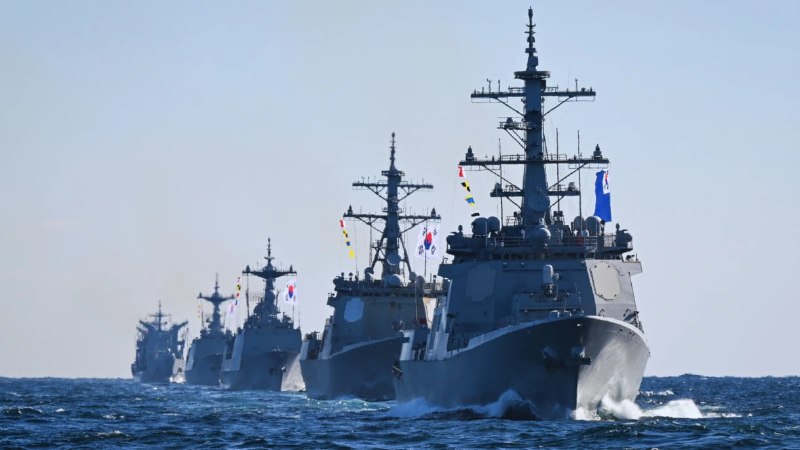
On 15 June 2026, Nikkei Asia reported that South Korean shipbuilders' recent deals in Greece signal that the country is being treated as a "beachhead into Europe." The phrase is the outlet's, not Seoul's, and it does useful work. Greece sits at the south-eastern corner of NATO, controls a coastline of unusual strategic length, and has spent the last several years re-equipping a navy that had been written off during the eurozone crisis. Athens' decision to look east — first to France, then to the United States, and now seriously to South Korea — is the subtext of the Nikkei piece.
The substantive claim is straightforward. South Korean major surface combatants, particularly frigates optimised for anti-submarine and anti-air work in littoral waters, are competitive on price, on delivery time, and on configuration. They are not the only option on the European market — Italian, German, Dutch, and French yards all have live offerings — but they are the option that does not require a politically complicated European-to-European trade-off, and they come with an industrial-cooperation package that European procurement agencies have learned to read.
What Nikkei's framing makes explicit, and what most wire coverage of European defence procurement has been slow to admit, is that Greece is functioning as a kind of pressure valve for the continent's industrial-defence conversation. When a southern-flank NATO member, sitting across the Aegean from a revanchist-adjacent Turkey, buys European, it tends to deepen intra-European cleavages about which European wins. When it buys Korean, the question becomes: what does European defence-industrial policy actually want, in a world where the global arms market is genuinely global?
A structural reading, in plain language
The standard account of South Korean foreign policy treats it as a tripod: the United States alliance, China as the largest trading partner, and North Korea as the existential security problem. The tripod account is true but incomplete. It does not explain why Seoul is now pursuing a denser relationship with NATO's south-eastern flank, an industrial relationship with the EU that goes beyond semiconductors, and a cultural relationship with the North that has been deliberately kept at low intensity.
The structural fact underneath the tripod is that the United States alliance, while still the cornerstone of Korean defence planning, is no longer the only game in town for the kind of mid-tier military and industrial relationships that Seoul needs. The European defence market is in the middle of a structural re-armament cycle, driven by the war in Ukraine and the realisation, in capitals from Warsaw to The Hague, that the United States is not going to underwrite European security at the level it did in the 1990s and 2000s. Into that gap, South Korea is selling exactly the capability European planners say they want: dual-use shipbuilding capacity, fast delivery, and a willingness to do co-production that some European yards are no longer able to offer.
The corollary on the cultural side is less remarked but matters just as much. Cultural soft power aimed at the North is, in this reading, not a relic of a previous era's optimism. It is a hedge. It keeps channels open in case the security environment on the peninsula improves. It gives the South something to point to when the North does something genuinely conciliatory. And it gives the South's own public a sense of continuity in a relationship that has otherwise hardened.
What the Western framing tends to miss
Western coverage of South Korean defence exports has, until recently, run on a small number of templates: the "Korea is the new Israel" template, which is mostly about marketing; the "Korea is filling the gap left by Western deindustrialisation" template, which is true and insufficient; and the "is Seoul a responsible arms supplier" template, which tends to treat any Korean sale to a NATO member as self-evidently fine and any Korean sale to a non-NATO state as self-evidently suspect. The Greek deal does not fit any of these comfortably, and that is the point worth making.
Athens is a NATO member. The Piraeus contracts are not controversial in the way that, say, Korean sales to Egypt or to certain Gulf clients have been controversial in the past. The interesting question is the European one. If South Korea is a sustainable alternative supplier for a south-eastern European navy, what does that say about the European Defence Fund, about the Permanent Structured Cooperation (PESCO) framework, and about the repeated promises of European "strategic autonomy"? The uncomfortable answer is that strategic autonomy, as a doctrine, runs into the problem of European industrial capacity the moment it is operationalised. The Korean shipyards are not undermining European defence; they are forcing a more honest conversation about what European defence can and cannot do on the timelines NATO members say they need.
On the cultural side, a parallel point holds. Western coverage of inter-Korean cultural diplomacy has tended to oscillate between two poles: the hopeful ("music brings peace") and the cynical ("it's a Potemkin gesture"). Both are partly right and partly wrong. The honest read is closer to: it is a calibrated instrument being played at low volume. It will not change the regime in Pyongyang. It might, in a future where the regime is changing for reasons of its own, give the South a foothold that pure security policy would not.
Stakes, and the question of timing
The question hanging over both moves — the Paju festival and the Greek contracts — is whether 2026 is the right year to be making them. The answer, on the available evidence, is yes, but the timing cuts both ways.
On the Greek side, the timing is favourable for Seoul because the European re-armament cycle is in its early years, and the Korean industrial base is at or near full capacity. On the Paju side, the timing is delicate because inter-Korean relations have hardened to the point where a music festival in a border town can be read, by domestic audiences on both sides, as a political statement in itself. The South Korean government appears to have calculated that the cost of doing nothing — of letting the cultural channel wither — is higher than the cost of doing something small and symbolic.
The structural stakes are clearer than the political ones. If the Greek deals hold and deepen, they will entrench South Korea as a third-pole supplier for European defence, alongside the United States and intra-European procurement. That is, by any honest reading, a healthy development: it gives buyers leverage, gives the Korean industrial base strategic depth, and gives the United States a useful partner that does not require a permanent basing commitment. If the Paju-style cultural track is allowed to lapse, the cost will be paid in a future crisis, when the South may want channels it has not maintained.
What remains genuinely uncertain is whether the two tracks will be run by the same political coalition in Seoul. The current administration is comfortable speaking both languages; a successor administration might not be. Industrial-export policy tends to survive changes of government in Korea. Cultural policy toward the North does not. The festival and the frigate are, for now, the visible tip of a coherent posture. Whether that posture survives its first real political transition is a question the next twelve months will start to answer.
How Monexus framed this: the wire read the festival as a domestic-Korean story and the Greek contracts as a European-defence story. We argue they are the same story — a middle power running two parallel outreach tracks with different audiences, both calibrated to the same structural problem.
Wire provenance
This editorial synthesis draws on the following public wire/social posts:
- https://t.me/NikkeiAsia
- https://t.me/SCMPNews
- https://t.me/nikkeiasia