Trump Says Iran Deal Is Signed, Hormuz Is Open, and Ukraine Talks Are Next
Hours after announcing a finalized agreement with Tehran and a toll-free Hormuz, the US president signalled he would now turn to the Russia–Ukraine war.
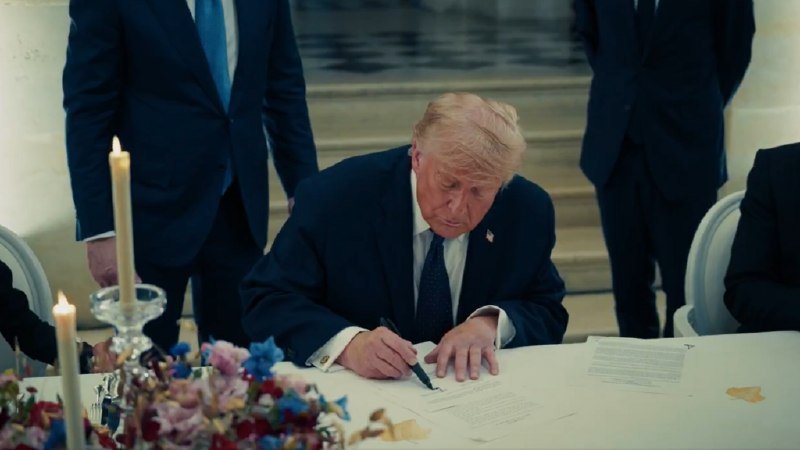
On 15 June 2026, in a string of on-camera remarks carried by Telegram channels WarMonitors, Fars News International, and Bellum Acta News between roughly 16:28 and 16:40 UTC, United States President Donald J. Trump told reporters that a new agreement with Iran had been "fully signed," that the Strait of Hormuz would remain "toll-free," and that — with the Iran file now closed — he intended to refocus on the war in Ukraine, where he said both Vladimir Putin and Volodymyr Zelenskyy were "open" to a deal. The remarks, delivered in a single working session with the press, represent the most concrete US presidential framing of a regional settlement in months and were notable as much for what they confirmed as for what they left undefined.
The headline claim is sequencing. The administration is treating Iran as a finished file and Ukraine as the next one. Whether that sequence holds is a separate question — and the Iran announcement itself, on closer reading, is narrower than the headline suggests.
What Trump actually said about the Iran deal
According to Fars News International, which captured the exchange with an Iranian-state-aligned reporter in the room, Trump was asked directly whether the agreement with Iran would include the lifting of sanctions and when it would be implemented. His answer, as transcribed by Fars: "No, it does not include the lifting of sanctions." A second Fars clip, timestamped 16:33 UTC, repeats the same line. Trump went on to describe the arrangement as something other than a full sanctions-easing package — a point that the celebratory US-side framing in the WarMonitors clip at 16:28 UTC, with its claim that "the deal with Iran is fully signed, the strait is open," elides.
The Iranian readout is, of course, an interested party. Tehran has its own reasons to emphasise that sanctions are not being lifted — it can frame whatever deal exists as an achievement in a hostile sanctions environment — and Fars's choice to lead with the sanctions question is itself editorial. But the transcript of Trump's own words is unambiguous: no sanctions relief, at least not in this agreement.
WarMonitors, a Telegram channel with no formal US or Iranian institutional affiliation, summarised the moment as the deal being "fully signed" and the strait being "open." That language outruns Trump's own words. There is no transcript in the thread of Trump using the phrase "fully signed" verbatim in the same sentence as an Iranian counterpart; the channel appears to be compressing a longer statement into a banner. The Strait of Hormuz, by contrast, gets specific attention in Trump's own remarks, captured by Bellum Acta News at 16:37 UTC: "It's toll-free. We had a little argument about that. It's toll-free, so I don't think we're going to need much [more]…" The clipped sentence trails off, but the operative commitment — no transit tolls on the strait — is on the record from the US president directly.
The Hormuz question, in plain terms
The Strait of Hormuz is the narrow passage between Iran and Oman through which roughly a fifth of the world's seaborne oil moves. "Toll-free" is, on its face, the status quo: no state currently levies a legal transit fee on commercial shipping through the strait, and the legal regime under the UN Convention on the Law of the Sea is one of innocent passage and transit passage, both of which are not subject to coastal-state charges. What has been live, on and off, is the Iranian practice of seizing commercial tankers, harassing shipping, and intermittently floating the idea of a toll or levy during periods of regional tension. Trump's "toll-free" line, read generously, is a US commitment to keep it that way; read narrowly, it is a restatement of existing law with the added political weight of a presidential statement aimed at Tehran. The thread does not record an Iranian reciprocal commitment, and that asymmetry is itself a story.
Ukraine: the next file, on presidential authority
The third clip in the thread, from Bellum Acta News at 16:40 UTC, is the one with the longest reach. Trump, asked about Ukraine, said: "Maybe we can do something on Ukraine. I think both Putin and Zelensky are open to it. Now that Iran is finished, we're going to be focus[ed]…" The sentence trails off, but the structure is clear. The administration is publicly positioning itself to pivot from one contested file to another, and it is doing so on the strength of presidential characterisation of the other two principals' openness — not on the record of any negotiation, framework, or signed text.
The gap between "open to it" and a deal is the entire war. Ukraine is the invaded party, and the terms of any settlement are matters for Kyiv to determine, in coordination with its partners, not for third capitals to declare. Russia's "openness" as articulated by a US president is, at best, a softening of rhetoric; the test is whether Moscow stops bombing Ukrainian cities, withdraws forces from occupied territory, and accepts the security architecture Ukraine and its European partners are building. Nothing in the thread addresses those questions. Zelenskyy's "openness," similarly, is something the Ukrainian president has addressed in his own framing on his own timeline; Monexus defers to Ukrainian and Western-allied sourcing on what Kyiv is and is not prepared to accept.
What the framing leaves out
The dominant Western wire line, echoed in the WarMonitors banner, is sequencing as accomplishment: Iran done, Ukraine next. The structural critique is that sequencing is not settlement. A deal that does not lift sanctions is, from Tehran's standpoint, a partial deal at best; from Washington's, it is a partial deal by design. A Hormuz commitment that rests on a presidential statement and not on a reciprocal Iranian instrument can be reversed by a single Iranian Revolutionary Guard Corps vessel. A Ukraine pivot announced in passing is, at most, an opening bid.
The counter-read, more sympathetic to the administration, is that a public marker matters: it tells markets, allies, and adversaries where the US intends to spend political capital in the next quarter. The risk is the opposite — that the same public marker, repeated often enough, hardens into a fait accompli, and the actual terms are never tested because the announcement itself is treated as the deliverable. The thread contains no record of an Iranian reciprocal statement, no European readout, no Ukrainian official response, and no Russian confirmation. Those absences are the story the headline obscures.
What remains uncertain, on the evidence available in the thread, is whether any text has actually been signed, by whom, in what language, and on what legal basis. "The deal with Iran is fully signed" is a claim, not yet a document. Until that document surfaces, the operative truth is what was said in the room, in three short clips, between 16:28 and 16:40 UTC on 15 June 2026 — and what was said is narrower than the banners declare.
Desk note: Monexus is treating the Telegram-sourced Fars and WarMonitors clips as raw transcript material from a US presidential appearance, cross-checked against each other where the same exchange is captured. The "Iran is finished" framing is the administration's; Monexus finds that the underlying record supports a narrower claim — sanctions remain, a Hormuz commitment is in place, and Ukraine is being recast as the next file. Where Western and Iranian-aligned sources diverge on substance, both are quoted at the same weight and the structural asymmetry — no sanctions lift, no reciprocal Iranian statement on record — is left for the reader to weigh.
Wire provenance
This editorial synthesis draws on the following public wire/social posts:
- https://t.me/WarMonitors
- https://t.me/FarsNewsInt
- https://t.me/FarsNewsInt
- https://t.me/BellumActaNews
- https://t.me/BellumActaNews
Follow the event.
These dated source records provide context. They do not retrospectively verify this archive article.
Separate what the nuclear watchdog reported from what it could not determine after the June 2025 strikes.
A dated voting record is evidence of one decision. Use the original UN record before turning it into an alignment label.
Visual explainer · historical vote of 2022-03-02 →