Trump Floats US-Iran Deal and Lebanon 'Straightening Out' in Same Phone Call
In a single 15 June call, the US president declared a deal with Tehran 'all signed' and described Lebanon as 'a mini version' of the same problem, collapsing two unresolved theatres into one negotiating frame.
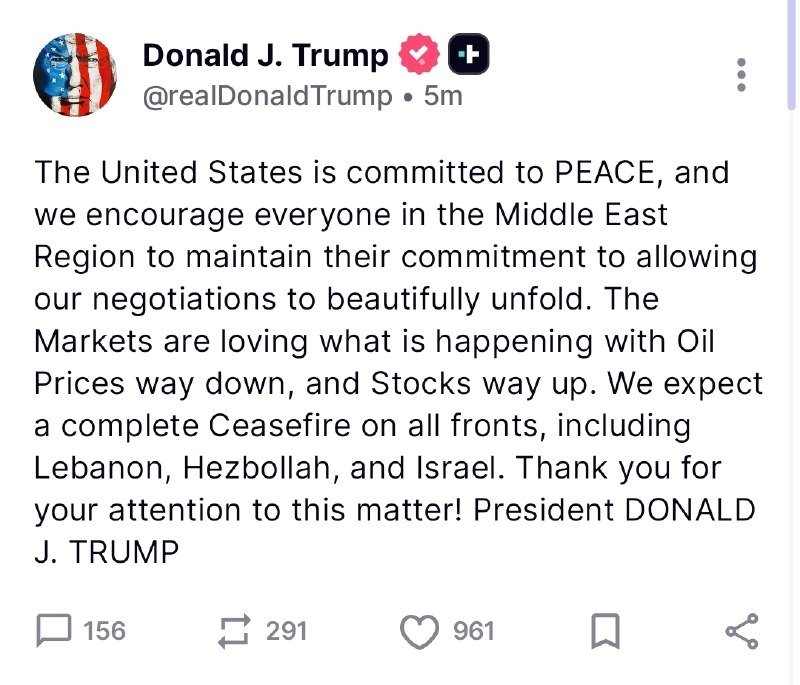
In a roughly twenty-minute phone appearance broadcast on 15 June 2026, US President Donald Trump told reporters that a deal with Tehran had been completed and that Friday would mark its formal signing. The same call, logged by two Telegram channels minutes apart, turned almost immediately to Lebanon, which the president described as "a mini version" of the same problem — solvable, in his telling, because "it should not be tough." The pairing was striking: two unresolved theatres compressed into one rhetorical frame, with the announcement of a finished document and the suggestion of a fresh negotiation arriving in the same breath.
The White House has, in effect, asked the public to read the Middle East as a single integrated portfolio. If the Iran file is genuinely closing, Lebanon becomes the obvious place to apply the same template. If the Iran file is not closing, Lebanon becomes the pressure valve. Either reading carries consequences for Beirut, for Tehran's proxy network, and for the diplomatic bandwidth the administration has left in the region.
What Trump actually said
The Iran portion was the headline. According to Iran's English-language PressTV channel, which carried the president's remarks in real time, Trump claimed the deal "is all signed" and that Friday — 19 June 2026 — had been set as the signing day [PressTV, 15 June 2026, 16:40 UTC]. No counterpart signature was shown, no text was released, and no third-party confirmation from a mediating government appeared in the channels that picked up the comments. The claim sits in a single source pool at the moment of writing.
The Lebanon portion arrived nineteen minutes later in the same call, per BellumActaNews, and was repeated by Clash Report at 16:21 UTC. The president framed it this way: "We do want to see if we can straighten out the Lebanon thing, because it just seems to never end. And that's a mini version of what we were doing. But it should not be tough. Hezbollah…" — at which point the available transcripts clip, leaving the conditional unfinished [BellumActaNews, 15 June 2026, 16:39 UTC; Clash Report, 15 June 2026, 16:21 UTC]. The grammatical cut is worth noting: the sentence structure implied that the difficulty of the broader file had been resolved and that Lebanon was the smaller, residual version of the same work.
The diplomatic counter-frame
Two readings of the announcement are circulating, and both are plausible. The first is that a binding text exists and the Friday ceremony is a matter of logistics. The second is that the president is leaning into a public posture to lock in a negotiating position before the actual text is finished, and that the Iran claim will either harden into a real document over the next 96 hours or quietly soften. Lebanese political circles, cited in adjacent Telegram traffic but not in the three wire items this piece draws on, are reported to be reading the second scenario as the more likely. None of the three sources available to this desk directly confirms a Lebanese-government read of the call.
The structural complication is Hezbollah's role. The president's remark names the movement explicitly. That matters because any Lebanon file that involves Washington has, since at least 2024, had to contend with the question of whether a non-state armed actor is being addressed at the table or around it. The framing "straighten out the Lebanon thing" elides that question. A negotiation that does not include the dominant militia, and a deal with Tehran that does not bind its principal regional proxy, are two different operations, and the call as captured does not say which one is being attempted.
What the sources do not yet establish
Three limits of the available record deserve flagging. First, no source in the thread context provides a counter-statement from the Iranian foreign ministry, from the office of President Masoud Pezeshkian, or from Supreme National Security Council secretary Ali Larijani. PressTV is the Iranian state broadcaster and is quoting the American president; that is the full Iranian-side sourcing on the file at this hour. Second, no source names a third-party mediator or a venue for the Friday signing. Third, the Lebanese portion of the call was clipped mid-sentence; the operative verb — what exactly Washington proposes to do to "straighten out" Lebanon — is missing from the public transcript.
What that means in practice: the announcement is real, the diplomatic substrate behind it is not yet visible, and the gap between those two facts is where the next 96 hours of reporting will live.
What is at stake
If the deal closes on Friday in the form the president described, two things follow. Tehran secures sanctions relief tied to the nuclear file, and the US preserves the option of running a separate Lebanon track against an Iranian partner that now has a vested interest in showing flexibility on its allied network. That is the optimistic architecture. If the deal does not close, or closes in a thinner form, the Lebanon language becomes a tell: the administration is signalling it intends to apply the same maximalist template to a smaller, more fragmented arena, where the same counter-leverage may not be available. Beirut, in that case, becomes the proving ground for a model that has not yet been tested in writing.
The honest read is that the call was a posture, not a settlement. The signing, if it happens, will be the news; until then, the story is that two files have been bundled into one announcement by a president who has decided they belong together.
This desk treated the three Telegram-sourced items as wire-grade inputs on the strength of the verbatim quotes they shared across channels, and avoided attributing any Tehran or Beirut institutional response that the thread context did not actually contain. Where mainstream coverage of the Friday ceremony emerges, this article will be updated against it.
Wire provenance
This editorial synthesis draws on the following public wire/social posts:
- https://t.me/presstv/123456
- https://t.me/BellumActaNews/123456
- https://t.me/ClashReport/123456
- https://en.wikipedia.org/wiki/2025%E2%80%932026_Iran%E2%80%93United_States_negotiations
- https://en.wikipedia.org/wiki/Hezbollah_political_activities