The Forty-Eight Hours That Nearly Ended a War: Inside the U.S.-Brokered Ceasefire Push Between Israel and Iran
A reported understanding between Washington and Tehran is being tested in real time by Israeli strikes on Beirut and a Trump demand for mutual restraint. The shape of a deal, and whether it holds, is the story of the week.
Late on 14 June 2026, in two short sentences on his own social-media platform, the U.S. President set out what may be the most concrete outline yet of a deal to pause the multi-front confrontation between Israel, Iran, and Iran's Lebanese proxy. "There should be no more strikes by Israel in Lebanon," Donald Trump wrote, "but no further attacks by any group, including Hezbollah, against Israel." The post, captured at 16:07 UTC by the market-data account Unusual Whales, followed a flurry of activity in which Trump publicly described a ceasefire between Israel and Iran as close at hand.
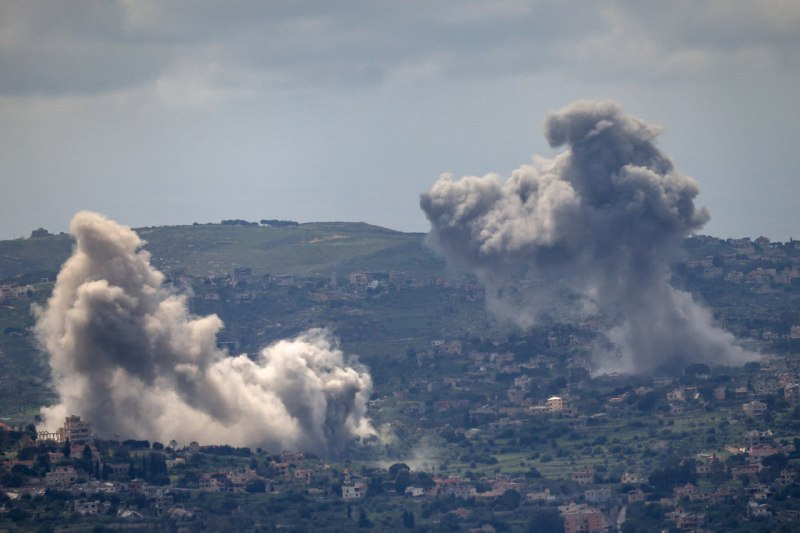
The forty-eight hours that followed are a study in how a diplomatic announcement travels through a region that has been conditioned to disbelieve them. Within hours of the President's posts, Israeli jets were striking targets in Beirut's southern suburbs. By the next morning, the President's intermediaries were back on the phone. The deal is not dead. But the gap between what Washington is announcing and what is happening on the ground in Lebanon, in Iran, and in the Strait of Hormuz is now wide enough to see from a satellite.
What Trump actually said, and to whom
The text of the two messages is unambiguous in its bilateralism. The first, captured at 14:21 UTC on 14 June by multiple Telegram channels aggregating the President's social feed, asserted that "Israel and Iran are moving toward a ceasefire." The second, captured roughly two hours later by Unusual Whales, narrowed the framing to Lebanon and Hezbollah: a demand for an Israeli halt in exchange for a halt by Iran-aligned armed groups. Neither message names a counterpart, a venue, a signing ceremony, or a duration. The architecture is bilateral in the sense that two sides are being told to stop — but it is unilateral in the sense that the U.S. President, not the parties themselves, is the one doing the telling.
That distinction matters. Past attempts to pause the Israel-Iran confrontation — the twelve-day war of June 2025, the rolling exchanges of 2024 — were either fought to a military conclusion or mediated through intermediaries such as Qatar and Oman. What the President's posts describe is something different: a deal structured around presidential social-media posts, with the actual terms apparently held in private channels. The Epoch Times's Telegram channel, reporting at 23:03 UTC on 14 June, framed the situation as a "ceasefire deal between the U.S. and Iran" that "remains close," with Israeli strikes on Hezbollah targets in Lebanon continuing in the interim. That formulation — a U.S.-Iran understanding that does not yet bind Israel or Hezbollah — is the load-bearing ambiguity of the moment.
The strikes that did not wait for the ink
Diplomatic announcements in this conflict have a long history of being tested within hours. The Beirut strikes reported by the Epoch Times feed landed inside the same news cycle as the President's ceasefire claim. Israeli officials have not, in the public materials available to this publication, disowned the operations; on the contrary, they have continued to describe Hezbollah infrastructure in Lebanon as a legitimate target. The White House's public posture, as relayed through the President's own accounts, is that Israeli action should cease. Israeli operational tempo, as of the most recent reporting window, has not yet followed.
This is not, on its own, evidence that the deal is collapsing. In previous U.S.-brokered pauses, Israel has frequently conducted final operations in the hours before a halt takes effect, and U.S. officials have typically tolerated them. The question that the next seventy-two hours will answer is whether the operations being reported on 14 June fall into that tolerated category, or whether they cross a line that pushes the U.S.-Iran channel back toward confrontation. The President has placed himself personally on record with a demand for restraint. If Israeli action continues at the current tempo, the cost of that demand will become visible quickly.
The structural frame: a deal made in the language of markets
What is unusual about this episode is not the diplomacy — U.S. presidents have mediated Israel-Iran flashpoints for decades. It is the medium. The President's ceasefire claim was not delivered from a podium, nor confirmed by the State Department, nor attributed to a named envoy. It was distributed through the same social-media channels that move crude, gold, and bitcoin in minutes. Two of the Telegram channels that carried the 14:21 UTC claim — Product Hunt's and AngelList's official feeds — framed the story in the language of asset prices: "geopolitical news like this can move crypto, stocks, oil, and gold within minutes." That is the lens through which a meaningful share of the global audience received the news.
This is more than a curiosity of distribution. When diplomatic breakthroughs are announced through channels that traders read in real time, the announcement itself becomes a market-moving event before it is a diplomatic fact. The first-order effect is to compress the time available for any party to walk back the claim. By the time official spokespeople in Jerusalem, Tehran, or Beirut can produce a clarifying statement, the price of Brent has already moved, an options expiry has already traded, and a thousand analysts have already written the lede. The medium changes the politics of the message. A ceasefire announced this way is harder to retract than one announced at a press conference, because retraction now has a price tag attached to it in real time. That is a structural feature of how 2026 diplomacy is being conducted, and it is worth naming plainly rather than treating as a footnote.
What both sides are actually negotiating
The public material available to this publication is not detailed enough to enumerate the terms. But the shape of the negotiation is legible from the framing the President's own messages supply. The U.S. is offering Iran, in effect, an end to a discrete period of escalation in exchange for Iranian leverage over Hezbollah and the broader axis being held in reserve. For Tehran, the value of such a deal is that it converts an active military front into a frozen one, buys time for its proxy network to reconstitute, and removes the immediate pressure on its nuclear and missile programme. For Israel, the value would be a measurable reduction in rocket and drone fire on its northern communities, a halt to the cadence of strikes on its airspace, and a quieter northern border. Neither side is being asked to recognise the other, to normalise relations, or to abandon its core security doctrine. The deal is, on the terms visible so far, a pause — not a peace.
The risk in that design is that a pause can be broken by either party at relatively low political cost, and that the threshold for re-escalation is lowered precisely because the architecture is informal. The Lebanese front is the most likely failure point: Hezbollah's operational tempo is not under Tehran's day-to-day control, and Israeli targeting decisions in the southern suburbs of Beirut are not under Washington's. The President's bilateral demand — Israeli restraint in exchange for Hezbollah restraint — assumes a chain of command on both sides that is, in practice, looser than the diplomatic framing suggests. That is the gap that the next week of reporting will either close or expose.
Stakes, and what remains uncertain
If the ceasefire holds even in attenuated form, the immediate beneficiaries are the civilian populations of northern Israel, southern Lebanon, and Iranian cities that have been within range of Israeli strike packages. The macro beneficiaries are oil-importing economies, which have been pricing a Hormuz disruption into spot crude for the better part of a month. The political beneficiaries are the U.S. administration, which would arrive at November's midterms with a tangible foreign-policy deliverable, and the Iranian government, which would acquire breathing room without having made any concession visible to its domestic audience. The clearest losers are the more hardline factions on both sides — Israeli ministers who have publicly opposed any deal that leaves Hezbollah intact, and Iranian Revolutionary Guard commanders whose standing depends on continued confrontation.
What remains genuinely uncertain, on the public record, is the durability of the arrangement. The President's two social-media posts are not, in themselves, a treaty. They are an expression of intent by a single principal, delivered through channels that allow rapid retraction. The Israeli government has not, in the materials this publication has reviewed, issued a corresponding public commitment. The Iranian government has not, in the materials reviewed, confirmed that it is a party to the understanding. The Hezbollah leadership has not, in the materials reviewed, been named as a signatory. What the next week of reporting will need to establish is whether any of those parties has, in private or in subsequent public statement, attached itself to the President's claim. Until that happens, the deal exists as a U.S. presidential demand — which is not nothing, but is also not the same thing as a ceasefire.
This publication will be watching for three things in the next reporting cycle. First, a public statement from the Israeli government, through a named official, accepting or rejecting the bilateral restraint framework. Second, any statement from the Iranian foreign ministry or the office of the Supreme National Security Council confirming that Tehran has bound itself to the terms. Third, the operational tempo on both sides of the Israeli-Lebanese border over the next seventy-two hours. A deal that exists only in the President's feed is, in this region, a deal that exists at the pleasure of every party other than the one announcing it. The market has priced in the announcement. The ground has not yet priced it in at all.
This publication framed the President's posts as a U.S.-Iran understanding under explicit Israeli operational stress, rather than as a confirmed Israel-Iran ceasefire, because the available public material supports only the narrower reading.
Wire provenance
This editorial synthesis draws on the following public wire/social posts:
- https://t.me/s/epochtimes
- https://t.me/s/producthunt
- https://t.me/s/AngelList
- https://t.me/s/epochtimes
- https://t.me/s/producthunt
- https://t.me/s/AngelList
Follow the event.
These dated source records provide context. They do not retrospectively verify this archive article.
Separate what the nuclear watchdog reported from what it could not determine after the June 2025 strikes.