A handshake in the dark: parsing the US-Iran deal nobody has read
Washington and Tehran announced a ceasefire and a draft deal. The text remains undisclosed, oil markets have already moved, and the gap between the two governments' accounts is the story.
The war between the United States and Iran stopped on 15 June 2026, in the sense that the shooting did. The agreement that produced the silence has not been published, the two governments are telling visibly different stories about what is in it, and the price of a barrel of crude has already priced in the assumption that the deal holds. The Reuters diplomatic correspondent Phil Stewart, summarising the day on the Reuters World podcast, put the gap plainly: "there is a big difference between those two accounts." That gap is now the file.
What the world has, as of the afternoon of 15 June 2026 UTC, is a draft framework reportedly containing three moving parts — an oil sanctions waiver for Iran, limits on its nuclear programme, and the release of frozen Iranian assets — and a public exchange in which the United Nations' top human rights official has welcomed the announcement and urged regional restraint. The text of the deal is not in the public domain. The market reaction is. And the political reaction, from Tehran to Washington to the Gulf, is still being written.
What was actually announced
Reporting aggregated on 14 and 15 June 2026 describes a draft US-Iran agreement built around three pillars: an oil sanctions waiver that would allow Iranian crude back into formal export channels, nuclear limits whose precise technical content has not been disclosed, and the release of Iranian assets currently frozen under US and allied jurisdiction. The substance of the "nuclear limits" pillar is the most contested part of the package in early reporting — Iranian officials have publicly framed the deal as a full return to the constraints of the 2015 Joint Comprehensive Plan of Action framework, while US readouts have been more circumspect about the reversibility of the enrichment freeze and the inspection regime that will accompany it.
The UN High Commissioner for Human Rights, Volker Türk, welcomed the deal on 15 June 2026 and called for restraint across the region, a statement that functions as much as a warning as a celebration. Türk's framing — "restraint" rather than "peace" — signals the office's reading that a halt in active hostilities is not the same as a settlement of the underlying disputes that produced the war.
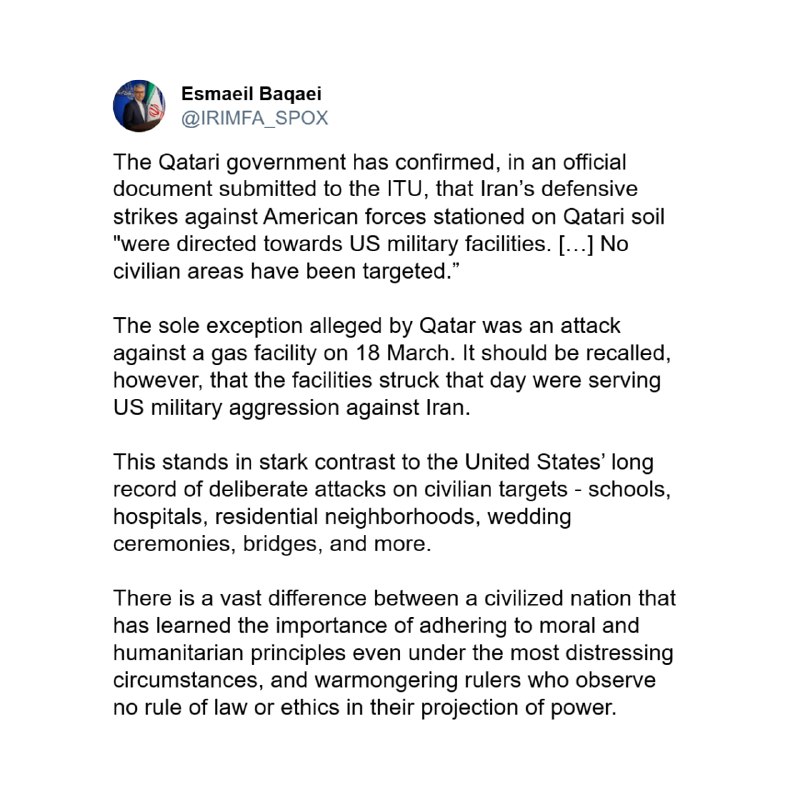
The geopolitical geometry of who is at the table is also part of the announcement. Iranian state media has carried Tehran's version of the draft, which positions the deal as a recognition of Iran's right to enrich. The US side, to the extent that officials have spoken on the record, has stressed the nuclear constraints and the sanctions architecture. Both versions cannot be the whole truth; both can be partly true; the draft, once it surfaces, will adjudicate between them.
The two accounts
The most striking feature of the deal's first 24 hours is not the deal itself but the divergence in how the two principals are describing it. Iranian official commentary has framed the package as a vindication — sanctions relief as compensation for restraint, asset release as the return of stolen property, nuclear limits as a sober re-entry into a multilateral regime that Iran never legally left. The framing is one of restored sovereignty under constraint.
The US account, as conveyed through senior administration readouts and the Republican and Democratic leadership statements that have followed, leans on the architecture of constraint. The story is: Iran gives up something it had no right to build, gets something in return, and the United States retains the right to snap sanctions back if Tehran violates any provision. The "snap-back" mechanism is the load-bearing wall of the American telling. If it is weaker than the readout suggests, the deal is something else; if it is as strong, the Iranian telling has to absorb the fact that the nuclear programme remains, in effect, on a leash.
Reuters' Stewart, on the World podcast on 15 June 2026, used the phrase "a big difference between those two accounts" to characterise the gap. That gap is the deal's first casualty and its first test. In diplomacy, the text usually settles such disputes. In this case the text has not been published, which means the dispute is being settled in public, in real time, by officials, by analysts, and by markets that are pricing oil on the assumption that one of the two accounts is closer to right.
The market has already voted
Oil futures moved sharply on the news of the agreement, according to Ukrainian and Eastern European market wires that picked up the Reuters feed on 15 June 2026. The direction of the move is the easy part to explain: a sanctions waiver on Iranian crude expands the effective supply available to the formal market, and the price of a barrel of benchmark crude has accordingly dropped. The harder part is the magnitude, and the harder-harder part is what the move implies about the market's reading of the deal's durability.
Markets do not generally move on announcements they expect to be reversed. The price action suggests traders are treating the deal as more likely than not to hold, at least in its headline features, for long enough to alter forward supply expectations. That is a meaningful signal. It says the market is pricing in a sanctions waiver that will be operational — that oil tankers will actually load in Iranian ports, that insurers and refiner counterparties will actually clear the transactions, that the European and Asian buyers that stepped away from Iranian crude will actually come back. None of that is automatic. Each link in the chain can break.
The same price action also disciplines the politics. A market that has priced in an Iran-deal is a market that will punish a re-escalation. That gives the deal an automatic constituency of refiners, importers, and sovereign consumers in Asia, and it gives the US administration a domestic economic reason to defend the package against the hawks in its own coalition. It also gives Iran's domestic critics of any deal a measure of leverage: if the market moves on a leaked paragraph, every leaked paragraph is itself a small geopolitical event.
What a structural reading suggests
Strip away the personalities and the war stories and what is happening is a small but real re-anchoring of the global oil-supply architecture. For the better part of a decade, sanctions on Iranian and Russian crude have been a load-bearing element of US economic statecraft — a way of converting dollar-cleared finance into a foreign-policy weapon without firing a shot. A working sanctions waiver does not end that weapon. It does, however, signal that the weapon is being used as a bargaining chip rather than as an instrument of regime change. That is a meaningful shift in the operating logic of dollar politics, even if the dollar's centrality is unchanged.
The deal also repositions the regional balance in a way that will be felt most acutely in the Gulf. Saudi Arabia and the United Arab Emirates, which have absorbed a great deal of the supply that Iran was locked out of, will read a sanctions waiver as the beginning of a more competitive market for their crude. Israel, which has read the Iranian nuclear file in existential terms for two decades, will read a "limits" framework as a pause rather than an ending. Turkey, which has maintained a working commercial relationship with Tehran throughout the sanctions years, is the most obvious short-term beneficiary on the demand side.
The non-obvious beneficiary may be China. Chinese refiners were the largest customers of Iranian crude during the sanctions era, working through a parallel clearing system that the Treasury tolerated for geopolitical reasons. A formal sanctions waiver does not give China anything it did not already have; it does, however, convert the grey-channel trade into a transparent one, and it removes the political risk premium that Chinese counterparties have carried on every Iranian barrel they have processed for the last several years. That is a quiet but real win for the Chinese refining complex, and it is one of the reasons Beijing has not been vocal in either welcoming or opposing the deal — its interests are served by a deal that holds, and damaged by one that collapses.
Stakes and what to watch
The first thing to watch is publication. Until the draft text is public, every claim about the deal is a claim about a claim. The most consequential question is the snap-back architecture: what specifically triggers re-imposition, who certifies the trigger, and how long the process takes. The second is the nuclear constraints — whether the limits are expressed in terms of enrichment percentage, centrifuge count, stockpile size, or some combination, and what the inspection regime looks like. The third is the asset release — which assets, in which jurisdictions, under what verification.
The second thing to watch is whether the deal holds for 90 days. Sanctions waivers are not durable until the first full quarterly cycle of oil has flowed under them. Until then, every cargo is a referendum on the architecture.
The third thing to watch is the regional reaction. Türk's call for "restraint" is not decorative. The deal removes one source of tension — direct US-Iran kinetic exchange — and replaces it with a new source of tension: the politics of an Iran that is sanctions-relieved and nuclear-limited, operating in a Middle East that includes states that will read either the relief or the limits as more threatening than the war was. The next flare-up, if there is one, is more likely to be a proxy incident than a direct one, and the deal's architecture will be tested not by what it says but by how its signatories behave when a third party tries to break it.
A final word on what remains uncertain. The sources reporting on the draft as of 15 June 2026 describe its contents in summary form; the operative text has not been published. Iranian and US characterisations of the deal diverge on the central question of whether the nuclear limits are a return to the JCPOA framework or a tighter arrangement with stronger snap-back provisions. The price of oil has moved on the announcement, which suggests the market is treating the deal as likely to hold, but market consensus is not a verification. The text, when it appears, will be the only document that matters. Until then, the most honest reading is the one Phil Stewart offered on the morning of 15 June 2026: there is a big difference between the two accounts, and the difference is the story.
— For this publication, the wire consensus and the Iranian account diverge in ways that matter for oil flows, for the regional balance, and for the architecture of dollar-based sanctions. We have foregrounded both accounts rather than choosing between them, on the principle that the public has a right to see the gap before it sees a verdict.
Wire provenance
This editorial synthesis draws on the following public wire/social posts:
- https://x.com/Reuters/status/2033931462311187976
- http://reut.rs/4vbv2aJ
- http://reut.rs/4vTTehQ
- https://t.me/TSN_ua/
- https://x.com/unusual_whales/status/2033928945632157842
Follow the event.
These dated source records provide context. They do not retrospectively verify this archive article.
Separate what the nuclear watchdog reported from what it could not determine after the June 2025 strikes.