Eight dead in B-52 crash at Edwards — and the questions that won't wait
A B-52 went down shortly after takeoff from Edwards Air Force Base on 16 June 2026, killing all eight aboard. The aircraft is a nuclear-capable pillar of US strategic deterrence — which is why the loss is already more than a local tragedy.
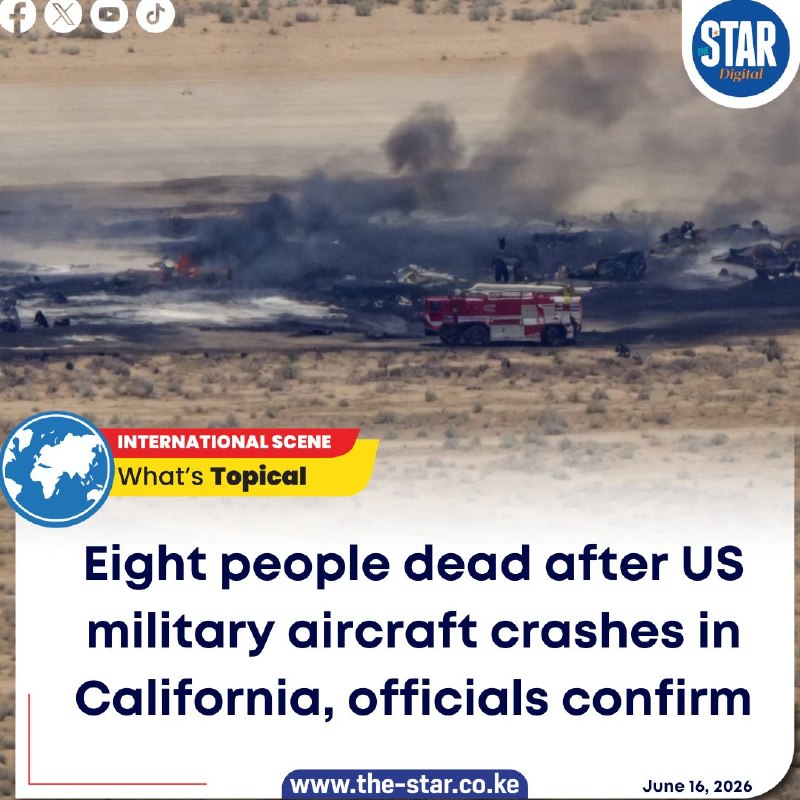
A US Air Force B-52 Stratofortress crashed shortly after takeoff from Edwards Air Force Base in Southern California during what officials described as a routine test mission on 16 June 2026, killing all eight people aboard. Initial reporting, carried by The Star Kenya from a US military statement, confirms eight fatalities and frames the loss as a total hull loss. The aircraft was operating out of Edwards — the Air Force's premier flight-test installation in the Mojave Desert — which places the sortie inside a community of test pilots, contractors and engineers who treat the line between routine and catastrophic as thinner than most.
Eight people, dead. An airframe older than most of the people flying it. And a mission that nobody outside the test community will be allowed to read about in detail for months.
The aircraft that doesn't retire
The B-52 is, in operational terms, an artefact. The airframe family first flew in 1952; newer airframes on the ramp are still 1960s builds, and the fleet has been repeatedly re-engined and re-avionics'd to keep it flying into the 2050s. That longevity is precisely the point. A B-52 carries the air-launched leg of US strategic nuclear deterrence, and the Pentagon has invested in keeping roughly 70-plus of them in service for another quarter-century rather than buying a clean-sheet replacement. A loss of one airframe is therefore not a rounding error in the inventory; it is a one-per-cent drawdown in a fleet that, by design, cannot grow fast.
The Star Kenya's wire carries the official confirmation of eight fatalities and the location. The X account @sprinterpress adds detail that is consistent with the wire but useful for the picture: the aircraft went down immediately after takeoff. "Immediately" is the word that matters in any post-takeoff investigation. It points at the takeoff phase — thrust, rotation, gear retraction, initial climb — when loss of an engine, a control surface, a flight-control sensor or a piece of flight-test instrumentation can convert a recoverable malfunction into a runway-area disaster in seconds.
What the wire is not telling us
The official framing is "routine test mission." That is a description of paperwork, not a description of risk. Edwards exists to push airframes to their limits; the fleet there includes a high fraction of aircraft on modification, test or evaluation status. A "routine" sortie from a flight-test base is not the same animal as a "routine" sortie from Minot or Barksdale. Until the Air Force releases the mishap board's findings — typically six to twelve months later for a Class A aviation accident — readers will not know whether this was a propulsion failure, a structural event, a software issue introduced by a recent avionics upgrade, or a crew-procedures question.
There is also the question of the airframe's modification state. The B-52 fleet has been in the middle of a long-running commercial-engine re-engining programme and a separate radar and avionics modernisation. Either programme introduces integration risk. The Air Force's own published statements on the re-Engining programme have acknowledged the schedule pressure of fitting new powerplants to airframes that predate the moon landing. The mishap board will look at the modification history of this specific jet. For now, that record is not public, and speculation about which upgrade touched this airframe last is exactly the kind of detail the wire will not volunteer.
A strategic-bomber crash, not just an aviation one
The B-52 is a nuclear-capable platform. Treat the language carefully: a test sortie carrying a test crew is not the same as an alert sortie with weapons. But the airframe is the same airframe the US would put on rotation if a nuclear tasking order ever came, and the public cannot fully separate the two conversations.
That is why a single hull loss triggers a different register of concern than, say, the loss of a transport aircraft. One fewer B-52 means a smaller margin in long-range strike planning. It means a tighter rotation for the crews who maintain nuclear certification. It means, in the budget conversation that quietly follows every mishap, an argument either for buying more capacity elsewhere or for accelerating the next-generation bomber programme already on the flight line in test status. The strategic balance that strategic bombers are meant to underwrite is a stock variable, not a flow variable; drawing down the stock is permanent until Congress funds replacements.
There is a second-order point that the wire will not make. The B-52 has been the visible symbol of US extended deterrence for so long that its symbolic stock has outrun its tactical utility in conventional scenarios. A crash at Edwards does not change that symbolism, but it does sharpen the question of whether a seventy-year-old airframe, however well maintained, is the right platform to underwrite the nuclear leg through the 2040s. Engineers will say yes; auditors will ask how much longer.
What we know, what we don't, and what to watch
The confirmed facts on 16 June: eight dead, a B-52, Edwards Air Force Base, Southern California, shortly after takeoff on a routine test mission. Every other element of the story — cause, modification state, the identity of the eight, whether this triggers a fleet-wide stand-down on similar configurations — sits inside a process that the US military will run behind closed doors for the rest of the year. The families will be notified first, then the names. The Air Force Safety Center will publish a redacted mishap report in due course. Congress will receive a classified briefing sooner. The public will get the thinnest possible version.
The thing to watch is the modification line. If the Air Force grounds a specific configuration of B-52 pending inspection, that will say more about cause than any initial statement will. Until then, the honest answer is: eight people went to work at one of the most demanding flight-test installations on Earth, and the aircraft they were in did not give them the time to do anything about it.
This publication treats the B-52 fleet as the strategic-asset ledger it is, not as a piece of aviation nostalgia. The crash at Edwards is both a human tragedy for eight families and a small subtraction from a stockpile that the United States, by policy, is not in a hurry to grow.
Wire provenance
This editorial synthesis draws on the following public wire/social posts:
- https://t.me/TheStarKenya/
- https://x.com/sprinterpress/status/2066769281753243648
- https://x.com/sprinterpress/status/2066771221161672704