Eight dead: what a B-52 crash at Edwards tells us about an aging nuclear triad
All eight crew members perished when a B-52 Stratofortress crashed on takeoff at Edwards Air Force Base on 15 June 2026, reviving a long-running argument about the cost of flying 1960s airframes into a multipolar 2030s.
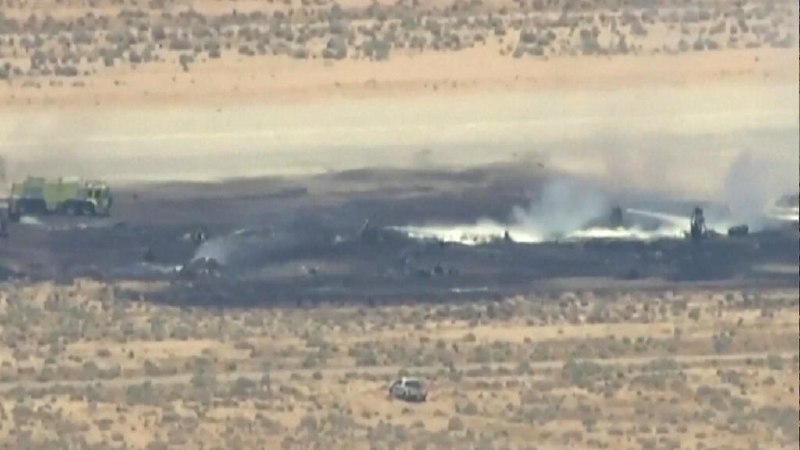
A US Air Force B-52 Stratofortress crashed and burned shortly after takeoff from Edwards Air Force Base in Southern California's Mojave Desert on 15 June 2026, killing all eight service members aboard in what the Air Force described as a non-survivable accident. Reuters and CGTN both reported the loss of the aircraft and the crew within hours of the incident; France 24's English and French services confirmed the eight-fatality toll; Iran's PressTV carried footage of thick black smoke rising over the base, a reminder that even closed military accidents now circulate globally before investigators have reached the wreckage.
The crash is the deadliest US bomber accident in years and the most public since a B-1B went down at Ellsworth in 2024. Beyond the loss of life, it is also a stress test of a different kind: a 1960s-era airframe, crewed by airmen who joined the service when the aircraft was already a museum piece elsewhere, is the same airframe the United States plans to keep flying into the 2050s.
The accident as the Air Force reported it
According to Reuters, the B-52 crashed on takeoff at Edwards Air Force Base, bursting into flames on the runway. The Air Force confirmed there were no survivors among the eight crew members aboard. CGTN cited the Air Force's determination that the crash was "not survivable"; France 24's English service put the death toll at eight, and its French edition matched the figure of "at least eight presumed dead." The base is the Air Force's premier flight-test installation in the Mojave Desert, a stretch of Southern California that has hosted nearly every major US military aviation programme since Chuck Yeager broke the sound barrier there in 1947.
The B-52 is a heavy, swept-wing bomber designed for high-altitude nuclear strike. The eight-seat crew configuration reported by Reuters — a mix of military personnel, according to France 24's English write-up — is consistent with the standard Stratofortress crew complement used on training and test sorties. Edwards is unusual only in being the place such flights are routinely taken, not in hosting bombers at all: the 412th Test Wing and the Air Force Test Center operate a string of B-52 test programmes out of the base, including engine and avionics work intended to keep the jet viable for decades.
The Air Force has not, in the reporting available on 16 June 2026, named the eight service members or released a unit designation. That is normal in the first 24 to 48 hours after a fatal military aviation accident. What is unusual is the speed with which the visual record of the crash has been distributed: PressTV's footage of the smoke column over the base reached Telegram channels within hours, and the same imagery was picked up by other aggregators, including the CGTN wire. The result is that the public has now seen the visual residue of the accident before the safety investigation board has reached the site.
Why an aging fleet is not a metaphor
The B-52 first flew in 1952. The youngest airframes still in service were delivered in the early 1960s. The US Air Force has, in successive budget submissions, told Congress that the bomber is to remain in service through 2050 and beyond — a runway that, if achieved, would give some individual airframes nearly a century of operational life. That is not a rhetorical flourish: it is a line item in long-range force-structure planning documents. The aircraft have been re-engined, re-avionicked and re-winged more than once, but the airframes themselves are pre-Vietnam.
The structural point is straightforward. A bomber fleet that must remain combat-coded for another quarter-century is a fleet that is being asked to operate on infrastructure — hangars, training pipelines, spare-parts supply chains, instructor pilots — that has to remain funded across multiple budget cycles and several changes of administration. When an aircraft crashes at a test base, the question is rarely only mechanical. It is also whether the broader system of maintenance, crew currency, and engineering judgement that keeps a 60-year-old jet airborne is being asked to absorb cuts it cannot easily absorb.
The reporting on 16 June 2026 does not establish a cause. Reuters' filing is descriptive. CGTN's note that the crash was "not survivable" is a clinical term of art, not a finding on origin. France 24 frames the accident as a takeoff event. Any pilot will recognise that takeoff is the phase of flight in which a heavy, four-engine jet is most exposed: high power setting, low altitude, low margin for recovery from a system failure. But whether the underlying cause sits in the airframe, the powerplants, the maintenance pipeline, or the crew's training hours is precisely the work the safety investigation board has yet to do.
The nuclear-deterrence backdrop
A B-52 on a test sortie at Edwards is not, on the face of it, a strategic weapon. It is an aircraft. But the airframe is one of three legs of the US strategic bomber force, and the strategic bomber force is one of three legs of the US nuclear triad. A B-52 can carry air-launched cruise missiles and, in the nuclear role, gravity bombs. The decision to keep the type in service through 2050 is not a museum decision; it is a deterrence decision.
This matters because the environment the bomber is meant to deter has changed materially in the last decade. Russia retains the largest deployed nuclear arsenal outside the United States and is modernising its delivery systems, including long-range cruise missiles and a refurbished heavy bomber fleet. China is expanding its own nuclear posture, including a growing air-launched component, and the Pentagon's most recent annual China military power report has tracked that expansion. North Korea's missile tests continue. Iran's missile and drone reach has extended, with the most recent exchanges between Israel and Iran — June 2025, October 2024, and the broader escalation arc around them — underlining that air-launched standoff weapons are not a Cold War artefact.
In that context, a delay in the B-52's replacement programme is not free. The Air Force's proposed successor — the B-21 Raider — is in flight test and on contract, but a fleet of "at least 100" aircraft, as currently planned, will not replace a fleet of 76 (and shrinking) B-52s on a one-for-one basis. The two will overlap for years. During that overlap, every B-52 lost to a crash is one fewer airframe available to be re-winged, re-engined, and kept combat-coded.
The reporting that is missing — and the press that carried it
There is, as of the morning of 16 June 2026, no official name list for the eight service members. There is no unit assignment. There is no preliminary accident classification. The Air Force will stand up a formal accident investigation board, which will produce a publicly released report in due course; that is the standard process. The reporting on 16 June 2026 is a wire snapshot, not a record.
The sources that carried the news on 16 June 2026 are themselves worth noting. The two Reuters and CGTN filings on X carried the same core facts — B-52, Edwards, takeoff, eight crew, no survivors — within roughly an hour of each other, with CGTN adding the explicit "not survivable" framing. France 24's English and French services both ran the story, drawing from the same wire inputs. PressTV, the Iranian state broadcaster, carried footage of the smoke column and framed the crash as evidence of US military vulnerability — a frame that the underlying facts do not support and that the Iran International editorial line would, predictably, reject. A reader scanning the wires on 16 June 2026 can see the news cycle working in real time: the same accident, the same eight names yet to be released, the same footage, refracted through different editorial house styles.
What the wires did not do, and what is worth saying out loud, is place the crash in any larger narrative. The Reuters and CGTN filings are descriptive. The France 24 pieces are short and largely reportorial. PressTV's frame is openly adversarial. The structural question — what it means to lose a B-52 in 2026 to an accident at the test base, and what the loss tells us about a fleet the US intends to fly into the 2050s — is one this publication will sit with over the coming days as the official record fills in.
Stakes: a fleet, a workforce, a window
Three stakes are worth naming, all of them grounded in facts already on the public record on 16 June 2026.
The first is the airframe itself. A B-52 lost at Edwards is a B-52 that is not available to be re-winged and re-engined and returned to the combat-coded fleet. The Air Force's plan to keep the bomber in service through 2050 assumes that the airframes that exist now are the airframes that will exist then. Every unrecoverable loss tightens that margin.
The second is the workforce. Eight service members died at a US Air Force base in the United States. The families and units involved are now part of the standing human cost of a bomber programme that has not been formally justified on a fresh basis in years. The Air Force's aviator community is smaller than it was a decade ago, and training pipelines for heavy-bomber aircrew are not elastic. Eight losses on a single sortie compress a generation of experience.
The third is the window. The B-21 is in flight test. The LRSO (Long-Range Standoff) cruise missile is in development. The Sentinel intercontinental ballistic missile programme has been re-baselined. The ground leg of the triad is being rebuilt. The B-52 is the leg that is not being rebuilt; it is being kept flying. If 2026 is the year in which the airframes begin to fail in ways the budget did not anticipate, the strategic bomber leg of the triad is the leg that bends first.
None of this is to predetermine the cause of the Edwards accident. The investigation board's work will determine that, on its own timeline. It is, however, to note that a B-52 loss in 2026 sits inside a set of decisions that have been on the public record for years. The aircraft is old. The plan is to keep it old. The plan is, in this respect, not a plan to be relieved until the B-21 fleet is large enough to absorb the role. The crash at Edwards is a reminder that the relief is still years away.
What we do not yet know
A short, honest ledger of what the public record on 16 June 2026 does not contain. The names of the eight service members. The unit to which they were assigned. The maintenance and training history of the airframe in the days and weeks before the crash. The runway configuration, weather, and weight-and-balance profile of the sortie. The output of the cockpit voice recorder and flight data recorder, if they were recovered. The position of the throttles, the engines, and the flight controls at the moment of the accident. The classification of the accident under the Air Force's standard taxonomy. Whether the sortie was a test event, a training event, or an operational re-deployment. And, finally, the public release of the formal accident investigation report, which under standard procedure is the document that will, in time, tell the story the wires cannot.
Until that report is published, the editorial position this publication takes is the same position Reuters took in its first filing on the night of 15 June 2026: the crash happened, all eight aboard are dead, the cause is to be determined. Everything else is structure, and structure is what the news is for.
— A Monexus long read. This article will be updated as the Air Force releases the names of the eight service members and as the formal accident investigation produces a public report.
Wire provenance
This editorial synthesis draws on the following public wire/social posts:
- https://x.com/CGTNOfficial/status/
- https://t.me/PressTV/
- https://t.me/france24_en/
- https://t.me/france24_fr/
- https://x.com/Reuters/status/