FIFA's flag, Iran's grief: how a stadium stunt reopens the country's deepest wound
Iranian fans at the Iran–New Zealand World Cup match in Los Angeles stitched the pre-revolutionary flag back together in the stands. FIFA is calling it a protest; the regime is calling it a crime.
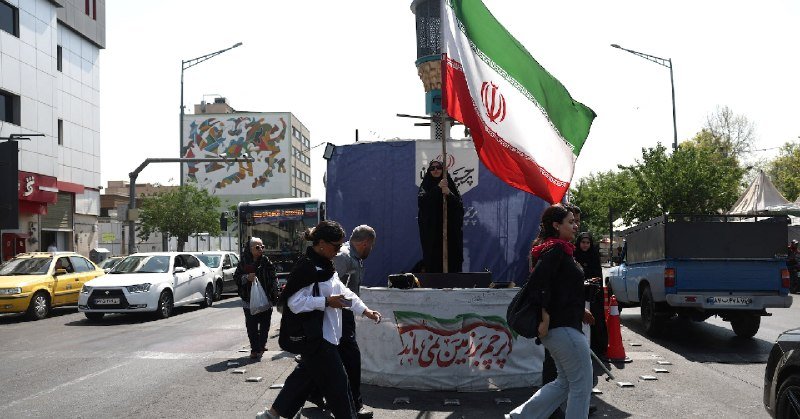
At SoFi Stadium in Los Angeles, in the early hours of 16 June 2026 UTC, a 1–1 draw between Iran and New Zealand became the smallest kind of newsroom. Inside the ground, supporters carried separate panels of the pre-revolutionary Iranian tricolour past security, sewed them together in the stands, and raised a finished flag. Outside, a crowd of protesters did the same. The flag in question is the one the Islamic Republic has spent four decades trying to retire from memory: the Lion and Sun on a striped field, the banner under the Pahlavis, the banner that went on being waved after September 2022.
For FIFA, this is a stadium-discipline problem. For the Iranian state, it is something worse. The match, the stitched flag, the chants, and the FIFA inquiry that will follow all sit inside a single, unfinished argument that began with the death of Mahsa Amini in the custody of the morality police in September 2022 and has not stopped since. Sport, in other words, has done what sport so often does: it has dragged a political argument into a venue that markets itself as apolitical, and forced everyone inside the venue to take a position on it.
What actually happened on the night
The 90 minutes themselves were secondary. Elijah put New Zealand ahead in the first half; Ramin Rezaeian equalised for Iran in the 32nd minute, the match finishing 1–1. The football was a backdrop to a choreography the Iranian diaspora and the domestic opposition have been rehearsing for almost four years. Supporters inside the stadium and on the approaches to it waved the Lion and Sun flag — the imperial-era tricolour with the sword-bearing lion at its centre — and at least three such flags were visible in the lower tiers of SoFi Stadium, close enough to broadcast cameras to be legible. The thread of Telegram posts that documented the evening, mostly from the BellumActaNews channel, captured both the act and the complaint that will follow it: that FIFA had moved to suppress the flag inside the venue, and that fans responded by concealing pieces of it and reassembling it once seated.
That is the story's news value. It is not the result. It is the fact that a global governing body, on the biggest stage in its sport, attempted to police a symbol that an entire national opposition treats as a proxy for the state they want, and that the policing failed in real time.
The flag, and what it carries
The Lion and Sun is not a fringe symbol. It was the state flag of Iran from 1846 to 1979, with a brief interregnum under the Republic of Mahabad. After the revolution, the Islamic Republic replaced it with a tricolour bearing the Allah-o-Akbar inscription; the older flag migrated into exile, into the diaspora's living rooms, and into the visual grammar of every wave of protest since 2009. It is the flag that Crown Prince Reza Pahlavi and the monarchist opposition use. It is also the flag that, during the 2022 protests, was raised from rooftops in Tehran, Shiraz, and the Kurdish cities of the north-west, and that the security forces have explicitly criminalised. Displaying it inside Iran can draw arrest under the same statutes used to prosecute hijab violations and "propaganda against the system."
FIFA's position, articulated through its stadium regulations and competition bylaws, is that national symbols of recognised states are the only flags permitted in football venues. The Lion and Sun is not the flag of a FIFA member association. The Football Federation Islamic Republic of Iran plays under the post-1979 tricolour; therefore, in FIFA's reading, only that flag is admissible in the stands. This is administratively tidy. It is also politically untenable: a body that earns billions from a global audience, an audience a large share of which is watching specifically to see what those stands look like, has chosen to enforce a national-association rule in a way that aligns it, wittingly or not, with the visual preferences of one of the world's more repressive governments.
The diaspora's read, and the regime's read
Two interpretations of the same footage are now in circulation, and they do not meet in the middle.
The diaspora reading, which the in-stadium organisers and the protesters outside articulated on the night, is straightforward: the flag is a memorial to people killed in the 2022 uprising — including, by the diaspora's count, hundreds killed by security forces in Mahsa Amini's wake — and FIFA's attempted ban is a sanitisation of that grief. The stitching of separate panels, the deliberate concealment, and the speed with which the finished flag was raised are presented as evidence that the diaspora believes the international institutions that govern world sport are, at best, indifferent to Iranian civilian death.
The regime's reading, which state-aligned outlets will produce in the coming days, is the inverse: that the Lion and Sun is a "terrorist" symbol associated with the Pahlavi restoration, that the diaspora is weaponising the World Cup to advance regime change, and that FIFA's rules — whatever the federation's actual motive — produced the right outcome. The state will not call the flag a national symbol. It will call it a sedition.
The honest position sits between, or rather outside, both. FIFA is enforcing a rule designed to prevent racist banners and political messages; it is not, on the available evidence, conducting Iranian foreign policy. But the rule, in this case, has a political effect indistinguishable from censorship, because the only flag that FIFA will permit inside its stadiums is the one the opposition is forbidden to display inside Iran. That is not a coincidence. It is the structural condition of staging an authoritarian state's national-team fixtures on a global stage.
What this opens up
The 2026 World Cup is forty-eight matches old, and already the political economy of the tournament is being written. The next forty will be watched, in Iran, in the diaspora, and in human-rights offices from Geneva to New York, for two things in particular: whether FIFA reverts to its usual practice of waving through political messages it does not like when those messages happen to embarrass a powerful member association, and whether the Football Federation Islamic Republic of Iran, the member association in question, is sanctioned, fined, or quietly tolerated.
The larger pattern is the one sport has been walking into for at least a decade: the realisation that major tournaments are not held in the political world; they are the political world, wearing a kit. The choice facing FIFA is no longer whether to engage Iranian domestic politics — it made that choice the moment it accepted the federation as a member in 1945 and then again in 1979. The choice is whether to enforce its own rules symmetrically, or only when the rule's enforcement is politically cheap. So far, the answer is the cheap option.
Iran's fans stitched the flag together anyway. That is the line the rest of this tournament will be written against.
This article documents the events of 15–16 June 2026 UTC at SoFi Stadium and the immediate protest reaction. The sources cited are a single Telegram channel's running thread; the underlying claims about the flag's prohibition, the symbolism of the Lion and Sun, and the political backdrop of the 2022 protests are well-established and have been reported on extensively elsewhere. Monexus flags that the diaspora's casualty figures and FIFA's eventual ruling remain unverified at the time of publication.
Wire provenance
This editorial synthesis draws on the following public wire/social posts:
- https://t.me/BellumActaNews