The Minab school strike and Iran's football pitch: how a deal that promises peace still leaves a city counting its dead
A US-Iran deal drafted to end a war still has to account, on live television, for the children of Minab. Iranian fans carried their answer onto the pitch before kick-off.
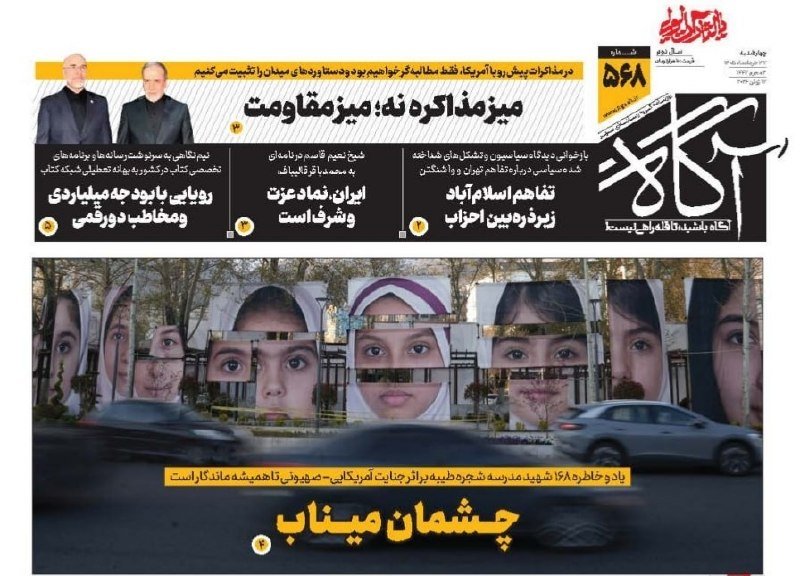
A US-Iran deal, negotiated to end a war whose shape the world is still being told about in fragments, is supposed to land as a piece of paper with consequences. The version reported by Reuters on 16 June 2026 at 06:40 UTC promises an end to the conflict. It does not, as of that timestamp, explain how the ending works: who disarms first, who inspects what, what happens to the stockpile that built the crisis in the first place. The agreement is, for the moment, a headline without an operating manual. The headline arrived in a region where, in the same news cycle, a football match between Iran and Australia was about to be played in front of cameras, and where supporters chose the first minute of that broadcast to remind an international audience of a place the deal's text does not name: Minab, a city in Hormozgan Province on Iran's southern coast, where 168 people — the figure carried on banners and repeated by Iranian state media on 16 June — were killed in a strike the Iranian government attributes to the United States.
What is now in play is a contradiction the diplomatic language is not built to absorb. A peace deal is meant to retire grievances, or at least to push them off-stage. The Iran-Australia fixture on 16 June, by contrast, brought one specific grievance — civilian death in a named town — back into the frame, with a number attached and a banner held up for the broadcast camera. The two facts are not separate stories. They are the same story told from two registers: the diplomatic one, where language is calibrated to permit signatures, and the public one, where language is calibrated to keep the dead present.
What the deal reportedly says, and what it does not
According to the Reuters dispatch dated 16 June 2026 at 06:40 UTC, the framework Washington and Tehran have reached is built around the standard architecture of such agreements: an end to hostilities in exchange for verifiable constraints on the nuclear programme and some mechanism for sanctions relief. The reporting is explicit that "how it will work remains unclear." That phrasing matters. It means the verifiable constraints — enrichment caps, inspection regime, timeline for stock-drawdown, sequencing of sanctions unwinding — have not been made public in a form that analysts can interrogate. The deal, in other words, is being sold to two domestic audiences (a US administration that wants an off-ramp from a costly war, and an Iranian establishment that wants sanctions relief) before its technical content has been audited by the people who would have to live with its terms.
The absence of a public operating manual is the familiar shape of a diplomatic product in the final stretch. It is also the familiar shape of a deal that can collapse the first time a hard question is put to it. The Reuters framing — "promises end to war but how it will work remains unclear" — is the wire's way of saying the same thing without taking a side.
Minab, the figure of 168, and what gets carried onto a football pitch
The second input into this story is not diplomatic at all. According to Middle East Eye, reporting on 16 June 2026 at 06:13 UTC, Iran supporters in the stadium during the Iran-Australia match held up a banner honouring children killed in a US strike on a school in Minab. The Telegram channel @myLordBebo, posting at 06:02 UTC the same day, gives the specific figure: 168 victims, attributed to a US strike on a school in the city, with supporters chanting "Iran, Iran" and the match ending in a 2-2 draw.
Those two pieces of information — a banner in a stadium, and a number — do something the cable-news summaries of the deal will not. They make the cost of the war a specific weight in a specific town. Minab is not a strategic abstraction; it is a place on the map of Hormozgan Province, on the coast near the Strait of Hormuz, a region whose geography has been treated as a strategic asset by every external power that has operated in the Persian Gulf for a century. The number 168, on the banner and in the Telegram post, is presented by Iranian state media and Iranian-aligned channels as a fact. The US side has, in the reporting available on 16 June 2026, not publicly disputed the strike on the school in those terms. The wire coverage, in other words, has not yet caught up to a question that supporters in the stadium have already put to the cameras: if the war is ending, what is being done about what the war did?
The football-fan angle is not a footnote. It is the part of the story that the diplomatic transcript cannot absorb, because the diplomatic transcript is written in the language of mutual de-escalation, and the banner is written in the language of named children in a named school. Iranian state-aligned social channels have, since at least 06:02 UTC on 16 June, been treating the banner as a piece of soft pressure aimed at the negotiations: a reminder, in front of an Australian opponent and a global broadcast audience, that the public memory of the war is not transferable to the foreign-policy ministries of either capital.
The counter-narrative the wires have not yet carried
The structural pattern here is well-rehearsed. A war is wound down, a deal is announced, and the deal's text is treated as the end of the story, while the communities that absorbed the war's specific costs — in this case, the families of the children reported killed in the Minab strike — are left to negotiate a separate settlement through memory, mourning, and visibility. The Western wire line tends to treat the deal itself as the news. The Iranian-aligned coverage treats the dead of Minab as the news, and the deal as an attempt to move past them.
Monexus finds that neither framing stands on its own. The Reuters line, taken alone, understates the political weight of a population that has been shown, on live broadcast, that it can still reach the cameras. The Iranian-aligned framing, taken alone, treats the deal as if it were a unilateral concession rather than a document signed by two governments under mutual pressure. The truthful version is the conjunction: a deal that has to be implemented by a public that has been given a specific reason, in a specific town, to test every clause of it.
What the trajectory looks like from here
If the deal holds in its announced form, the verifiable constraints will eventually be published, the inspection regime will either function or it will not, and the question of Minab will move from the stadium to a separate channel — reparations, an acknowledgement, an exchange of names, or a silence that will itself become a story. The Iranian government has an interest in keeping the 168 visible: the number is leverage in any subsequent negotiation over sanctions sequencing, and a public reminder of cost strengthens the hand of the faction that argues for a tightly conditional deal. The US side has an interest in letting the figure fade: a deal that is presented as ending a war is harder to sell if the war's most specific casualty event is being rebroadcast on every international sports feed.
The audience for the 16 June match — the broadcast camera, the wire photographers, the social channels that picked up the banner in the first minutes of play — is also an actor in this. They are the mechanism by which a piece of grief, in a city most international readers will need to look up, gets translated into a frame that a deal's drafters cannot quietly leave out of the negotiating record. The 168 are not a rhetorical device in the Iranian-fan banner; they are a constituency that the deal will, one way or another, have to address — by acknowledgement, by compensation, or by the kind of studied non-mention that itself becomes a story the next time a stadium camera is pointed at an Iranian crowd.
The honest reading, on the evidence available at 06:40 UTC on 16 June 2026, is that the deal and the banner are running on parallel tracks. One is being drafted in the language of state-to-state negotiation. The other is being drafted in the language of a city that lost a school. The next phase of the story is which language, in the end, sets the terms.
This publication framed the US-Iran deal alongside the Minab banner because, on the source material available at 06:40 UTC on 16 June 2026, the two belong in the same sentence. The wires lead with the framework; the stadium is keeping the receipt.
Sources
Reuters — US-Iran deal promises end to war but how it will work remains unclear (16 June 2026, 06:40 UTC): http://reut.rs/4vc88Qe
Middle East Eye — Iran football fans display banner honouring children killed in US strike in Minab (16 June 2026, 06:13 UTC): https://www.middleeasteye.net
Telegram, @myLordBebo — Iran fans display banner, Minab school strike, 168 victims (16 June 2026, 06:02 UTC): https://t.me/myLordBebo
Hero image (Telegram-sourced, Middle East Eye wire photo of Iran–Australia supporters, 16 June 2026): http://nitter.perennialte.ch/pic/media%2FHK6gu8OXMAAVdp-.jpg
Wire provenance
This editorial synthesis draws on the following public wire/social posts:
- http://reut.rs/4vc88Qe
- https://t.me/myLordBebo
Follow the event.
These dated source records provide context. They do not retrospectively verify this archive article.
Separate what the nuclear watchdog reported from what it could not determine after the June 2025 strikes.