Iran's team lands in Los Angeles with a diplomatic backdrop heavier than the fixture
Iran's national side walked out at SoFi Stadium in Los Angeles for a friendly against New Zealand, the kind of match that normally draws little notice — except that nothing involving Iran on American soil in 2026 is just a match.
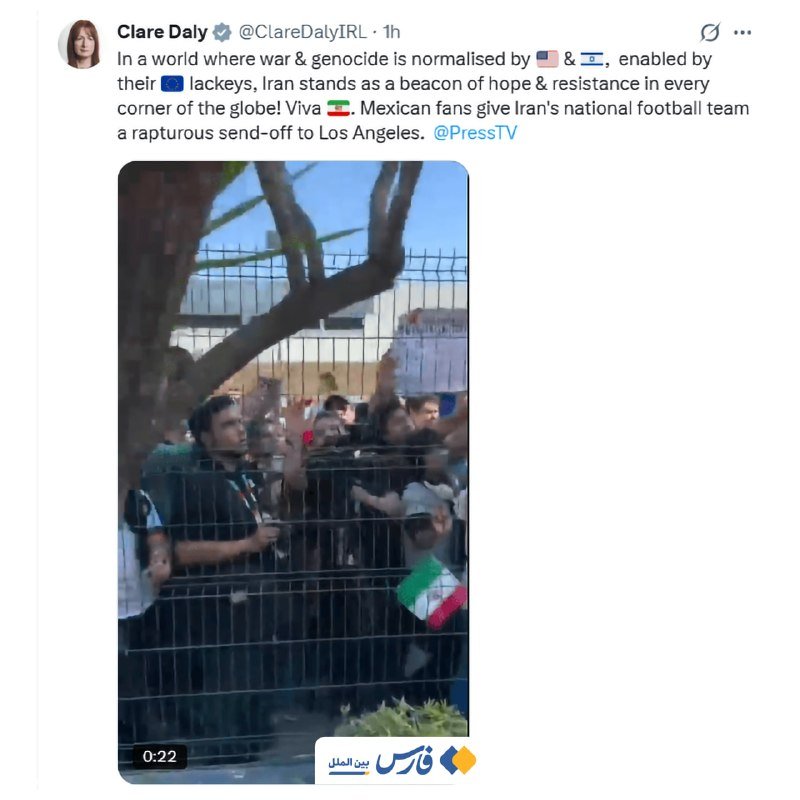
Iran's national football team stepped out at SoFi Stadium in Los Angeles in the early hours of 16 June 2026 to face New Zealand, a fixture that, on any ordinary international window, would have been treated as a routine friendly — a late-cycle tune-up before autumn qualifiers. On this occasion, the staging was a small act of choreography in its own right. Footage published by Fars showed the squad boarding the team bus for the stadium at 23:30 UTC on 15 June, with the lineups confirmed shortly after by the Fars-affiliated Sport Fars account. By 00:21 UTC on 16 June, Mehr News was posting warm-up clips from inside the ground.
The match itself is a footnote. What it sits inside is not. A senior Iranian delegation arriving on American soil, even for a sporting fixture, in the middle of an unresolved nuclear file and amid an active war in which Tehran-backed actors are engaged, is the kind of soft-foreign-policy moment that reads differently depending on the wire you trust. Fars, Tasnim and Mehr — the three Iranian state-adjacent outlets covering the trip — frame it as ordinary diplomacy, the sports-federation equivalent of a handshake. Western coverage of any Iranian arrival in the United States in mid-2026 tends to invert the frame, treating the event as a probe of intentions, a test of visa leniency, a courtesy extended by Washington that carries a price. The honest read is somewhere less theatrical, and more interesting.
A friendly with a security perimeter
SoFi is not a neutral venue. It sits in Inglewood, a few miles from Los Angeles International, and has hosted World Cup matches, NFL fixtures and the 2022 Super Bowl. Putting Iran there means American federal, state and local agencies coordinating on a security footprint for a delegation from a country the United States has sanctioned comprehensively, in a year when the relationship is being recalibrated under the shadow of an unresolved nuclear file. The Iranian state press covered the moment in the register of any away-day sports bulletin: lineups at 23:33 and 23:48 UTC, the bus leaving the hotel, the warm-ups. That register is itself a framing choice — a determination to treat the fixture as a sporting event rather than a geopolitical event wearing sporting clothing.
New Zealand's Football Ferns — the senior men's side, in this case — accept the fixture for the sporting logic of it: a trans-Pacific opponent, a stadium date, revenue. The All Whites' own federation has, in recent windows, shown a willingness to play a wide range of opponents, and a June friendly against Iran fits that pattern. Neither federation is the actor driving the politics. The political weight is imported by the venue, the year and the visitor's flag.
The counter-read on the Western side
On the Western side, the framing is more cautious. Any Iranian delegation on US soil is read as either (a) a confidence-building gesture by Tehran that the diplomatic track is alive, or (b) a courtesy by Washington designed to lower the temperature in a year that has already seen direct exchanges between the two militaries in the Gulf. Both readings treat the event as a signal. The Iranian coverage treats the event as an event. The interpretive gap is the story.
That gap is widening rather than narrowing. The Iranian outlets carrying the warm-up footage — Fars and Tasnim in particular — have spent 2026 covering negotiations, sanctions pressure and the regional security environment in terms that frame Iran as a sovereign actor managing a portfolio of conflicts on its own terms. The American and European wire coverage of the same period tends to read Iranian moves through the prism of US-led pressure, as if Tehran's choices were reactive rather than strategic. The friendly at SoFi is too small an event to settle that argument, but it is, in miniature, the same argument.
The structural frame in plain language
What is being staged in Los Angeles in the early hours of 16 June is a soft-instrument version of a much larger contest. The dollar architecture, the sanctions list, the visa regime and the broadcasting rights for international football are all part of the same lattice. When an Iranian team lands in the United States and plays a match that is streamed back into Iranian living rooms, several of those instruments are relaxed for a 90-minute window. Tehran is, in effect, auditing the lattice — testing which permissions hold and which bend, and which wires in the Western press treat the test as news and which treat it as a fixture list.
This is what an older vocabulary called soft power; the more useful way to describe it is as the soft edge of structural power. The decision to issue the visas, to stage the game, to allow the broadcast back, is a sequence of small choices that collectively shape the diplomatic weather. Iran's interest in a friendly on American soil in mid-2026 is, in part, an interest in those small choices. Washington's interest is, in part, an interest in not appearing to escalate. New Zealand's interest is in a pay-day and a fixture. Each side is acting rationally inside its own incentive structure. The mistake is to read any one of those incentive structures as the whole story.
Stakes, and what the wires disagree about
The immediate stakes are low. No policy decision turns on the result. The medium-term stakes are higher. The fixture is being read, in real time, by audiences in Tehran, Washington, Wellington and the Gulf as a small data point in a larger negotiation. Iranian state media will report the result in the language of national dignity. The Western wires will, in all likelihood, report it in the language of diplomatic signal. The result itself will be a number in a column; the framing will be the news.
What remains genuinely uncertain is whether the fixture has any effect at all on the diplomatic file behind it. The sources do not specify any linkage between the match and a specific negotiating track, and the Iranian coverage presents the game as a standalone sporting event on the federation's calendar. The Western press has not, on the basis of the materials available to this publication, formally linked the fixture to a particular policy outcome. The relationship between the event and the diplomacy is therefore correlation rather than causation — a soft signal, not a hard move. Readers should hold that distinction clearly: a friendly is a friendly is a friendly, until the wires around it say otherwise, and right now the wires are saying different things.
This publication framed the fixture as a small window into a much larger diplomatic lattice, not as a standalone sports story. The Iranian state press treated it as routine; the Western wires will, on past form, treat it as a signal. Monexus's read is that the framing gap is itself the most useful place for a reader to start.
Wire provenance
This editorial synthesis draws on the following public wire/social posts:
- https://t.me/mehrnews
- https://t.me/farsna
- https://t.me/farsna
- https://t.me/farsna
- https://t.me/farsna
- https://t.me/tasnimnews_en