Iraq's World Cup qualification arrives freighted with a generation's grief
A side coached by the son of a man killed by Al Qaeda has reached the 2026 World Cup. The story is bigger than the standings.
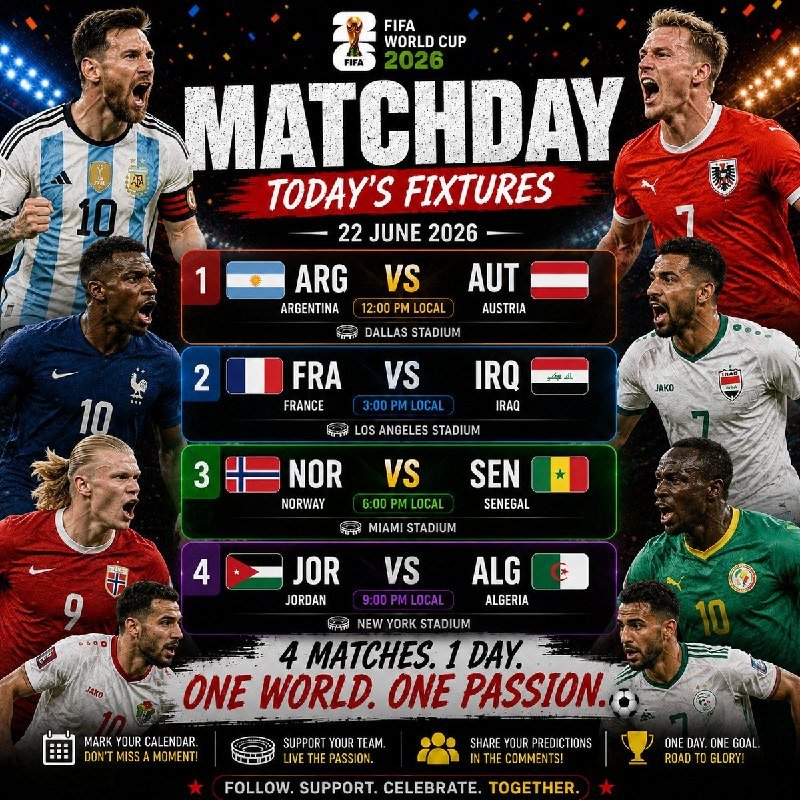
Iraq will be at the 2026 FIFA World Cup. The qualification was sealed on 16 June 2026 in the manner the country has come to expect from its football team: against a backdrop that has almost nothing to do with football. According to reporting carried by The Indian Express, the man who guided Iraq to North America is the son of a father killed by Al Qaeda and the brother of a player who disappeared in circumstances the family has never fully been able to narrate. The result is a national-team story that doubles as a document of what the last quarter-century has done to Iraqi public life.
That Iraq's appearance at a World Cup is treated as news at all tells you something about the depth of the country's footballing dislocation. Iraq's only previous trip to the finals came in 1986, a generation ago, when the side still travelled under a flag that would soon be contested by two wars, a sanctions regime, an occupation, and a sectarian insurgency. Reaching the United States, Canada and Mexico next summer is, on the touchline, a coaching achievement. Off it, it is also a small argument that the institutions of Iraqi football have, against the odds, held.
A qualification earned in a different kind of tournament
The details that matter are biographical, not tactical. The Indian Express's profile centres on a head coach whose family has been shaped by the violence that ran through Iraq from 2003 onwards. His father was killed by Al Qaeda. A brother who played the game at a high level vanished — the word the family uses, the paper notes, rather than "was killed" — and has not returned. The coach himself continued. The qualifier against a continental opponent delivered the result; the years of context had been accumulating for two decades.
Football in the Gulf has always carried a heavier political load than in most federations. Iraq's 2007 Asian Cup, won in Jakarta amid a wave of optimism about a country that was, even then, sliding back into bloodshed, remains the reference point for what the team means to supporters. The current cycle has been quieter in tone and more efficient in execution. The qualification, secured on 16 June 2026, closes a long campaign and opens a different one: a finals at which Iraq will, for the first time in forty years, be present as a member of the expanded 48-team field.
The sport-politics line that runs through Iraqi football
It would be glib to read the result as a clean piece of redemption. Iraq's football federation has spent much of the post-2003 period navigating the same pressures that have shaped every other Iraqi institution: factional politics, the long shadow of the Iran–Saudi rivalry, the financial dependence on a federation budget that has had to be renegotiated with each change of minister. The squad that has just qualified is drawn from a generation of players who came through academies built during the period when the country was hosting — and losing — major international tournaments. That they are competitive at all is the story.
The counter-narrative, and it is a serious one, is that success on the pitch has often functioned as a permission slip for failure off it. The 2007 Asian Cup did not stop the second half of the country's civil war. A World Cup place in 2026 will not, on its own, settle the question of whether Iraqi football's developmental pipeline — the youth setups, the diaspora-recruitment policies, the federation's relationship with clubs in Erbil and Basra — can sustain this level across a four-year cycle. Supporters are entitled to enjoy the moment. They are also entitled to ask what comes after the parade.
What a World Cup appearance actually delivers
The practical stakes are not abstract. A 48-team tournament, hosted across three North American countries, generates a different economics than the 32-team model Iraq last qualified under. FIFA's expanded prize-money pool, broadcast allocations, and federation development grants all scale with participation. For a federation that has had to do more with less for most of the last twenty years, the windfall is meaningful. There is also the visibility effect: Iraqi players on a World Cup pitch, in front of an audience that does not otherwise follow the Asian qualifying rounds, become assets in a transfer market that has, in recent windows, moved more Iraqi players into European leagues than at any point in the federation's history.
The structural point is that global football's centre of gravity continues to drift. The 2026 tournament is the first hosted across three sovereign jurisdictions, the first to use the 48-team format, and the first in which the Gulf's footballing federations will be represented at scale. Saudi Arabia has already qualified. Iran is well placed. Iraq's place among them matters less for the bracket than for the signal: a region that has been written off, repeatedly, as unable to produce competitive senior sides outside of its club competitions, will arrive in numbers.
What remains uncertain
The Indian Express profile is a human-interest frame on a result; it does not specify the date of the decisive match, the scoreline, or the opponent, and the wider wire has not, as of 16 June 2026, picked the qualification up at the granularity that would let a reader reconstruct the final round of fixtures. The reporting also does not detail the federation's longer-term plan for the coach whose family story it foregrounds, or address how the squad is expected to approach a group-stage draw that will, in all probability, place Iraq against a side drawn from the stronger end of the confederation pairings. Those are the questions the next reporting cycle will have to answer.
What is not in doubt is that the qualification has been received, in Iraq, as a national event rather than a sporting one. The flags, the car horns, the television studio breakdowns — they are the same rituals that greeted the 2007 Asian Cup, and they are the rituals a country reaches for when other forms of national expression have been constrained. A World Cup ticket is not a peace dividend. It is, at most, an evening off.
— This article was framed by Monexus as a sport-politics story rather than a results line, on the view that the family biography at its centre is the news, and that the result itself is the receipt.
Wire provenance
This editorial synthesis draws on the following public wire/social posts:
- https://en.wikipedia.org/wiki/Iraq_national_football_team
- https://en.wikipedia.org/wiki/2026_FIFA_World_Cup_qualification_(AFC)