The Los Angeles Stadium, the Chants, and the Reach of State Media
A World Cup warm-up in LA became a backdrop for chants of “Iran, Iran” — and Iranian state-aligned outlets were on hand to package the moment. The pattern is the story.
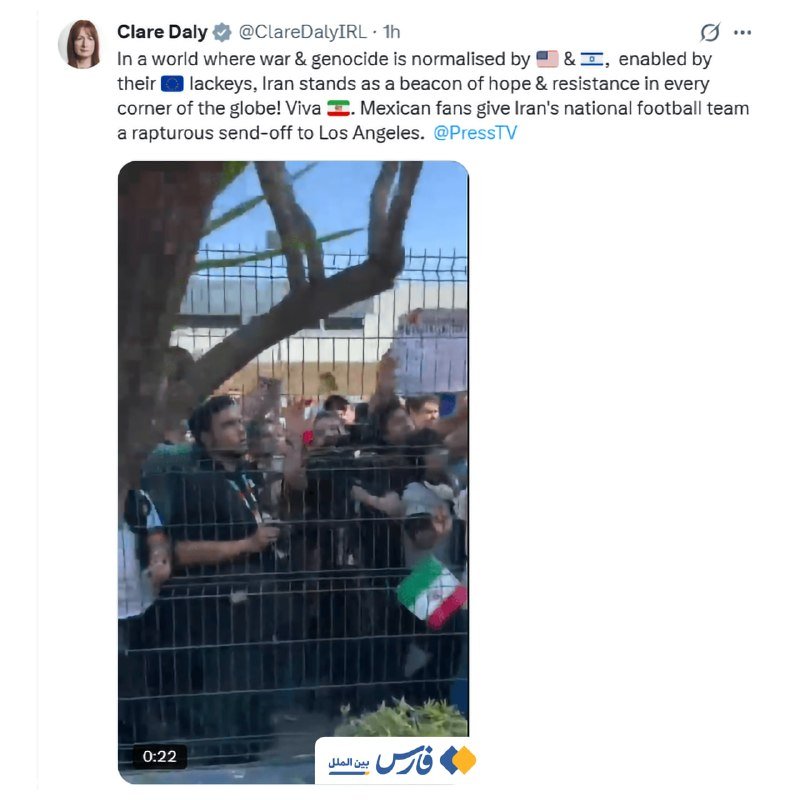
The footage is short, the angles are from the stands, and the editorial thumb is unmistakable. In the early hours of 16 June 2026 — just past 01:14 UTC — the Iranian outlet Fars posted video from a World Cup warm-up in Los Angeles showing New Zealand's opener against Iran in the seventh minute. By 01:38 UTC and 01:45 UTC, Fars was already circulating the equaliser from Ramin Rezaiyan, including a referee-cam cut. By 01:56 UTC, Fars had packaged the offside ruling that nullified Iran's second-half stoppage-time strike; by 02:02 UTC, Tasnim Plus was amplifying the crowd's “Iran, Iran” chant as a stand-alone viral artifact; by 02:14 UTC, Fars was rerunning it as its own branded post.
This is what diaspora sport looks like in 2026: a regional friendly in California, processed in real time by state-aligned media in Tehran, and rebroadcast to a global Persian-speaking audience. The match result — a 1–1 draw, with Rezaiyan's 32nd-minute equaliser offset by an offside call in the 45+5 — is almost beside the point. The point is the pipeline.
The dominant frame on Western wires is the scoreline. The dominant frame on Iranian state-aligned channels is the crowd. Both are technically true. The interesting question is which one travels furthest in the next 24 hours, and to which audience.
When the press box is the embassy
For decades, the standard complaint about Iranian state media — the outlets in the Fars / Tasnim / IRNA cluster — was that they reached Iranian audiences at home and paid little attention to the diaspora. That assumption has not aged well. The Los Angeles footage shows the apparatus in a different posture: less broadcast tower, more roving production crew with a phone, packaging the diaspora as the message.
The mechanism is unglamorous. A staffer in the stands shoots vertical video, captions it in Persian with the chant transcription, and pushes it to a Telegram channel with a multi-million-subscriber footprint. Within minutes the same clip resurfaces on a second state-aligned channel — in this case Tasnim Plus — with the same emotional payload repackaged. The viewer is not being told who won. The viewer is being shown that the country's name is being chanted on foreign soil, in a stadium the regime's critics use as a stage for protest.
This is not journalism in the conventional sense. It is closer to atmosphere as product.
The reading the Western wire will not write
The Western sports press will, fairly, focus on the football: the offside timing, the referee-cam angle, the tactical shape. Iranian diaspora outlets — IranWire, Iran International's Persian service, BBC Persian — will, fairly, cover the politics in the stands: the women in the crowd, the anti-regime banners, the security presence. Both are legitimate angles. Neither captures what the Fars and Tasnim feeds are actually doing.
The state-aligned channels are competing for the same diaspora eye with a different proposition: that the chants of “Iran, Iran” belong to the nation they define, not to the opposition that has historically claimed them. The framing is subtle. There is no flag pin, no portrait of the Supreme Leader in the B-roll, no explicit political claim. There is simply the sound of the chant, stripped of context, presented as self-evidently unifying.
That is a sophisticated media strategy executed in 1080p vertical video. It deserves to be named as such, not dismissed as crude propaganda, and not laundered as neutral coverage either.
What the footage actually shows — and what it does not
The counter-read is straightforward and should be made explicit. The same crowd, in the same stadium, almost certainly contains Iranians who would not recognise the chant as a regime-friendly artifact. Diaspora polling on this is thin, but the basic sociology is not: the Iranian diaspora in Los Angeles is large, ideologically mixed, and includes a substantial constituency that is hostile to the Islamic Republic. The “Iran, Iran” chant can mean loyalty, lament, defiance, or simply the rhythm of being in a stadium during a World Cup year. Treating the footage as a clean readout of diaspora sentiment would be a category error.
What the footage does show is that state-aligned media now have a fast, well-distributed pipeline for putting their preferred reading of any diaspora moment into circulation before any independent journalist can file a take. That is the structural fact, and it is the one that will outlast this particular match.
Stakes
The World Cup returns to North America in 2026. Every Iranian match — and there will be several — will be a stage for this same contest: who gets to define the soundtrack, who gets to choose the angle, who gets to put the chant in front of the global Persian-speaking audience first. The teams on the pitch will determine the scoreline. The channels on Telegram will determine the meaning. The two races are not the same, and the second one is the one that actually shifts political weather inside Iran.
The serious point: a 1–1 draw in Los Angeles is, on its own, a forgettable warm-up. The media system that processed it inside two hours is not forgettable. It is the kind of infrastructure that, multiplied across a tournament, can quietly redraw the map of who speaks for a diaspora — and who is left reacting to footage the regime's cameras chose to release.
Kicker
The result of the match was a draw. The result of the information war around the match was less even, and it was decided long before kick-off.
Desk note: Where a Western wire would lead with the offside call and a diaspora outlet with the protest banners, Monexus reads the same footage as a media-strategy story — a real-time test of who frames the diaspora for the diaspora.
Wire provenance
This editorial synthesis draws on the following public wire/social posts:
- https://t.me/farsna
- https://t.me/tasnimplus