The $165 billion day: what SpaceX's valuation jump really tells us
A single trading day added roughly $165 billion to Elon Musk's net worth on paper — more than Bill Gates's entire fortune — and prediction markets are betting Mars slips past 2030. Both signals are pointing at the same question.
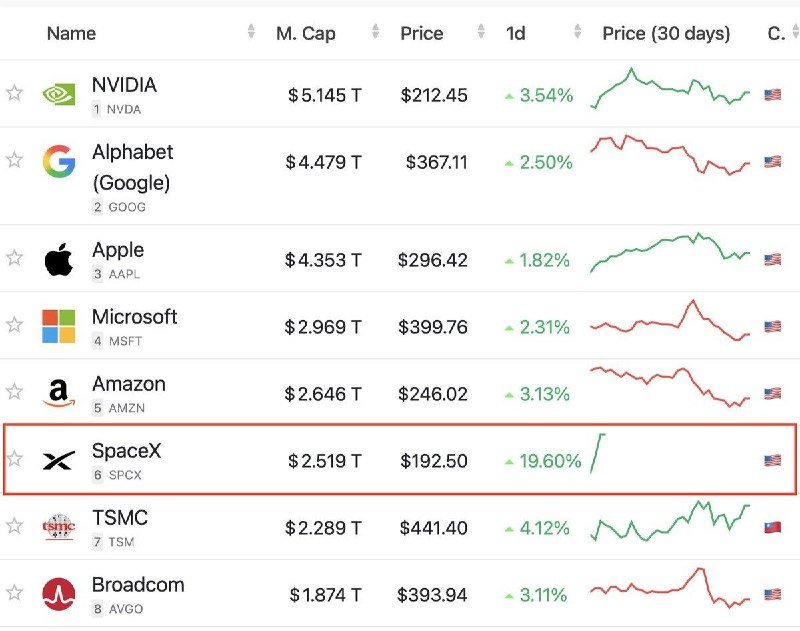
On 15 June 2026, a single session in the private-markets data that feeds Polymarket's tracking feeds added an estimated $165 billion to Elon Musk's net worth — a paper gain larger than the entire fortune Bill Gates has accumulated over four decades at Microsoft. The move was triggered by a re-rating of SpaceX on the back of a fresh funding discussion that lifted the company's implied valuation into territory previously reserved for the very top of the public-market cap table. The number is the headline. The interesting story is what the rest of the market is saying about whether SpaceX can sustain the trajectory Musk himself is now publicly claiming.
The thesis worth sitting with: a company without a credible timeline to Mars is being priced as if the Mars timeline is the business. The gap between those two beliefs is the asset.
The number versus the roadmap
Kalshi traders currently give SpaceX roughly an 18% chance of putting humans on Mars before 2030, according to reporting on the prediction market published 15 June 2026. That is not a fringe read. Prediction markets on spaceflight timelines have a reasonable track record of pricing in engineering and regulatory reality rather than press-release optimism. An 18% probability over four years is the market's way of saying: maybe, but not as a base case.
Musk, asked about the company's revenue trajectory the same day, said he would be "surprised" if SpaceX revenue did not exceed $1 trillion by 2031 — and in a separate remark on 15 June 2026 suggested $1 trillion in revenue by 2030 was plausible. Put those two statements next to the Kalshi number and the picture is unusually clean. A private valuation is being marked on the assumption of a $1 trillion-revenue business inside five years. A peer-reviewed prediction market is giving the same company a one-in-five shot at the milestone event that is supposed to justify the franchise narrative. Both can be true; they just cannot both anchor the same price.
The structural frame: valuation, narrative, and the new financial vernacular
The mechanics of the 15 June move deserve naming. A $165 billion single-day swing in a founder's net worth is not a function of SpaceX selling rockets, satellites, or Starlink subscriptions at a new run-rate. It is a function of a mark — a tender, a secondary, a funding round — at a higher reference price. In a public company, that mark would print as a tape move and be arbitraged within milliseconds. In private markets, the same re-rating is a slow-motion event, and the gap between successive marks is what creates the optical illusion of a fortune rising in a day.
That illusion is doing real work. It is the input to the political economy of the Musk enterprise — the collateral posture of xAI, the leverage assumptions inside any SpaceX-backed derivative, the negotiating position in Washington on launches, spectrum, and contracts. A $165 billion one-day mark is a balance-sheet event as much as it is a news event, and the rest of the private-markets complex is now recalibrating around it.
Counterpoint: the bulls have a case
The honest version of the bull case is that the Polymarket / Kalshi apparatus is good at pricing discrete events with a defined resolution rule, and bad at pricing compounding moats. Starlink is not a Mars bet. It is a cash-generative broadband business with structural advantages in launch cost that no competitor currently matches. If Starlink is the spine of SpaceX's revenue path and Mars is the option premium, then a $1 trillion 2030 number is not insane — it is aggressive. The 18% Mars-by-2030 print from Kalshi is not a refutation of the revenue line. It is a separate question, and conflating the two is the first analytical mistake most coverage is going to make.
The uncertainty that the sources do not resolve
The Polymarket-derived figure of $165 billion is a derived number, not a primary disclosure. It depends on which funding round, which share class, and which secondary is used as the reference mark on 15 June 2026 — and the source material does not specify the inputs. Musk's $1-trillion-by-2030 and $1-trillion-by-2031 statements are on the record, but the relationship between them (a glide path, a marketing line, a stress-test of investor appetite) is not. The Kalshi 18% figure is a market consensus at a moment in time and will move. A serious read of the day requires holding three propositions at once: a private valuation re-rated sharply upward, a founder promising a revenue scale that would require near-perfect execution, and a market of professional bettors pricing the marquee milestone at less than one-in-five. The space between those three things is where the actual story lives.
The stakes are not abstract. If the bull case holds, SpaceX becomes the first private company to break into the public-market top tier on the strength of a launch cost curve and a satellite constellation. If the bull case does not hold, the $165 billion day becomes the textbook example of private-market marks running ahead of underlying cash flow — a familiar pattern from the late stages of prior cycles, and one that historically ends with the marginal holder absorbing the re-pricing.
Desk note: wire coverage on 15 June focused on the headline number and Musk's own revenue framing. Monexus read the Polymarket mark, the Kalshi Mars-by-2030 contract, and Musk's two on-record revenue statements as a single coherent picture rather than three separate stories.