Terrain That Tells the Same Story Twice: How a Single Ukrainian TV Frame Became a Six-Hour Veracity Test
A Ukrainian television broadcast offered a one-line proof that its combat footage was not synthetic — matched terrain across two camera angles. The episode reveals how thin the evidentiary floor has become for a public that has been told, repeatedly, not to trust its eyes.
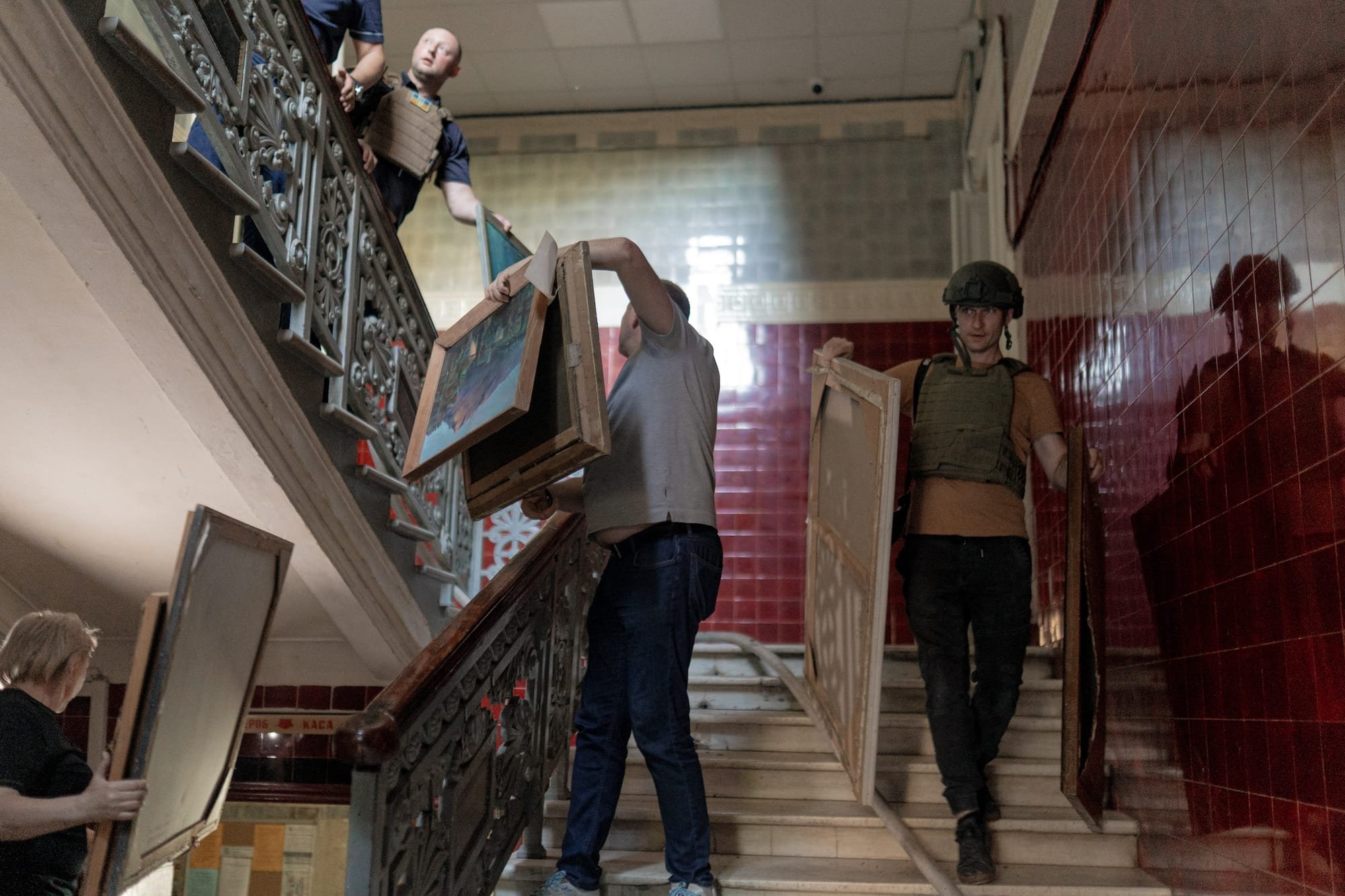
At 07:47 UTC on 16 June 2026, the Telegram channel myLordBebo published a short, pointed argument: a piece of footage being aired on Ukrainian television could not, in the channel's reading, have been generated by an artificial-intelligence tool, because the terrain visible in the shot matched the terrain visible in another shot taken from a different angle. The case was made in a single caption. The evidence was a continuous landscape. The stakes were larger than the clip itself.
The episode is small. It is also, in its way, a portrait of where visual verification stands roughly four years after synthetic media became a routine item of public anxiety. A channel that aggregates and contextualises front-line footage is doing, on its own, much of the work that news organisations once did in house. Its proof is not a forensic report, a chain of custody, or a signed affidavit. It is an eyeball comparison that a viewer can repeat in five seconds. The fact that the channel felt obliged to publish it is itself a story.
A short, unlovely sentence about a continuous landscape
The myLordBebo post, repeated almost identically in a 07:46 UTC posting from the same channel, runs in essence: here is proof that the picture is not AI-generated; the terrain matches across the video. The channel adds that it is not aware of any generative tool capable of considering a whole terrain in the round while keeping the lighting, the camera motion, and the perspective consistent. The argument is plain, the standard modest, and the case it makes — that a moving image of a real place is harder to fabricate than a still — is widely accepted among people who track synthetic media for a living.
That standard, modest as it is, has not always been available. For roughly the first two years of widespread public anxiety about AI-generated imagery, the burden of proof often fell on the person claiming a picture was real. A reasonable default — that an unverified image is treated as suspicious until corroborated — was, in practice, indistinguishable from a presumption of guilt against the photographer. The Ukrainian-broadcast footage inverts that default. The image carries its own internal corroboration. Two angles of the same ground cannot, in current tools, be generated together without producing the kind of tell-tale inconsistencies that the channel is explicitly inviting the viewer to look for.
The counter-narrative the image does not need
There is a familiar counter-reading: that any image can be staged, that any clip can be re-cut from a rehearsal, that the war in Ukraine has become a content mill in which the same grenade impact gets reissued with new captions. That reading is not frivolous. Ukrainian state and pro-Kyiv channels have, at points, been caught recycling older material; Russian-aligned channels have done far more than that, building an industry of misattribution. The reasonable sceptic's position is that even a continuous landscape, even a perfectly consistent perspective match, only proves that the landscape is real. It does not prove when the shot was taken, who fired what, or whether the impact shown is the impact claimed in the chyron.
The Ukrainian broadcast is not asking the viewer to take its word for the latter. It is asking the viewer to accept a much narrower claim — that the pixels depict something a current generative system could not have produced unaided. That claim is supportable. The broader claim, about the event the pixels depict, requires the kind of corroboration that no single frame can supply on its own: range-finding, weapon signature, debris analysis, geolocation, and witness testimony, all set against the operational pattern of the units known to be in the area. The myLordBebo post does not pretend to be doing that work. It is doing the prior, more limited work — establishing, cheaply and publicly, that the picture is at least a picture.
Structural frame: when the floor of trust is a Telegram caption
The interesting thing about the myLordBebo post is not that it is a Telegram caption. It is what its existence implies about the institutional map of visual verification. Major wire services — Reuters, the Associated Press, Agence France-Presse, the BBC — maintain provenance metadata, satellite corroboration desks, and named staff who sign their work. None of that was needed to make the point the channel was making. A continuous landscape, presented across two perspectives, performed the work of a provenance file.
The wider pattern here is that the verification budget is migrating. Specialist OSINT researchers, several of whom post publicly under their own names, have absorbed functions that used to live inside news organisations. So have channels like myLordBebo, which combine aggregation with a kind of informal audit. The result is a verification ecology in which a great deal of the labour is volunteer, in which reputation is built on being right often enough that the next caption is taken seriously, and in which the consumer of news is asked to read the captions as carefully as the original reporting. None of that is intrinsically a problem. It is, however, a system that scales differently from a wire service, and that fails differently too: a wire service can publish a correction under a masthead; a Telegram channel can simply delete the post.
Stakes: what an honest uncertainty looks like
The honest uncertainty in this episode is not about the matched terrain. The terrain either matches or it does not, and the eye is a reasonable instrument for that comparison. The honest uncertainty is about the broader question the post gestures at: how much of the visual record of this war, day to day, is being checked by anyone with the resources to check it properly, and how much of it is being read, briefly, by viewers who have learned to perform verification as a kind of attentive scrolling.
The structural pattern here is familiar from other domains. When the cost of producing a forgery falls, the cost of authenticating a real thing rises, and the institutions that used to absorb the second cost shrink. What replaces them is rarely a single replacement. It is a patchwork — a few well-staffed desks at the wire services, a larger number of self-trained researchers, a long tail of channels, and a public that has been told, with some justice, that it cannot afford to look away. The myLordBebo post is one small instance of that patchwork doing useful work. It is also, like any single post, one bad day away from the limits of its own methods.
The reasonable reader's posture, on the evidence available, is straightforward: treat the terrain match as a real but narrow result, and ask the next question — the one about what was being struck, by whom, and on what day — of the broader reporting on the engagement in question. The myLordBebo channel has, on this small piece of evidence, earned the next question. It has not pre-answered it.
Desk note: Monexus ran this item as a narrow, sourced note rather than as a claim about the underlying strike. The matched-terrain point is reportable; the operational event shown is, on the available sources, not independently verified.
Wire provenance
This editorial synthesis draws on the following public wire/social posts:
- https://t.me/myLordBebo
- https://t.me/myLordBebo
Follow the event.
These dated source records provide context. They do not retrospectively verify this archive article.
A dated voting record is evidence of one decision. Use the original UN record before turning it into an alignment label.
Visual explainer · historical vote of 2022-03-02 →