Tehran's 60-Day Clock: What the Iran Foreign Ministry Is — and Isn't — Saying About the New Nuclear Memorandum
Spokesman Esmaeil Baqaei frames a freshly signed memorandum as the end of a war and the start of a 60-day nuclear-and-sanctions negotiation. The framing leaves more questions than it answers.
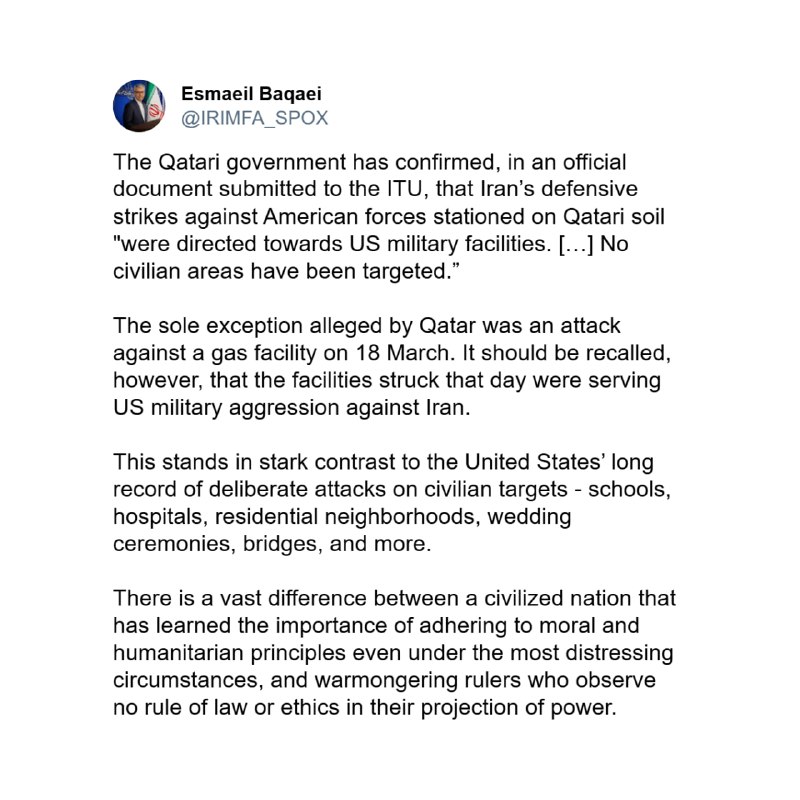
At 21:18 UTC on 17 June 2026, Esmaeil Baqaei, the spokesperson of Iran's Ministry of Foreign Affairs, took to a podium in Tehran and did something unusual in the genre of Iranian diplomatic communiqués: he framed a freshly signed memorandum as both a closure and a beginning. The text of that statement, relayed in Persian by the Tasnim News Agency in the minutes that followed, opens with a single, deliberate sentence — "The fact that we have signed an agreement to end the war at this stage does not mean that we have forgotten the past and the lessons that we have learned from it" — and from there walks the listener through a two-stage theory of the deal. First, the document brings a war to a halt. Second, and more consequentially, it sets a clock: negotiations on the nuclear file and on sanctions, Baqaei said, must begin within sixty days of implementation, "which is now," and the Iranian side would prefer them to start sooner rather than later (Tasnim News, 17 June 2026, 21:19 UTC; Mehr News, 17 June 2026, 21:46 UTC).
That second half of the sentence is the part the wires are going to spend the next week arguing about. The memorandum, in the Iranian telling, is not a peace treaty and not a nuclear deal. It is the envelope inside which both of those are supposed to be written — with Tehran reserving the right to insist that what is negotiated, and in what order, stays within a narrow lane.
What the spokesperson actually said
Read against the rolling Tasnim thread, the briefing has three distinct moves. The first move is rhetorical. Baqaei warns against treating the signed text as victory: the work, he says, is not finished, it has just begun, and the Iranian side must remain attentive to "the implementation by the other party" (JahanTasnim, 17 June 2026, 21:22 UTC). The phrase "other party" is doing a lot of work — it is the standard formulation for a counterparty whose good faith Tehran is publicly reserving judgment on. The second move is procedural. "In the text of the memorandum, it is emphasized that we will only negotiate on the nuclear issue and the lifting of sanctions," Baqaei said (Tasnim News EN, 17 June 2026, 21:19 UTC). The word "only" is the load-bearing one. It is a flat exclusion of the broader set of issues — regional behaviour, missile programme, human-rights dossiers, detainee files — that have historically been on the table in the longer cycle of US-Iran talks. The third move is tempo. The 60-day clock begins, in the Iranian reading, from implementation rather than signature, and Tehran would prefer that the negotiations on the nuclear file and sanctions begin sooner (Mehr News, 17 June 2026, 21:46 UTC; Tasnim News EN, 17 June 2026, 21:19 UTC).
Put together, the briefing is a remarkably disciplined piece of public positioning. It acknowledges that something has been signed, narrows the scope of what is negotiable, and signals that Tehran intends to be the tempo-setter for the next two months.
The counter-narrative the spokesperson is pre-empting
The phrasing of the briefing makes more sense once it is read against the two framings Tehran appears to be defending against. The first is the maximalist reading — common in some Western commentary — that any agreement with the Islamic Republic at this point is, by default, a concession to a regime that has not yet earned the trust of the negotiating counterparty. The Baqaei line "we have not forgotten the past and the lessons" is built precisely for that audience. It concedes nothing about the war's history; it reframes the memorandum as the end of one chapter and the start of a harder one. The second framing is the scope-creep worry — the fear, especially in Washington and in some Gulf capitals, that the narrow nuclear file will, in implementation, be allowed to expand. "We will only negotiate on the nuclear issue and the lifting of sanctions" is Baqaei's answer to that: a written constraint, now on the public record, that the scope of the talks is closed. Whether the other party is bound by the same self-description is precisely the question the next sixty days are designed to test.
What the structural frame looks like in plain prose
Strip the briefing of its diplomatic packaging and three structural facts are visible. First, the deal that has just been signed is a memorandum and not a final agreement. In the slow grammar of US-Iran negotiations, that distinction matters: a memorandum signals political will between principals; it does not bind the technical track that has to follow. Second, the timing architecture — sixty days from implementation, with a stated preference for earlier — places the burden of pace on the side that is widely understood to have more to lose from delay. Tehran is publicly choosing speed. Third, the simultaneous insistence on a narrow agenda ("the nuclear issue and sanctions, and only those two") is itself a negotiating posture. It tells the other party that any attempt to bundle the regional file into the next round will be read, in Tehran, as a violation of the written text. In other words, the briefing is not just a statement of position; it is the opening procedural argument of a process whose rules are still being written.
The stakes — for whom, and over what horizon
The clearest immediate winner, if the memorandum holds, is the Iranian economy's access to a portion of frozen assets and to a narrow easing of sanctions — though the briefing is careful not to claim any of that as already in hand. The clearest short-term loser would be any actor whose preferred outcome was a complete collapse of the negotiating track rather than a managed slowdown of it. The medium-term stakes are sharper. A successful 60-day round would, for the first time in years, place the Iranian nuclear file inside a documented, time-bound, agenda-limited negotiation rather than inside the cycle of incidents and escalations that has characterised it since the United States withdrew from the Joint Comprehensive Plan of Action in 2018. A failed 60-day round, by contrast, would re-open the file to a wider set of actors, and the briefing's careful exclusion of "the regional file" would look, in retrospect, less like a constraint and more like a missed opportunity.
What remains uncertain
The public record, as of 21:46 UTC on 17 June 2026, contains no independent confirmation from the other principal that the 60-day clock begins from implementation rather than signature, no public statement on the agenda constraint, and no agreed definition of "implementation" itself. The Tasnim thread and the Mehr wire relay the Iranian position with consistency, but neither outlet is in a position to verify the counterparty's understanding. The sources do not specify which sanctions are within scope, what the sequence of steps looks like, or how disputes about implementation will be adjudicated. Those are precisely the questions the next sixty days are meant to answer — and they are the questions the briefing, in its careful way, leaves open.
Desk note: The wire services carried this as a single sentence about a "memorandum." Monexus read the rolling Tasnim and Mehr threads and parsed the briefing into its three moves — rhetorical closure, procedural constraint, tempo — to surface what the spokesperson is actually claiming about scope and timing.
Wire provenance
This editorial synthesis draws on the following public wire/social posts:
- https://t.me/tasnimnews_en
- https://t.me/tasnimnews_en
- https://t.me/JahanTasnim
- https://t.me/mehrnews
- https://en.wikipedia.org/wiki/Esmaeil_Baqaei
- https://en.wikipedia.org/wiki/Ministry_of_Foreign_Affairs_of_Iran
- https://en.wikipedia.org/wiki/2025%E2%80%932026_Iran%E2%80%93United_States_negotiations
- https://en.wikipedia.org/wiki/Joint_Comprehensive_Plan_of_Action
Follow the event.
These dated source records provide context. They do not retrospectively verify this archive article.
Separate what the nuclear watchdog reported from what it could not determine after the June 2025 strikes.
- https://t.me/tasnimnews_en
- https://t.me/tasnimnews_en
- https://t.me/JahanTasnim
- https://t.me/mehrnews
- https://en.wikipedia.org/wiki/Esmaeil_Baqaei
- https://en.wikipedia.org/wiki/Ministry_of_Foreign_Affairs_of_Iran
- https://en.wikipedia.org/wiki/2025%E2%80%932026_Iran%E2%80%93United_States_negotiations
- https://en.wikipedia.org/wiki/Joint_Comprehensive_Plan_of_Action