The Louvre says it is 'running out of steam.' The funding fight is now political.
The world's most-visited museum says it can no longer afford the upgrades its buildings need. The diagnosis is technical; the prescription is political.
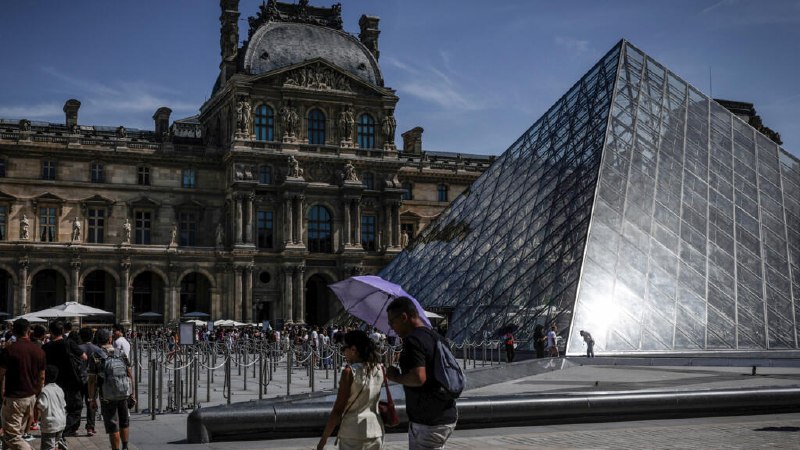
On the morning of 17 June 2026, the director of the Louvre told French media that the world's most-visited museum was "running out of steam." The line, carried by France 24 in English at 09:34 UTC and reported in French in the same news cycle, was not a metaphor. It was an itemised admission that an institution drawing roughly nine million visitors a year can no longer fund the maintenance its buildings require, and that a brazen $100-million jewellery heist has now been added to the catalogue of embarrassments waiting in the wings.
What is happening at the Louvre is not a story about art. It is a story about who pays for the upkeep of a national symbol, and what it means when the answer drifts.
A director's diagnosis, in plain language
The new director's message, as relayed by France 24 on 17 June, is essentially an audit. Ageing facilities need upgrading. The funding to do that upgrading has not been secured. The Louvre's famous glass pyramid, opened in 1989, is now closer to middle age than youth, and the climate-control and security systems that move the building from a tourist destination to a functioning museum have not kept pace with the visitor numbers that passed through its galleries this past year.
France 24 frames the warning as the opening shot of a campaign. The director is signalling, publicly and on the record, that the institution needs either more state money or a new revenue instrument — a ticketing reform, a dedicated sponsorship vehicle, a sovereign-heritage bond — to keep the building and its collections intact. Each of those options involves the French state, which owns the Louvre, and each of those options involves the French public, which visits it for free or at concessional rates for a large share of the year.
The heist that redrew the conversation
The director's comments land in a context already shaped by the $100-million jewellery heist referenced by France 24 in its dispatch. The intrusion is the kind of incident that does two things at once: it forces a candid conversation about the museum's physical security, and it gives a critic's argument about underfunding an air of prophecy. Whatever the precise inventory of losses, the public-facing fact is that a building holding some of the most closely guarded objects in France was penetrated. The director's pitch for upgrade money has, in effect, been pre-validated by criminals.
That sequence matters. Funding arguments in cultural institutions tend to move on multi-year horizons, governed by budget cycles and ministerial patience. A security breach of this scale compresses that timeline. Politicians who would normally defer a request for capital works now have a visible reason to act, and the museum's leadership has leverage it did not have a season ago. France 24's dispatch, with its juxtaposition of "running out of steam" and a "brazen" theft, signals that the timing is not coincidental.
A pattern bigger than one pyramid
The Louvre is not the only national museum in Europe confronting this arithmetic. Major state collections from Madrid to Berlin to London have spent the last decade juggling rising visitor numbers against static or declining maintenance budgets, with the result that essential work — climate systems, gallery rewiring, structural repair — accumulates as deferred liability. The British Museum's protracted debate over sponsorship and governance is the most-cited parallel; the Prado's recurring capital campaigns are another. The pattern is consistent enough to deserve a structural read: when a public asset becomes a global tourism engine, the cost of running it rises faster than the per-visitor subsidy scales, and the institution is forced into a permanent fundraising posture.
France 24's report does not need to draw that line for the reader to see it. The Louvre's dilemma is a particular instance of a general problem: a flagship cultural institution whose brand value grows with global footfall, while its cost base grows faster, and whose political ownership makes any revenue innovation a national debate rather than a board decision.
What is actually at stake
The choices the French state makes over the next budget cycle will be read by every major museum on the continent. A meaningful increase in direct subsidy would confirm the model of publicly funded heritage, at a moment when defence and social spending are competing for the same envelope. A new ticketing or visitor levy would reframe the Louvre as a partly user-funded asset and likely set a precedent for other flagship institutions. A private sponsorship expansion — closer to the model used by some British and American museums — would bring corporate money into galleries that have historically resisted it.
Each option has a constituency and a cost. The director's public warning, reported by France 24, is in part an attempt to make the trade-off legible to a public that has not yet been asked to choose.
The picture France 24 paints, in short, is not a crisis in the sense of collapse imminent. It is the more uncomfortable picture of a museum that knows what it needs, has done the arithmetic, and is now asking the state to ratify the bill before the deferred maintenance compounds into something irreversible.
Desk note: France 24 reported the Louvre director's remarks as a straight institutional story. Monexus frames the funding shortfall as the start of a wider European debate about who pays for national heritage when visitor numbers outrun the public purse.
Wire provenance
This editorial synthesis draws on the following public wire/social posts:
- https://t.me/france24_en