Qassem's victory lap and the limits of triumphalism in Tehran
Hezbollah's secretary-general used a public address on 17 June 2026 to declare that Iran had forced Israel to a halt. The claim is triumphalist — and the conditions attached to it are doing a lot of quiet work.
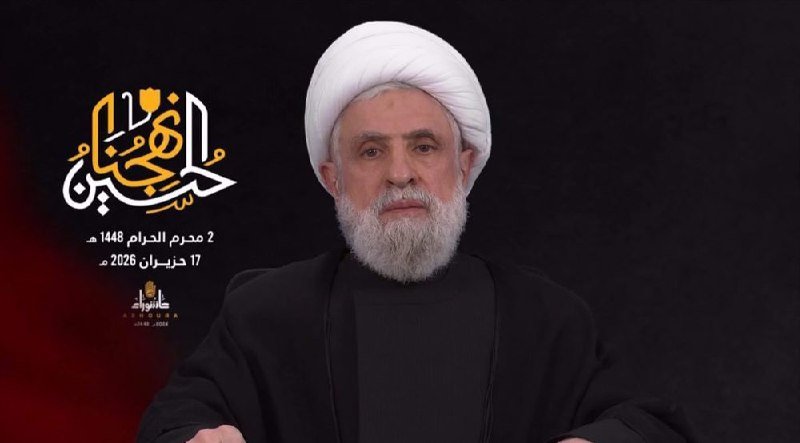
In a televised address on the afternoon of 17 June 2026, Hezbollah secretary-general Sheikh Naim Qassem framed the past year as a strategic vindication of Iran's regional posture. "Now the power of Iran is a significant power that has its say in the region and the world," he told viewers via Al-Alam Arabic's breaking-news ticker, "and the balance of power will change for the better in the interest of the peoples of" — the channel's live feed cut before the sentence finished. Minutes later, the same ticker carried a second message: "Do not underestimate the war that was taking place against Iran. The goal of overthrowing the Iranian regime and exterminating the dear and honorable life in Iran, the revolut[ion]." A third followed, in a register more overtly theological: "They wanted one thing and God wanted another thing. Therefore, God willing, humanity will be blessed with this pivotal change that occurred in the face of Islamic Iran."
Strip the eschatology away and a familiar argument is doing the work: a regional power that absorbed an unprecedented combined assault from Israel and the United States, suffered grievously, and emerged with its deterrent doctrine intact. Qassem's fourth message of the afternoon made the linkage explicit, thanking "the Islamic Republic of Iran for linking the Lebanese arena as a resistance and a people with the strength of willingness to sacrifice and forcing 'Israel' to stop t[he war]." Taken together, the four messages amount to a Hezbollah reading of the post-ceasefire order: that Iran is the indispensable patron, that its survival under fire has produced a regional correction, and that Lebanon's postwar trajectory is now downstream of Tehran.
The claim, taken seriously
Qassem's case rests on three propositions. First, that Israel's campaign in Lebanon was halted not by its own strategic calculus but by Iranian-supplied capability and Iranian political will. Second, that the cost imposed on Israel in personnel, materiel, and domestic legitimacy is large enough to deter a recurrence. Third, that the United States, having failed to translate the October 2023 air campaign into a decapitation of the Iranian system, is now in a managed-deterrence posture that concedes the Islamic Republic a wider regional margin. Each of these is a contestable reading, and Qassem's own text betrays the seams. The phrase "for the better in the interest of the peoples" is pointed, because the same address that claims victory in Lebanon cannot point to a single metric — a kilometre of recovered territory, a displaced community returned, a weapons program that survived the campaign — that the average Lebanese voter would recognise as a dividend.
The counter-narrative, harder to dismiss
The competing reading is not Western triumphalism; it is the arithmetic on the ground. The Israeli campaign degraded Hezbollah's senior command structure, killed or incapacitated a generation of mid-level cadre, and reduced the group's precision-missile inventory in a way that every open-source analyst, from Tel Aviv to Beirut, treats as fact. The Lebanese state, for its part, is engaged in a slow-motion reassertion of a monopoly on force in the south — a process Iran and Hezbollah are watching with more apprehension than the speeches suggest. The Al-Alam broadcast, in other words, is being delivered into a domestic Lebanese political environment in which the Shia street is more interested in reconstruction, currency stabilisation, and the return of displaced residents from the south and the Beqaa than in metaphysical claims about divine vindication. The framing Qassem is offering is a foreign-policy framing, addressed as much to Tehran and to the regional audience as to Beirut.
What "pivotal change" actually contains
Read closely, the four messages on the 17 June 2026 ticker describe a transition, not a victory. The first message frames Iran's regional role as a settled fact — "a significant power that has its say." The second insists on the existential character of the threat that was faced, which is a way of pre-justifying the cost. The third introduces the theological register, displacing ordinary strategic accounting with a providential one. The fourth monetises the linkage between Tehran and Beirut, promising that Iran's survival will underwrite Hezbollah's reconstruction. The structure is not a victory lap so much as a fund-raising document. It is asking, politely, for the regional audience to treat the present order as permanent and to extend credit accordingly.
The stakes if the reading is right
If Qassem is right — if Iran has indeed been forced to be treated as a peer competitor whose endurance imposes new constraints on Israeli and US action — then the operating environment for the next round of negotiations, whether over the Iranian nuclear file or the Lebanese–Israeli border regime, is one in which Tehran can credibly demand terms. Lebanese reconstruction aid becomes leverage; the disarmament clauses embedded in the November 2024 framework become paper. Iran's regional clients — Hezbollah among them — recover political space they had been losing. The cost of that reading, in the near term, is borne by the Lebanese state, which has an interest in a clean monopoly on force, and by the Israeli public, which was promised something more decisive than a strategic pause.
The stakes if the reading is wrong
If the competing reading holds, then Qassem's address is a sectarian mobilisation dressed in the language of national recovery, and the four messages of 17 June 2026 will be read in five years' time as the moment Hezbollah's leadership chose to define legitimacy through attachment to Tehran rather than through delivery to the Shia community in Lebanon. That is a choice with a half-life. The Lebanese Shia have been patient with foreign entanglements, but patience has a price, denominated in schools, hospitals, and the value of the lira. No televised address moves those numbers.
What remains uncertain
The four Al-Alam messages are the only sourcing the present analysis rests on. The full transcript, the venue, the audience composition, and the duration of the address are not specified in the public Telegram capture that this publication was able to review. It is also worth noting that Al-Alam Arabic is Hezbollah's principal media arm; the framing is therefore not an independent record of Qassem's words but a curated feed designed to amplify them. The same caveats attach to any read of the speech that flows exclusively through that channel. A fuller picture will require cross-checking against Reuters, AFP, and the Lebanese dailies, and against independent translation of the audio in full. Until then, the address stands as a statement of intent, not a description of a balance of power.
Desk note: Monexus reads the four messages on the Al-Alam ticker of 17 June 2026 as a single rhetorical act rather than as four discrete statements. The wire has tended to treat the Israeli campaign and its aftermath as a closed chapter; the present analysis treats it as an opening negotiation.
Wire provenance
This editorial synthesis draws on the following public wire/social posts:
- https://t.me/alalamarabic/
- https://t.me/alalamarabic/
- https://t.me/alalamarabic/
- https://t.me/alalamarabic/
Follow the event.
These dated source records provide context. They do not retrospectively verify this archive article.
Separate what the nuclear watchdog reported from what it could not determine after the June 2025 strikes.