Russia's drone war reaches the apartment block — and the G7 weighs in
A residential building in Ukraine was hit in the small hours of 17 June, while G7 partners weigh a missile package and Russia slides deeper into a fuel crisis of its own making.
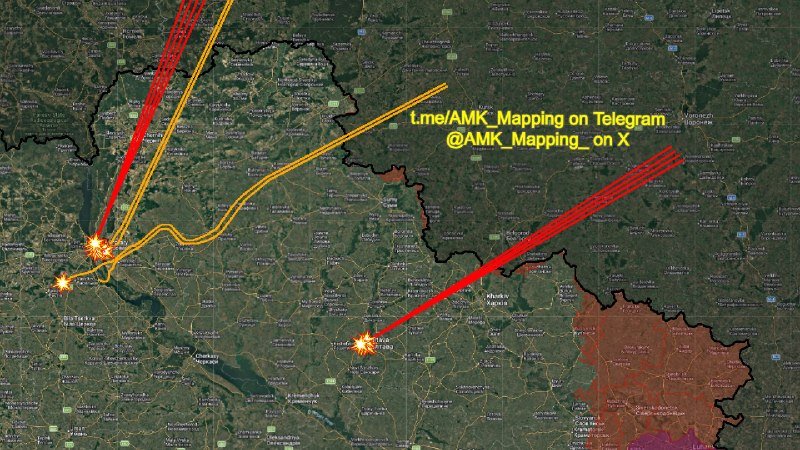
A suspected Russian drone struck a residential building in Ukraine in the early hours of 17 June, injuring at least seven people, Al Jazeera English reported at 03:02 UTC. The strike lands the same morning Kyiv's allies are openly weighing whether to send long-range missiles to the country, and as Russia's domestic fuel market shows fresh strain three and a half years into the full-scale invasion.
The convergence of those three threads is the story. A drone hitting an apartment block is not, in isolation, new — it is the daily texture of the war. What is new is the seam where Western industrial capacity, Russian logistics, and Ukrainian civilian exposure are being pulled into the same morning. The framing Monexus is most interested in is not the strike itself but the moment it sits inside.
The strike, the sirens, the solar weather
Al Jazeera English's breaking-news wire, citing on-the-ground reporting, said the suspected Russian drone attack injured at least seven people in a residential building in Ukraine. The dispatch carried no immediate claim of responsibility from Moscow, and no identification of the specific system used, though the Ukrainian side has, throughout the war, documented a sustained Russian campaign of one-way attack drones against civilian infrastructure, including apartment blocks, in cities far from the front line.
In a separate brief earlier the same morning, Ukrainian outlet TSN flagged an active magnetic storm on 17 June, the kind of geomagnetic event that intermittently disrupts radio and satellite navigation. The two items share a wire slot but not a story. They are noted here only to flag that reporting out of Ukraine right now is filtering through a noisy information environment — both literal (space weather) and figurative (a press cycle crowded with G7 communiqués and fuel-market headlines).
G7 missile debate, named and dated
The headline under the same TSN overnight brief on 17 June is the more consequential one for policymakers: the question of long-range missiles for Ukraine from the G7 partners. The framing matters because it is no longer a closed question inside the grouping. The shift has been incremental, but it is now public: G7 members are openly discussing whether to release systems that would let Kyiv strike deeper into Russian rear areas, including, plausibly, the logistics chains and fuel infrastructure that Moscow is finding increasingly costly to maintain.
This is not a charity debate. It is an industrial-capability debate dressed up as a humanitarian one. Each missile platform under discussion has a domestic-production story in at least one G7 country, an export-licensing chain, and a price tag. The countries weighing the decision are simultaneously the ones whose defence-industrial bases have spent two decades optimising for efficiency rather than throughput. Releasing missiles to Ukraine is, among other things, a vote of confidence in their own factories' ability to replace what is sent.
Russia's fuel crisis, again, only worse
The same TSN brief notes a deepening of the fuel crisis inside the Russian Federation. This is the third such "crisis" framing in eighteen months, and each one has been met with scepticism from Western analysts pointing to Moscow's continued export volumes and the seasonal pattern of Russian domestic-refinery maintenance. Scepticism is fair. So is the observation that the rhythm of these crises has accelerated, that Ukrainian long-range strikes on Russian refining capacity have, per Ukrainian and Western reporting over the past year, removed measurable barrelage from the system, and that the Russian state's preferred response — price caps, export-license tweaks, and rhetorical reassurance — has become more frequent and more shrill.
The counter-narrative is straightforward: Russia is a major hydrocarbons exporter with deep redundancy, and the domestic market has weathered worse. That is plausibly true. It is also true that the cost of weathering it — subsidies, opportunity cost, and the diversion of refinery output to military and front-line use — is not zero, and that the political cost of fuel queues in provincial Russian cities is non-trivial for a leadership that has staked much of its social contract on macroeconomic stability.
What the wires are not yet saying
What the available reporting does not specify is the exact weapon used in the 17 June strike, the city affected, and the condition of the seven injured beyond the headline figure. Ukrainian authorities have, throughout the war, published more granular tallies within hours of such incidents; those updates were not in the wire the moment Al Jazeera filed its 03:02 UTC brief. Monexus readers should treat the seven-injured figure as a floor, not a ceiling, and the drone attribution as suspected rather than confirmed until Kyiv's air force or the local prosecutor's office publishes its own preliminary finding.
The G7 missile discussion, similarly, remains a question, not a decision. The thinness of the evidence on the precise timing of any announcement is itself a story: capitals are visibly uneasy about moving first, and the sequencing will likely be driven by whichever member state is most willing to absorb the political cost of being seen to escalate.
Stakes
If the G7 releases long-range systems, the operational centre of gravity of the war shifts further east, and Russian refining and logistics infrastructure becomes a sustained target set rather than a periodic one. The Russian response, on the evidence of the past year, will be a mix of dispersal, hardening, and counter-strikes against Ukrainian energy and rail — meaning more apartment blocks, more sirens, more fuel anxiety on the other side too. If the G7 does not, the present trajectory of incremental Western systems continues, and the war's casualty ledger, on both sides of the line, continues to lengthen at roughly the rate it has for the past twelve months.
The drone that hit the apartment block at 03:02 UTC on 17 June is a small data point in a much larger curve. The fact that it shares a morning with an active G7 missile debate and a fresh Russian fuel headline is not coincidence — it is the shape the war is in.
— Monexus will update this piece as the G7 deliberations and the Russian fuel-market data firm up. The 03:02 UTC Al Jazeera wire remains the source of record for the strike; subsequent Ukrainian and Western reports will be folded in as they are verified.
Wire provenance
This editorial synthesis draws on the following public wire/social posts:
- https://t.me/TSN_ua/
- https://t.me/TSN_ua/
Follow the event.
These dated source records provide context. They do not retrospectively verify this archive article.
A dated voting record is evidence of one decision. Use the original UN record before turning it into an alignment label.
Visual explainer · historical vote of 2022-03-02 →