Trump's G7 "I'm the boss" moment, a non-final Iran deal, and a fresh Soleimani boast: three threads from a single morning
Three threads from the mid-morning of 17 June 2026 — a presidential boast about the killing of an Iranian general, a G7 stage moment, and a candid admission that the text signed with Tehran is not yet a deal — point to a foreign-policy posture that prefers leverage to closure.
By 11:00 UTC on 17 June 2026, three threads from three different Telegram channels converged on the same subject: the texture of how the United States is currently conducting its Middle East and alliance diplomacy. The fragments, taken alone, read like the ambient noise of a busy news day. Read together, they sketch a posture — brash, transactional, and deliberately conditional — that complicates the conventional reading of a White House supposedly racing to lock in a regional settlement.
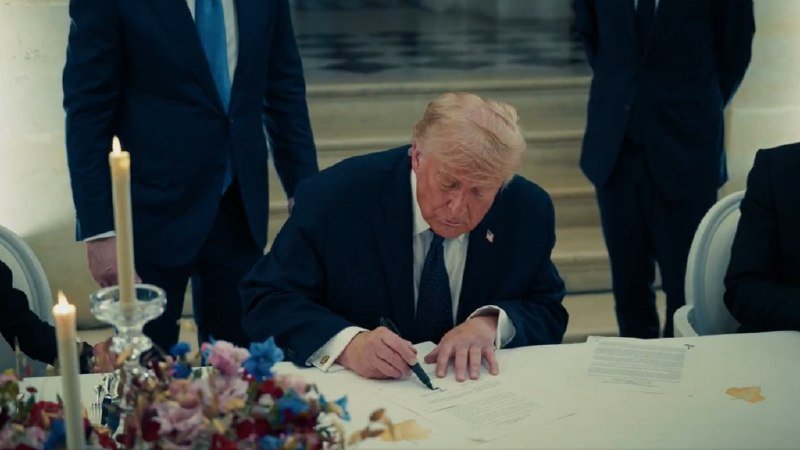
The substantive claim of the day, embedded in a brief quotation carried by the Israeli reporter Amit Segal, is that the document signed with Iran is not a final text at all. "The text is not final, it is a memorandum of understanding," the US president is quoted as saying. "If I'm not satisfied — we'll go back to bombing." The remark does two things at once. It signals to Tehran that the diplomatic opening remains revocable, and it signals to domestic audiences that military escalation is still on the table as a live policy instrument rather than a rhetorical threat. The framing is the opposite of the closure rhetoric that usually accompanies a signed document; it is closer to the conditional language of a framework agreement than to a final accord.
The G7 stage, and the politics of "boss"
Earlier the same morning, the Ukrainian news channel TSN_ua carried a clip in which the US president is reported to have told G7 leaders that "he's the boss." The remark, replayed widely on Ukrainian and Russian-language Telegram channels, is a small piece of theatre that says a great deal about how the administration positions itself inside the Western alliance. The conventional G7 script is consultative; even the most unilateral of recent US presidents have tended to wrap their preferences in the language of consensus. Telling peers that you are in charge is a different register, and the clip — circulated with the speed that only a pre-edited video can generate — feeds a specific narrative in allied and non-aligned media: that the United States is asking for compliance, not consultation.
The G7 also remains the principal Western forum coordinating the response to Russia's full-scale invasion of Ukraine, and the optics of the moment matter in Kyiv. The TSN feed, which is the Ukrainian public's most-watched nightly news brand, picked the clip up not for its entertainment value but for what it implies about the reliability of the American commitment to coalition politics at precisely the moment that commitment is being tested by Moscow's continued attacks on Ukrainian cities. A US president who tells his peers he is the boss is also a US president who, in the same breath, can decide what the boss wants to do about a given war.
The Soleimani boast, six years on
The most provocative fragment of the morning comes from the conflict-monitoring channel Clash Report, which carries the US president saying: "We took out a man named Soleimani. Do you think this would have happened if he were alive? He was an evil genius." The remark reframes the January 2020 killing of Quds Force commander Qassem Soleimani as a continuing argument rather than a closed chapter. It is also, structurally, an admission: the current administration is claiming credit for an operation conducted by its predecessor, while arguing that the killing is what made the present diplomatic opening possible.
That framing puts Tehran in a difficult rhetorical position. The Iranian state has spent the six years since Soleimani's death building a national narrative around his martyrdom, and the foreign-policy establishment in Tehran has consistently argued that the killing proved the United States was not a credible negotiating partner. If the current US president is now publicly arguing the opposite — that the killing is the reason a deal is even on the table — the Iranian side has to either accept that logic or repudiate the very negotiation it has agreed to enter. Both options carry cost.
Counterpoint: the deal is the deal, and the bombast is the bombast
The dominant Western wire reading of the morning's clip cluster is that the administration is performing toughness for a domestic audience while the substance of the deal moves forward. The argument runs that conditional language is a feature, not a bug: it gives the president room to walk away, but it also gives Tehran room to make the final concessions that would convert the memorandum of understanding into a binding text. On that reading, the G7 "boss" moment is the standard theatre of coalition politics, and the Soleimani boast is a campaign-trail line that should not be over-interpreted.
A competing read, more common in non-aligned and Global South commentary, is that the three clips together describe something more uncomfortable — a foreign policy that has internalised the conditionality and is no longer interested in the closure that allies, markets, and adversaries all need. The memorandum that is not a memorandum, the deal that is not a deal, the alliance in which the principal is the boss: this is a posture that maximises leverage at the cost of predictability. It is the diplomatic equivalent of an option that never expires, which is precisely what unsettles the counterparts who are asked to deal with it.
Structural frame: leverage over closure
The through-line is a preference for leverage over closure, expressed in three registers simultaneously. At the alliance level, the language of being the boss substitutes the consultative grammar of the G7 with a directive one. At the deal level, the document is publicly described as a memorandum that can be unmade if the principal is not satisfied. At the historical level, the killing of a named adversary is restated as the precondition for the present opening, which makes the opening itself dependent on the willingness to repeat the act.
For the Middle East, that posture means an Iran policy in which the off-ramp and the on-ramp sit on the same dial. For Europe, it means a G7 ally whose style of leadership assumes, rather than negotiates, consent. For Ukraine, the question — left unanswered by the day's clips — is whether the leverage posture extends to sustaining the military and financial support Kyiv needs to defend its territory against a continuing Russian invasion. The morning's clip cluster does not address that question directly, but the way the administration talks about its other commitments suggests it is one Kyiv should be asking out loud.
What remains uncertain
The clips circulating on the three channels are short, edited, and presented without the surrounding diplomatic context that would tell readers how seriously to take each remark. The G7 "boss" line is reported by a Ukrainian outlet covering the story as theatre, and may have been a throwaway line rather than a doctrinal statement. The Soleimani boast is a public re-assertion of a claim the current administration has been making since 2024, and its novelty is in the timing rather than the content. The most consequential line of the morning — that the Iran text is a memorandum and not a final agreement — is the one that will determine whether the next weeks bring a real accord or a return to the cycle of strikes. The clip does not tell us which.
For Monexus readers: the wire's instinct is to report the clip and move on; the Monexus instinct is to read the three clips together and ask what kind of diplomacy they jointly describe.
Wire provenance
This editorial synthesis draws on the following public wire/social posts:
- https://t.me/TSN_ua
- https://t.me/ClashReport
- https://t.me/amitsegal