Trump's Hormuz Deadline: How a Friday Reopening Claim Collided with an Unreleased Plan
On 17 June 2026 the US president said shipping was already resuming and the Strait of Hormuz would be "completely open" by Friday — without releasing the plan that would make it so.
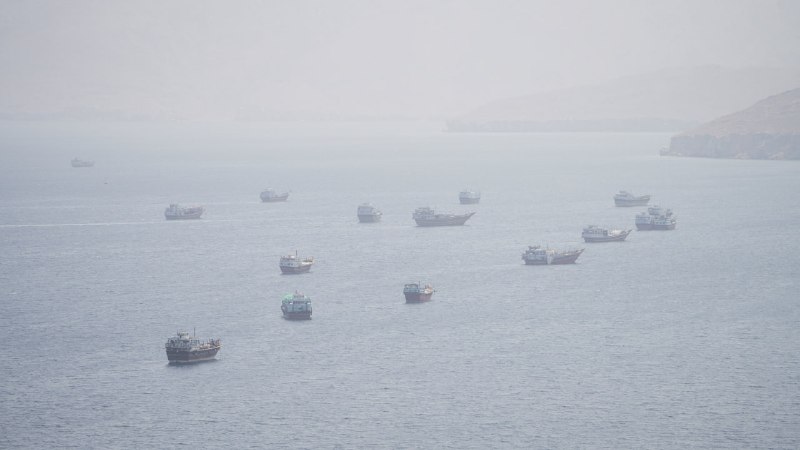
On 17 June 2026, the President of the United States told reporters that the alternative to a recent agreement with Iran was "a global recession," described those who rejected the deal as "simply stupid people," and declared that the Strait of Hormuz would be "completely open" by Friday. The remarks, carried across Telegram channels including englishabuali and abualiexpress, landed in markets and chanceries still waiting for the text of the arrangement that would, in theory, make the strait safe to transit. The claims — a binding deadline, a freight corridor about to clear, a macroeconomic cliff narrowly avoided — are unusually specific. The documentation that would let outsiders verify them has not, as of 19:00 UTC on 17 June, been released.
The pattern is familiar. A US administration manufactures a Friday, and the world's oil shippers, refiners, and insurance underwriters adjust routes and premiums around the rhetoric before the paperwork catches up. What is different this time is the gap between the certainty of the White House messaging and the thinness of the public record. No joint communiqué has been published. No third-party monitor has confirmed vessel movements. The mechanism by which the strait would move from contested to open has not been named — only the date.
This publication sets out what is on the public record, what the record does not yet support, and what is at stake if the Friday claim proves to be either an accurate breakthrough or a deadline that slips.
What the president said, and when he said it
The two most-watched lines from the 17 June remarks travelled quickly because they were short, quotable, and consequential.
First, the framing of the alternative. According to a Telegram post by the channel englishabuali at 13:04 UTC on 17 June 2026, the president said: "The alternative to this agreement was a global recession. There are stupid people who want to see a global recession. They are simply stupid people." The same line was carried at 12:10 UTC by the related channel abualiexpress. The repetition across two channels is consistent with the remarks being delivered earlier in the day and re-broadcast; the underlying quote does not appear to have originated with the channels themselves.
Second, the deadline. The X account @unusual_whales, a markets-news account that aggregates public statements and trade data, posted at 11:37 UTC on 17 June 2026 that "Trump has said ships are starting to go out and the Strait of Hormuz will be 'completely open' by Friday." A second post from the same account at 03:58 UTC, picking up coverage by the Unusual Whales news desk, added the qualifier: "though official details of the plan to reopen the strait have not been released."
The sequencing matters. The optimistic claim — that vessels are already transiting and the corridor will be fully open by Friday — was broadcast into markets before any official document explaining how the opening would be achieved, secured, or verified was placed in the public domain. For an oil market, where positioning is set on the basis of expected flows, the order of operations is the story.
The Strait of Hormuz, briefly
The Strait of Hormuz is the maritime chokepoint between the Arabian Peninsula and Iran, connecting the Persian Gulf to the Gulf of Oman and, beyond that, to the Arabian Sea and the open ocean. Its width at its narrowest is about 21 nautical miles. A substantial share of internationally traded crude oil and liquefied natural gas transits the strait in normal conditions; when the corridor is contested, freight rates, war-risk insurance premiums, and benchmark crude prices move in directions that depend on whether shipowners, crews, and underwriters believe the corridor is safe.
For decades, the strait's security has been a function of two overlapping equilibria. The first is the regional balance between Iran and the Gulf Arab states, anchored by the United States' naval presence in the Gulf and at its Indian Ocean approaches. The second is the price of oil: high enough to make the corridor strategically valuable, low enough that the cost of disruption is bearable for the global economy. Both equilibria have been stressed in 2026. The question the Friday claim answers — or purports to answer — is whether the second has been stabilised by agreement, and on what terms.
The plan that hasn't been published
The most consequential detail in the available record is also the one that is missing. The Unusual Whales post at 03:58 UTC noted explicitly that "official details of the plan to reopen the strait have not been released." As of the writing of this article, no joint US-Iran communiqué, no text of an agreement, no list of reciprocal commitments, and no description of an enforcement or monitoring mechanism has been published in the channels that have carried the president's remarks.
That absence is not, on its own, disqualifying. Diplomatic texts are sometimes withheld for days or weeks while implementation mechanisms are stood up. But it is consequential because the remarks are specific. "Completely open by Friday" is a statement with a falsification date. If the corridor is not, in fact, fully open on 19 June 2026, the statement is wrong in a way that is observable from satellite imagery, AIS vessel-tracking data, and the Lloyd's List intelligence that underwriters read before writing war-risk cover.
The structural problem is this: the president has put a precise date on the claim. The public record does not yet describe the instrument that would deliver on the claim. Markets are therefore pricing the claim, not the instrument. In oil, that distinction is the difference between a hedge and a gamble.
A precedent for deadline-driven diplomacy
The Hormuz claim sits inside a recognisable pattern of deadline-driven economic statecraft, in which a US administration announces a target date, allows markets to converge around it, and then either delivers or walks the deadline back. The pattern has been used, in different forms, on tariff schedules, sanctions wind-downs, and shipping-inspection regimes. Its rhetorical appeal is that it forces counterparties to choose between movement and a known, dated cost. Its operational risk is that credibility is consumed each time a deadline is set and not met, and the next deadline is harder to enforce.
The president has, in the same set of remarks, framed the alternative to the deal as a "global recession." That framing does two things at once. It raises the perceived cost of non-compliance for Iran. It also raises the perceived cost of non-delivery for the United States. A deal that averts a global recession is a deal against which success and failure will be measured by markets in real time. The threshold for calling a Friday reopening a failure is low: one named shipping line diverting a tanker is enough to surface the gap between the rhetoric and the reality.
The counter-narrative is straightforward and worth taking seriously. The deal may in fact work, and the absence of a published text may simply reflect that the implementation plan is being finalised in parallel with the announcement, the way that some sanctions snap-backs have been telegraphed hours before the underlying executive order is published. The "global recession" language may be read, charitably, as an honest description of the macroeconomic tail the administration believed it was buying down. The Friday date may be the date on which a first tranche of reopenings is scheduled, with subsequent tranches to follow.
The case for the more sceptical read is also straightforward. The same channels that carried the optimistic deadline carried the insult-laden framing of the alternative. The combination — a confident date, an aggressive posture, no published text — is the combination that has, in other episodes, produced a slip. Markets will price both reads until the documentation appears.
The structural frame: shipping corridors as policy instruments
The Strait of Hormuz is not, in 2026, the only contested corridor. The Bab el-Mandeb, the Black Sea, and parts of the South China Sea have all been sites of disruption, repricing, and partial reopening in recent years. The throughline is that shipping corridors have become instruments of policy in their own right. They are not just infrastructure; they are leverage. An administration that can credibly open a corridor can extract concessions; an administration that can credibly close one can too. The corollary is that the credibility of either move depends on the credibility of the underlying commitment.
This is the structural frame the Friday claim sits inside. The US is signalling, to Iran, to Gulf states, to China and India as the largest single customers for Gulf crude, and to global markets, that it can deliver a safe corridor on a known date. If it delivers, the signal is reinforced. If it does not, the cost is paid in the next negotiation, on whatever corridor is contested next, by whatever administration is in office.
The global recession language sits in the same frame. It is the claim that the cost of non-delivery is not just a local freight-rate spike, but a global contraction. That is a powerful claim, and if it is accurate, it is also a claim that comes with its own obligation. An administration that has publicly described the alternative as a global recession cannot, without cost, be the reason the alternative arrives.
What is at stake
For oil markets, the Friday claim has put a specific date on a specific repricing. If the strait is, in fact, fully open to commercial traffic on 19 June 2026, benchmark crudes will price the reopening in. If it is not, the same benchmarks will price the slip. War-risk insurance premiums, which have been a meaningful component of delivered crude costs in 2026, will move in the same direction. The exposure is largest for refiners in Asia, where the marginal barrel is most likely to be Gulf-sourced, and for European importers who have been managing around a constrained Mediterranean routing.
For the Iranian economy, the agreement, if implemented, would reopen a channel through which the state's hydrocarbon revenue flows. The incentive structure for Tehran is, on its face, aligned with the deal: a functioning strait serves Iranian revenue. The risk for Tehran is that the agreement is interpreted in Washington as a ceiling, not a floor — that the reopening is conditional, and that the conditions can be tightened.
For the Gulf Arab states, the agreement is a partial restoration of a security arrangement that has been under strain. The cost of the strain has been paid in defence spending, in the rerouting of trade, and in the diplomatic work required to keep Asian customers supplied by alternative corridors.
For the United States, the stakes are the credibility of corridor diplomacy as a tool. If the Friday claim holds, the next time a US president announces a deadline for a corridor to open or close, markets will price it in faster. If it slips, the next time will be priced with a discount.
What remains uncertain
Three things remain, on the public record, unverified.
First, the text of the agreement. No joint document has been published in the channels that have carried the president's remarks. The deal's existence is asserted; its contents are not.
Second, the monitoring and enforcement mechanism. Even where sanctions snap-backs have been telegraphed before publication, the implementation vehicle has usually been named. The Friday claim does not name a vehicle.
Third, the reaction of the Iranian side. The channels carrying the US remarks do not, in the items reviewed for this article, include a parallel statement from Tehran confirming the agreement, the timeline, or the mechanism. Without an Iranian confirmation on the record, the deal is, for now, a US statement about an Iranian position.
The Friday date is, in this sense, a stress test. It is the date on which the corridor either opens as advertised or does not. The two outcomes are both observable, and both will be priced. The administration's credibility on corridor diplomacy will be set, in part, by the result.
Desk note: The wire has carried the president's remarks at face value. Monexus has done the same for the quoted language, while flagging that the underlying agreement, the reopening plan, and the Iranian-side confirmation have not yet been published in the sources reviewed. The Friday claim is treated as a claim, not as a confirmed outcome.
Wire provenance
This editorial synthesis draws on the following public wire/social posts:
- https://t.me/englishabuali
- https://t.me/abualiexpress
- https://x.com/unusual_whales/status/