Trump floats 48-hour Iran deal, then revives the threat of bombing — within minutes of the same press gaggle
On 17 June 2026, the US president said an agreement would be signed inside two days — and warned that the bombing campaign would resume if Tehran did not "behave." The contradictions sit in the same transcript.
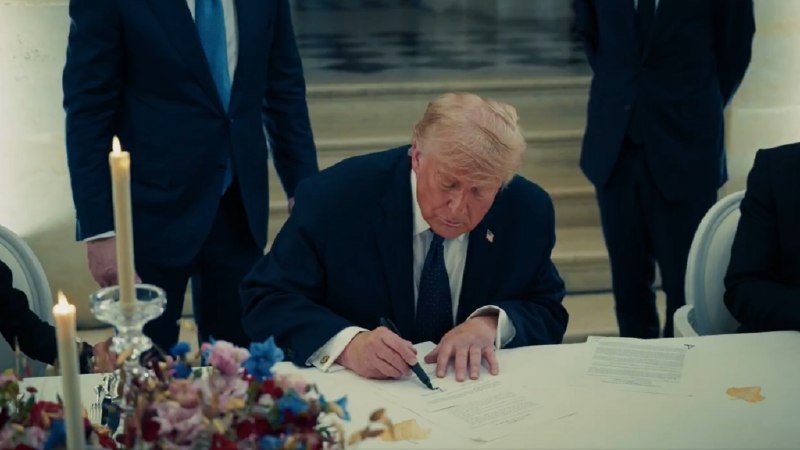
At 19:13 UTC on 17 June 2026, Donald Trump told reporters in the White House briefing room that an agreement with Iran would be signed "over the next 48 hours" — a line carried verbatim by Telegram channels that monitor presidential pool spray in real time, including al-Alam Arabic, which flagged the statement as urgent. Twelve minutes later, at roughly 19:25 UTC, a Reuters correspondent confirmed the same 48-hour window in a separate dispatch. By 19:35 UTC, the same president was telling the same press pool that the cost of rebuilding Iran would be "only" $300 billion — a figure that tracks with preliminary estimates of damage from the June strikes on Iranian nuclear and military infrastructure, and that lands, however implausibly, as a sales pitch for the deal he had just announced.
The problem is not any single line. The problem is the architecture of the threat inside which those lines are delivered. In the same exchanges carried by the Telegram channel Clash Report, a reporter pressed Trump on the text of the Iran memorandum, noting that its first paragraph disclaims both the use of force and the threat of the use of force — and then asked whether his prior public statements about bombing Iran constituted a threat. Trump replied, in the clipped style of the pool transcript, that if Iran does not comply, the bombing resumes. The conditional was not hypothetical. Reuters reported the threat to resume strikes in a separate bulletin at 18:40 UTC, under the headline that Trump "threatens to resume bombing campaign if Iran does not 'behave.'"
The deal that is also an ultimatum
The 48-hour announcement is the second pivot on Iran inside a week. As recently as 16 June, the same administration had denied the existence of a reconstruction fund and dismissed reporting about it as fake news, according to a WarMonitor post on X citing the on-record denial. The reversal — from denial to a $300 billion rebuild number in under 24 hours — is itself the story. It is consistent with a negotiating posture in which the deal is real, the threat is real, and the two are deliberately fused.
Reuters' second bulletin on 17 June, timestamped 18:25 UTC, noted that Trump suggested sanctions on Iran could be removed once Tehran "behave[s]" — language that puts economic re-engagement on the same conditional footing as the bombing threat. The structure is a familiar one in coercive diplomacy: a written agreement that disclaims force, paired with a public posture that promises force. The memorandum's first paragraph, as read back to Trump by the reporter, is the legal text. The press spray is the political text. The two are not the same document.
For Iran, the contradiction is not a bug. Tehran's negotiating position, reflected in the careful sequencing of official statements via Iranian state media in recent days, treats the threat of resumed strikes as the operative constraint and the memorandum as the negotiating floor. The reconstruction number — $300 billion floated by Trump on 17 June — would, in this reading, be a US-acknowledged cost of the very campaign the United States is now offering to suspend.
The $300 billion question
The reconstruction figure is doing more rhetorical work than the brief pool exchange suggests. Iran has not, as of the 17 June reporting, named a number of its own; the only published dollar figure is the one Trump volunteered. Independent damage assessments from satellite imagery analysts and from IAEA inspectors who have been inside struck facilities would normally take weeks to produce. That the White House is the first source on the dollar value — and is anchoring it at the low end of the speculative range — is itself a tell.
Three readings are plausible. First, the figure is genuine, drawn from a classified damage assessment that the administration is leaking selectively to shape Iranian expectations. Second, the figure is a negotiating chip, designed to make any future US demand for reparations or third-party funding politically legible. Third, the figure is a marketing line — $300 billion as a digestible number for American audiences being told that the war is over and the bill is reasonable. The source material does not let this publication adjudicate between the three. What is on the record is that the same president who denied the existence of any reconstruction fund on 16 June named a $300 billion figure on 17 June, in the same room where he announced a 48-hour deal.
What the memorandum does and does not say
The exchange flagged by Clash Report — the reporter reading the first paragraph of the Iran memorandum back to Trump — is the most concrete textual detail to emerge from the day's coverage. The text disclaims the use of force and the threat of the use of force. That phrasing is the international-law register the Iranian side would have demanded. It is also the register the US side would have conceded only under pressure, given the public posture the administration has maintained for weeks. The fact that the reporter felt obliged to ask whether Trump's own statements amounted to a threat of force is the cleanest evidence that the two registers are in tension inside the same deal.
Iran's leverage in that tension is real. The June strikes degraded but did not destroy Iran's enrichment capacity; the country's deep-burial facilities at Fordow and Natanz were not, on the evidence available to open-source analysts, put beyond recovery. The memorandum's force-disclaimer language, in this reading, is the US conceding that further strikes would have to clear a higher political threshold than they did in the run-up to June. The 48-hour signing window is the moment the diplomatic architecture replaces the military one — for as long as the paper holds.
Stakes and the next 48 hours
The structural pattern is familiar from other coercive deals of the past two decades: an agreement is announced under a deadline, the threat of escalation is kept on the table as an enforcement mechanism, and the dispute shifts from the page to the press gaggle. The Iranian side gains the force-disclaimer language; the US side retains the implicit threat of resumption. Both sides can claim a win inside their own domestic information space, which is the point.
The narrow question for the next 48 hours is procedural: does the document get signed, and at what level. The broader question is whether the deal is durable. The answer depends on whether the threat of resumed bombing is treated by both parties as a contingent deterrent or as a backstop that can be reactivated at the discretion of one side. The memorandum's first paragraph suggests the former. The 17 June press spray suggests the latter.
What remains genuinely uncertain is the content of the deal beyond the force-disclaimer paragraph. The 48-hour timeline, the $300 billion rebuild number, and the conditional sanctions relief are all on the public record; the verification architecture, the sequencing of sanctions relief against Iranian compliance steps, and the role of the IAEA are not visible in the source material. The deal that is being sold as a fait accompli is, on the available reporting, still a memorandum whose key chapters have not been read aloud.
Desk note: Monexus has run the 17 June remarks together as a single news event rather than treating the 48-hour announcement and the bombing threat as two separate stories, on the grounds that they were delivered inside the same press window and contradict each other on the page. Wire reporting on the same events is split across the Reuters bulletins, the WarMonitor X thread, and the Clash Report pool transcripts; this piece cites each where the specific claim originates.
Wire provenance
This editorial synthesis draws on the following public wire/social posts:
- https://x.com/reuters/status/2067312617647947776
- https://x.com/reuters/status/2067228579406979072
- https://t.me/ClashReport
- https://t.me/alalamarabic
- https://x.com/Osinttechnical/status/20672
Follow the event.
These dated source records provide context. They do not retrospectively verify this archive article.
Separate what the nuclear watchdog reported from what it could not determine after the June 2025 strikes.