Trump's Lebanon Tightrope: Backing Israel, Urging Restraint, Keeping the War Open
On 17 June 2026, President Donald Trump told reporters he does not want Israel's Lebanon campaign to stop, even as he described himself as the 'big partner' urging Bibi Netanyahu toward a 'softer touch.' The comments frame a widening US–Israel gap that has not yet altered the underlying operation.
On the afternoon of 17 June 2026, President Donald Trump walked a narrow line in front of reporters that he had been preparing for days: a vigorous defence of Israel's right to keep striking Lebanon, layered on top of an unusually public nudge to Prime Minister Benjamin Netanyahu to calibrate the campaign. Asked directly by a correspondent whether he wanted Israel to stop its military operation in Lebanon, Trump answered, "No, I want Israel to be able to defend itself." Moments later, in the same encounter, he described Netanyahu as "a good man" who "gets a little excited sometimes," and offered his own verdict on the war's tempo: "I told him to be gentler with Lebanon and not take down a building." The juxtaposition — categorical support, calibrated criticism — captured a US posture that has grown harder to characterise with a single word.
What Trump is not doing is what his own comments make most newsworthy. He is not calling for a ceasefire, he is not withholding military resupply, and he is not publicly threatening consequences for further escalation. He is, instead, taking ownership of the war's shape while publicly admitting friction inside the partnership. That is a different sort of message than either the White House or Jerusalem has historically sent, and it lands at a moment when the gap between American and Israeli tactical preferences has widened enough to be visible in real time.
The remarks, parsed
The president's comments came in two registers that do not contradict each other but are not the same thing. The first register is permissive: "I don't want Israel's military campaign in Lebanon to stop." The second register is advisory: when two drones land "in the desert and dropped harmlessly," the political optics of a large-scale retaliation are not always helpful. Israel, Trump said, "could do better." The framework he offered reporters was partnership, not supervision. "We are the big partner," he said, "and he is the very small partner," a formulation that simultaneously signals leverage and solidarity.
The comments were delivered with characteristic informality, but the structure underneath is familiar from earlier US-Israeli episodes. Washington provides diplomatic cover, weapons, and veto support at international fora; Israel conducts the operation; disagreements over tempo are aired privately and, increasingly, semi-privately. The novelty here is that the airing has grown louder. Trump's preferred method — calling into cable news, taking questions on a tarmac, ambushing the press pool — makes any private airing semi-public by default.
What Israel is actually doing in Lebanon
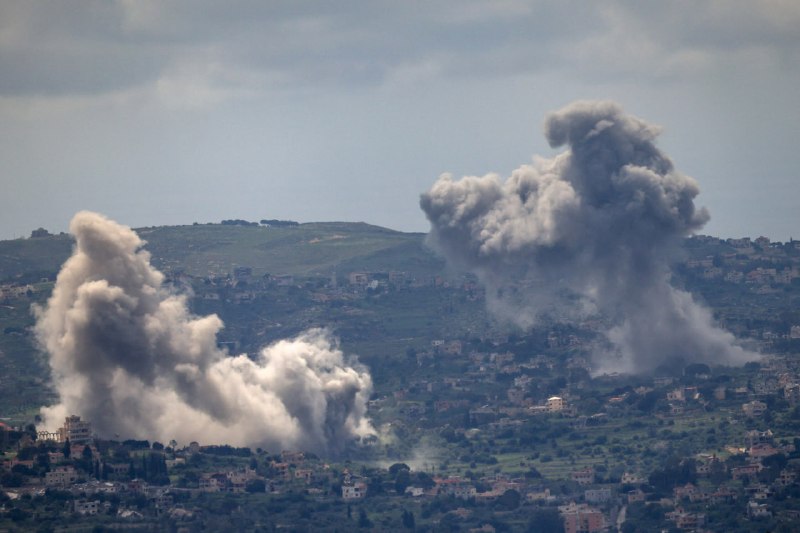
The remarks are not abstract. They presume a campaign that, by the president's own telling, is striking buildings and being judged by him on a case-by-case basis. The framing of the war as a counter-Hezbollah operation, distinct in Israeli and Western-wire language from a wider campaign against the Lebanese state, is the operative legal and political wrapper. Israel presents strikes as targeting militant infrastructure embedded in civilian areas; Lebanese and pan-Arab outlets report strikes that destroy residential blocks and displace communities, with civilian harm documented by UN agencies operating inside Lebanon.
Both descriptions are true at once. Hezbollah's presence in southern Lebanese villages and in the southern suburbs of Beirut is well documented in Western intelligence reporting and in Israeli security briefs. The destruction of those districts, including the strikes that Trump appears to be referring to when he says "not take down a building," is equally well documented by journalists on the ground and by UN OCHA situation reports that track displacement numbers across affected areas. The question that Trump's comments put on the table is not whether Israel should strike, but whether the destructive footprint of any given strike is proportionate to the operational gain — a question that Western capitals have largely declined to answer publicly, and that the Israeli defence establishment treats as an internal matter.
The asymmetry of partnership
"We are the big partner, and he is the very small partner." The line is blunt in a way that US presidents rarely are about Israel, and it does the rhetorical work of several policy memos at once. It acknowledges aid flows, arms transfers, and the diplomatic umbrella at the UN. It implies that the United States expects a consultative relationship in return. It sets up the conditions under which the United States can claim credit when restraint is exercised, and disclaim responsibility when it is not.
The asymmetry is real, even if it has been managed carefully on both sides. The United States supplies the air-refuelling capacity and a substantial share of the munition categories used in precision strikes; it maintains stocks in Israel that can be drawn on during an active campaign; it works through intelligence-sharing channels that, by both governments' public statements, have deepened since the 2023-24 war in Gaza and the subsequent broadening of confrontation with Iranian-aligned forces across the region. None of this compels Israel to take or refuse any specific target. It does mean that when the president of the United States calls a particular strike unhelpful, the comment is more than an opinion column.
Netanyahu's position, by contrast, is to absorb the advice in public and decline to be bound by it. His political coalition depends on constituencies for whom visible strength in Lebanon is a domestic asset, and his security establishment treats any externally imposed pause as a strategic gift to Hezbollah. The friction is therefore built into the relationship; the question is how loudly it gets discussed in any given week.
Why now
Trump's choice to have the conversation in the open on 17 June comes after a sequence of moves that have put the United States in an unusual position. The president has brokered — or claimed to broker — arrangements with several regional governments, including a draft text that he said had been sent to Israel on 17 June, characterised as "a draft to Israel, they are great partners." The precise content of the draft is not in the public record from the items read for this piece. What is in the record is the president's posture: engagement, ownership of the file, refusal to call for an end to operations, and an open preference for a less destructive tactical profile.
For Lebanon, the calculation is bleaker. The Lebanese state, working through whatever channels the diplomatic window allows, has limited ability to shape either the Israeli campaign or the American posture toward it. Domestic constituencies in both Beirut and the diaspora read Trump's remarks as confirmation that the United States will not intervene to halt the operation, regardless of Lebanese civilian casualties. Iranian-aligned outlets in the region have framed the same remarks as evidence of an open-ended permission slip. Neither reading is fully correct, but neither is baseless.
Stakes
If the trajectory of the past several weeks continues, the most likely short-term outcome is more of the same: operations continue, the US posture remains supportive-with-commentary, and the gap between American and Israeli tactical preferences narrows or widens in increments rather than steps. The long-tail risk is structural. A US-Israeli disagreement that is voiced in public, repeatedly, erodes the diplomatic certainty that has been the foundation of Israeli security planning for decades. Even when both governments treat the friction as manageable, adversaries and allies alike read it.
The other stake is humanitarian and is harder to fold into a strategic ledger. The Lebanese civilian population in the affected districts has been displaced, in many cases repeatedly, over the course of the campaign. The number of strikes that Trump is calling "gentler" strikes is, by his own framing, non-zero. Whether the president's commentary translates into fewer strikes of the kind he is publicly second-guessing is not knowable from the remarks themselves. What is knowable is that the United States has now placed itself on record, in the president's own voice, as having views on the proportionality of specific Israeli operations — without, so far, attaching those views to any mechanism that would change the operations themselves.
What remains uncertain
The single most consequential unknown is whether Trump's public commentary will produce a private adjustment. Presidents have made such comments before and seen no operational change. The diplomatic record of the past eighteen months suggests that when the United States wants to constrain Israeli operations, it does so through quiet channels that do not produce headline quotations; when it wants to preserve deniability, it offers public commentary without an enforcement mechanism. The 17 June remarks sit closer to the second pattern. Whether that is a deliberate choice or a constraint of the political environment in Washington is not in the public record.
Also unresolved is the status of the draft text the president referenced. If a US-Israeli draft exists, its provisions — whether it proposes a pause, a verification regime, an exchange mechanism, or something narrower — will determine whether the public comments and the document are part of the same negotiating posture or two separate signals crossing the same wire. Until the draft is reported in more detail, the gap between rhetoric and mechanism remains the story.
Desk note: this article leans on the live pool reporting of 17 June 2026 rather than on retrospective Western-wire reconstruction; the diplomatic substance of the draft Trump referenced remains to be reported.
Wire provenance
This editorial synthesis draws on the following public wire/social posts:
- https://t.me/ClashReport/123456
- https://t.me/amitsegal/123456
- https://t.me/ClashReport/123457
- https://t.me/ClashReport/123458
- https://x.com/sprinterpress/status/1234567890
- https://t.me/amitsegal/123457
- https://en.wikipedia.org/wiki/2024_Israeli_invasion_of_Lebanon