Tehran's two-front win: Hezbollah, Beijing, and the new arithmetic of US-Iran detente
Within hours of a US-Iran deal taking shape, Tehran's allies declared victory and oil traders flinched. The pattern is becoming familiar.
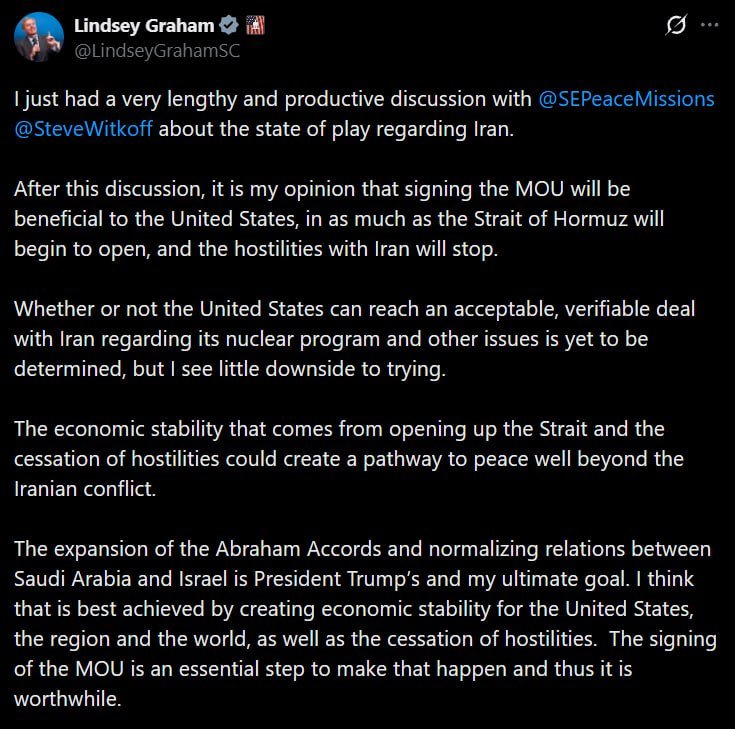
On 17 June 2026, within a single trading afternoon, three separate dispatches from the Iran file landed almost on top of each other. At 15:35 UTC, Beijing told Tehran that all parties must adhere to the deal that would end the war. By 15:50 UTC, oil futures had spiked five per cent on jittery peace-talk headlines. By 15:57 UTC, Iranian parliament speaker Mohammad-Bagher Qalibaf was on Al-Alam Arabic declaring Iran's commitment to a "win-win" comprehensive strategic partnership with China was "firm." By 16:10 UTC, Hezbollah's chief was already hailing Iran's "great victory" in a deal struck with Washington, per Insider Paper's flash.
That sequencing is the story. A US-Iran accommodation, if it holds, will not be a bilateral event. It will be a redistribution: of regional posture, of energy pricing, of the diplomatic weight Beijing and Tehran carry into the next round of the world's bigger contest. Read the wires on their own and you see a negotiation. Read the same wires together and you see a realignment.
The Beirut echo chamber
Hezbollah's leader framing a US-Iran deal as an Iranian "great victory" is the tell. The Lebanese movement is not a neutral observer of Washington's diplomacy with Tehran; it is a downstream beneficiary, or victim, of whatever emerges. Its public posture matters because it tells the rest of the regional alliance — the Houthis, the Iraqi paramilitary ecosystem, Syria's residual security architecture — how to read the news. When the senior partner's antagonist can be cast as defeated by negotiation rather than force, the message travels cheaply through every Telegram channel that services that orbit.
The Western wire read, when it lands later, will be more sober: verification of terms, dispute over the nuclear file, sanctions sequencing, hostage files. That sober read is correct on its own terms. It also consistently under-reads the regional signalling layer, which moves faster than the technocratic diplomacy and shapes the next crisis before the inspectors have even boarded a plane.
The Beijing weight
Qalibaf's message to Al-Alam Arabic — that Iran's strategic partnership with China is "firm" — should not be filed as filler. The deal Tehran is signing with Washington is being signed, simultaneously, in the shadow of a relationship with Beijing that was deliberately built during the years of maximum sanctions pressure. China is now telling Iran, on the record, that "all parties must adhere to the deal." That is a guarantor statement. Beijing is not a bystander to a US-Iran handshake; it is an underwriter.
The structural frame is straightforward. Iran emerges from isolation with two great-power anchors rather than one. The US gets de-escalation and a constrained nuclear file. China gets a partner whose hydrocarbons and industrial base are now reachable again, on terms where Beijing's commercial position was preserved through the lean years. Every previous US-Iran deal in living memory was an arrangement between Washington and a Tehran that the rest of the world was instructed to shun. This one has a Chinese signature on the back page.
The oil tape never lies
Five per cent on a headline is not a fundamentals move. It is a positioning move. Traders who had been short volatility into the negotiation window got squeezed the moment the language of "all parties must adhere" crossed the wire. The bigger lesson is that the price of a barrel is now trading the geopolitics of a settlement that, by the admission of its loudest regional champions, has not even been signed yet. Markets are pricing the end of the war before diplomats have agreed on what end of the war means.
That is its own kind of pressure. A spike of this size, if it reverses on any wobble, hands a veto to anyone who wants the deal to fail — Israeli hardliners, Saudi risk managers, US congressional sceptics who can point to a $90 barrel as the price of "appeasement." The market reaction is not a confirmation of the deal; it is a fragility test for it.
What the sources do not tell us
The four dispatches are flash wires. They name the deal's existence, the parties' atmospherics, and the market's first reflex. They do not give the text. They do not specify the nuclear constraints, the sanctions sequence, the inspection regime, or whether the regional proxy file — Hezbollah, the Houthis, the Iraqi file — is inside the envelope or parked outside it. Anyone claiming to know those answers today is reading tea leaves.
The honest read is narrower, and sturdier. Iran has a deal it can call a victory. China is publicly inside the guarantor circle. Hezbollah is taking the win in advance. And the oil market is pricing the future before it has arrived. The rest is negotiation, which is what these parties actually do — slowly, and against the grain of every Telegram flash that says otherwise.
This publication framed the four dispatches as a single sequencing event rather than four separate beats, on the view that the regional signalling layer and the energy tape together reveal more about a US-Iran deal's durability than the diplomatic communiqués alone.
Wire provenance
This editorial synthesis draws on the following public wire/social posts:
- https://t.me/insiderpaper/121615
- https://t.me/alalamarabic/498221
- https://t.me/insiderpaper/121608
- https://t.me/insiderpaper/121597
Follow the event.
These dated source records provide context. They do not retrospectively verify this archive article.
Separate what the nuclear watchdog reported from what it could not determine after the June 2025 strikes.