Trump's Iran posture fractures at the seams: World Cup, oil, and a piece of paper in hand
A week that began with an apparent diplomatic overture to Tehran ended with a US president refusing to guarantee the safety of Iranian World Cup players, while oil "independence" rhetoric collapses under market reality.
Three weeks into the World Cup, Iranian players on American soil have become an unlikely barometer of US foreign policy. On 18 June 2026, reporting carried by Mint Press News summarised the position now taken by the Trump administration: Washington will not guarantee the safety of Iranian athletes competing on US territory. The framing — that Iranian nationals in the United States "face hostility from the government" — is no longer an opposition talking point. It is the operating assumption of an ally-of-the-administration outlet covering a federation-level crisis in real time.
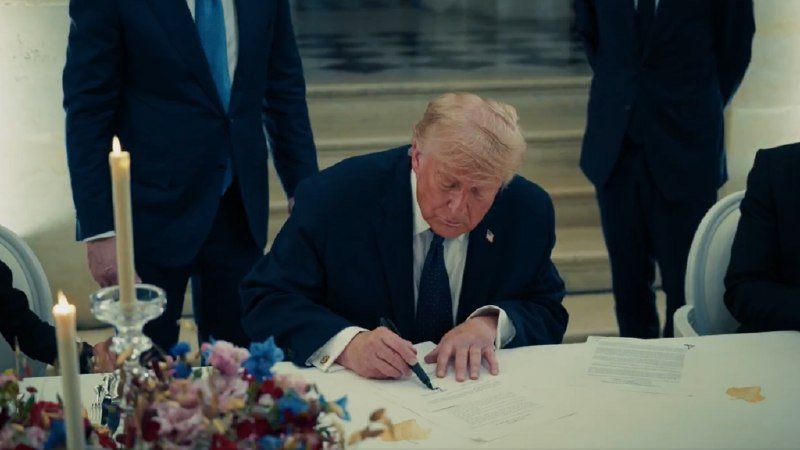
What makes the moment disorienting is the speed at which it arrived. The same week produced an image circulated by Middle East Spectator of an Iranian official visibly recoiling from a document bearing Donald Trump's signature — the disgust on his face evident, per the channel's own caption. Read alongside the World Cup posture, the picture is not a diplomatic hiccup. It is the visible end-state of an opening that closed before it could open. Whatever was on that paper, the Iranian side is treating the gesture as insult rather than invitation.
A sporting pretext, a political signal
The choice of venue is the story. Iran qualified for the 2026 FIFA World Cup, a tournament hosted across the United States, Canada and Mexico. Visa policy and the public safety guarantees routinely extended to visiting delegations are now an instrument of state. When the US president declines to underwrite the physical security of an Iranian squad, he is not making a sports announcement. He is signalling that the diplomatic channel, already narrow, is being narrowed further — and that the symbolic reach of US law into Iranian citizens' lives extends to the football pitch.
The Mint Press framing matters because it is one of the clearer English-language characterisations of the Iranian players' predicament that has run inside the US domestic conversation. It frames the Iranian athletes not as adversaries or negotiating chips but as a population the US government has decided to treat as hostile. That re-categorisation — from visitors to subjects of policy — is the structural move. Everything else, including the World Cup itself, is the backdrop.
The oil contradiction
The same afternoon, a separate current was running. A post by the Bowe Schay account, dated 18 June 2026, catalogued the inconsistency in Trump's public position on US oil "independence" — a posture that has flipped between energy-dominance swagger, strategic-petroleum-reserve interventions and now, implicitly, the diplomatic cost of being a swing supplier in a market where Saudi Arabia and the Gulf states retain pricing power. The post's coda was pointed: "The enemy can't predict your next move if you don't even know what you're doing yourself."
Stripped of its rhetorical garnish, the observation lands. A US administration that postures as energy hegemon while the SPR remains a managed political instrument, and while Gulf producers continue to set the marginal barrel, is not running a coherent energy strategy. It is improvising. The Iran question cannot be separated from that improvisation. Any deal that grants Tehran sanctions relief reshapes the oil market instantly; any deal that collapses — the more probable outcome as the week closes — leaves the White House holding the same exposure it began with, minus the diplomatic capital spent.
What the photo actually captures
The Middle East Spectator image is a piece of evidence, not a piece of commentary. An Iranian official is photographed holding a single sheet of paper — Trump's signature visible — with the facial affect the channel describes as disgust. Telegram channels, including Middle East Spectator, function here as primary-distribution infrastructure for material that would otherwise move through wire services on a longer lag. The image itself does not adjudicate what is on the page; it records a reaction. That reaction is the story.
A more cautious read: the document could be a routine communication, a protest artefact, a leaked correspondence, or a piece of stagecraft staged for a domestic Iranian audience. The sources do not specify which. What they do establish is that the photograph is circulating inside Iranian-aligned channels as proof that engagement with the current US administration carries reputational cost in Tehran. That perception is itself the policy outcome, regardless of what the page actually says.
Where this leaves the next 72 hours
Three trajectories are now in play. In the first, the World Cup fixture against Iran proceeds under standard FIFA protocols, and Iranian players are treated as a protected delegation — Trump's refusal to "guarantee safety" rendered rhetorical by the practical reality of host-city policing. In the second, the diplomatic collapse accelerates, Iranian state-aligned channels keep the photo in circulation, and Tehran declines any further paper from Washington until the November midterms reset the political map. In the third — the least likely but most consequential — a back-channel concession on sanctions enforcement or a prisoner exchange is announced within the week, and the photo is quietly retired.
What is structurally clear is that the United States is no longer operating from a position where its Iranian policy can be read as a single line. The energy file, the sporting file, the hostage-and-detainee file, and the regional-security file are being run on parallel tracks by different parts of the same administration, and the contradictions between them are now visible to audiences on both sides of the Persian Gulf. The Iranian official's expression in the Middle East Spectator frame is, in that sense, an unusually honest summary of the week.
This publication does not have independent confirmation of the contents of the document in the Middle East Spectator image, nor of the specific text behind Trump's reported remarks on Iranian players' safety. The framing here rests on the characterisation carried by Mint Press News on 18 June 2026, the Bowe Schay account's same-day catalogue of oil-policy inconsistency, and the Middle East Spectator distribution of the photograph itself. Subsequent wire reporting will determine whether the diplomatic channel is genuinely closed or merely performing closure.
Wire provenance
This editorial synthesis draws on the following public wire/social posts:
- https://t.me/Middle_East_Spectator