Trump and Iran's Pezeshkian sign Paris MOU as Tehran agrees to dilute enriched uranium
Signed over dinner at the Palace of Versailles, a US-Iran memorandum commits Tehran to dilute its enriched uranium stockpile in exchange for broad economic relief — a deal that, if it holds, reframes a year of escalation into a managed economic opening.
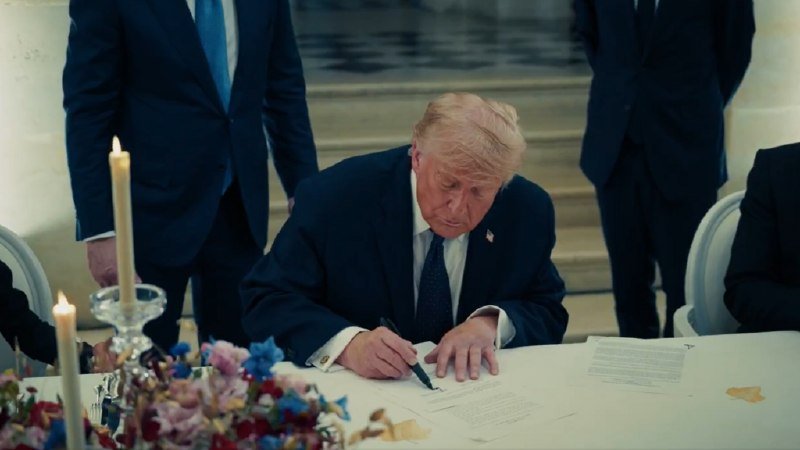
At 21:45 UTC on 17 June 2026, US President Donald J. Trump and Iranian President Masoud Pezeshkian signed a memorandum of understanding at the Palace of Versailles intended to close the latest chapter of a Middle East war that has, by any honest accounting, cost the region more than it has settled. The ceremony, hosted by French President Emmanuel Macron over dinner, produced both a signed document and a White House-released video of the pen touching paper — imagery that, in a deal of this sensitivity, is itself a kind of commitment device. Iran confirmed the signing on Thursday morning Tehran time, according to the Fars news agency. The deal's central bargain is straightforward: Tehran dilutes its stockpile of enriched uranium, and in return receives large-scale economic relief. That is a structure with precedent, but the politics around it are anything but routine.
What makes the Paris MOU worth treating carefully, rather than as another announcement in a long cycle of announcements, is the asymmetry it codifies. The West gets a non-proliferation outcome it has demanded for two decades; Iran gets sanctions relief it has demanded for the same period. Both sides can claim a win. The harder question — what enforcement mechanism sits underneath a memorandum that is, by definition, not yet a treaty — is the one the next several months will answer.
What was signed, and what was not
The text released on 18 June describes an arrangement in which Iran agrees to dilute its enriched uranium in return for broad economic relief, according to France 24's live coverage of the signing. The deal is a memorandum of understanding, not a binding treaty — a distinction that matters because MOUs typically signal political intent and a roadmap, while leaving the operative clauses to subsequent negotiation. Axios, cited by both Fars and the geopolitical-monitoring channel GeoPolitical Watch, reported that Trump personally signed a copy of the agreement during dinner with Macron at Versailles, with a photograph of the signed document forwarded to the Iranian side.
The Iranian read, carried by Fars in its English-language wire, framed the moment as confirmation of the signing rather than as a substantive revelation of terms. That is consistent with how Tehran has historically managed breakthroughs: confirm the gesture, defer the detail, preserve leverage for the technical follow-up. The American read, propagated through the White House video, foregrounded the personal — the president's hand, the presidential seal, the dinner setting — as evidence of seriousness. Both framings are doing work for their domestic audiences.
Why Versailles, why Macron, why now
The choice of venue is not decorative. By hosting the signing at the Élysée-adjacent Palace of Versailles and pairing the principals with Macron, the deal acquires a European imprimatur that a bilateral signing in Washington or Geneva would not. That matters for two reasons. First, sanctions relief on the scale implied by France 24's language ("large-scale economic relief") will require the cooperation of European financial institutions and EU member-state regulators, not just the US Treasury's Office of Foreign Assets Control. A French-hosted signing gives European compliance officers a political cover story. Second, it repositions the European Union as a diplomatic actor in a Middle East file from which it has been progressively marginalised, particularly since the collapse of the 2015 Joint Comprehensive Plan of Action's implementation in 2018 and the subsequent cycles of escalation.
For Macron, the hosting role is a domestic and a foreign-policy asset: France as indispensable intermediary, the Elysée as the venue that closes a war. For Trump, the venue diffuses the appearance of a unilateral concession to Tehran, an image that would be politically costly in a US environment where any Iran deal attracts immediate congressional scrutiny. For Pezeshkian, the legitimacy conferred by a European co-signatory provides cover against hardline critics in Tehran who frame any accommodation with Washington as capitulation.
The counter-narrative: an MOU is not a treaty
The most plausible alternative read of the 17 June ceremony is that the document is a holding action — a piece of theatre that buys time for negotiations that have not yet produced enforceable commitments. Sceptics will point to three structural weaknesses. The MOU format itself is non-binding; the verification regime for diluted uranium is unspecified in the public readouts; and the economic-relief architecture depends on a sanctions architecture that the United States can in principle unwind, but which requires waivers and licensing decisions that take months to operationalise. Iran's Fars wire emphasised the signing itself, not the timetable, which is itself an indicator that Tehran is buying diplomatic space rather than closing a deal.
A further scepticism is procedural. MOUs between the United States and Iran have collapsed before — most pointedly the 2018 US withdrawal from the JCPOA, which Iran had spent two years complying with in good faith, by the International Atomic Energy Agency's own accounting. Tehran's negotiating class has institutional memory of that episode. A memorandum signed in a gilded hall is, for them, a promissory note that can be defaulted on at the convenience of the other party. The economic relief on offer is what makes the MOU durable; the political goodwill is not.
What the larger pattern looks like
Read in isolation, the Paris MOU is a discrete event. Read in sequence, it is one node in a broader restructuring of Middle East economic and security arrangements that has been underway, in fits and starts, since the 2020 Abraham Accords and the regional realignments those documents anticipated. Each successive agreement has traded nuclear, territorial, or economic concessions for normalisation, with the implicit currency of the deal shifting as the underlying balance of leverage shifts. What this MOU does, if it holds, is reopen the Iranian economy to global capital at a moment when Gulf states, Turkey, and Egypt are competing for the same investment flows. That competition is the structural frame inside which the document's real significance sits: it is a permissive signal to investors who have been waiting on the sidelines, not a final settlement of the nuclear file.
The pattern that matters most for readers is the recurring one. Diplomatic openings between the United States and Iran have repeatedly been followed by cycles in which hardliners on one or both sides test the limits of the deal — through proxy actions, through sanctions evasion, through nuclear advances at the margin. A deal that does not anticipate that testing, and does not build a verification architecture robust to it, will be vulnerable to the same kind of collapse that ended the JCPOA's effective life. The Paris MOU, as presently described, does not yet disclose the architecture that would make it durable. That is the honest gap in the available reporting.
Stakes, and what remains uncertain
If the deal holds and the diluted-uranium commitment is verified, Tehran gains access to foreign exchange, hard-currency trade, and the kind of investment that its oil-dependent economy has been starved of for over a decade. The Iranian rial, which has traded at multi-thousand-to-the-dollar discount levels, would face an immediate repricing pressure. The Gulf states would face the first genuine peer-competitor for post-hydrocarbon investment in the region. Israel, whose security doctrine has rested in part on the assumption that Iran would remain a sanctioned, isolated actor, would face a strategic environment it has not operated in for a generation.
If the deal collapses — whether by US withdrawal, by Iranian non-compliance, or by a proxy incident that one side uses as a pretext — the regional escalation ladder is short. The sources available at the time of writing do not specify the verification regime, the timeline for dilution, or the sequence in which economic relief is to be phased. The MOU, in other words, is the photograph of the handshake. The handshake itself, and what it produces, is the next twelve months.
Monexus framed the signing around the MOU's structural asymmetry — what each side is trading, and what each side retains as leverage — rather than as a victory lap for either principal. The wire read on Wednesday night emphasised the ceremony; the harder reporting will be in the verification architecture that has yet to be disclosed.
Wire provenance
This editorial synthesis draws on the following public wire/social posts:
- https://t.me/FarsNewsInt
- https://t.me/farsna
- https://t.me/osintlive
- https://t.me/FarsNewsInt
- https://t.me/GeoPWatch
Follow the event.
These dated source records provide context. They do not retrospectively verify this archive article.
Separate what the nuclear watchdog reported from what it could not determine after the June 2025 strikes.