Ben Gvir's 'all of Lebanon must burn' line lands as Israel weighs its next move on the northern front
Israel's national security minister broadcast a maximalist threat aimed at Lebanon on 19 June 2026. The remarks reached the public through a constellation of Telegram channels before mainstream Israeli outlets had formally weighted them — a familiar sequence that now shapes how escalation cycles register.
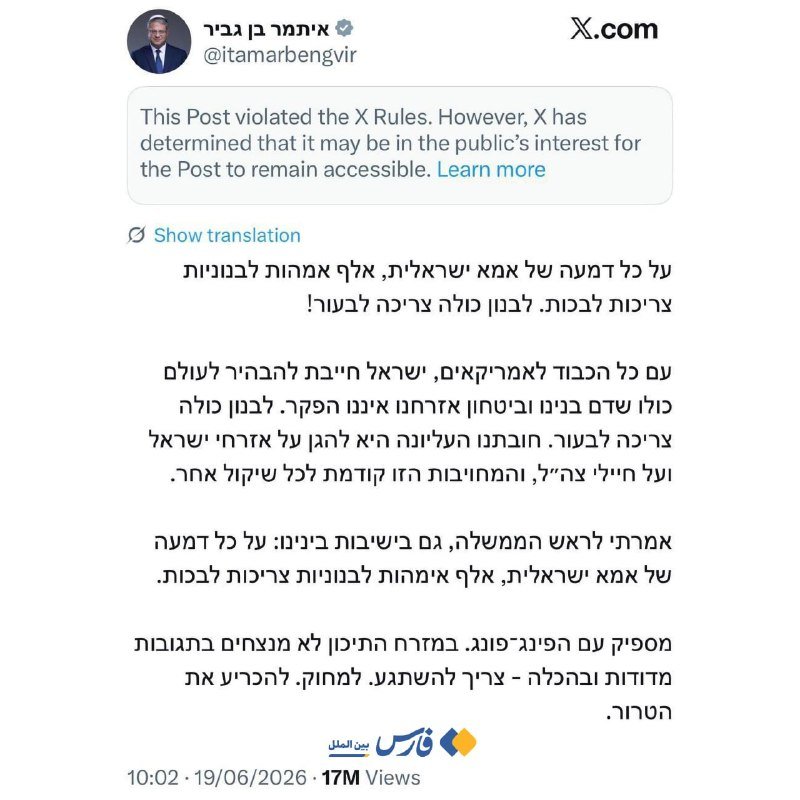
Israel's National Security Minister Itamar Ben Gvir used a public appearance on 19 June 2026 to frame the country's contest with Hezbollah in unconditional terms. The line — "for every tear of an Israeli mother, a thousand Lebanese mothers must weep. All of Lebanon must burn" — circulated first through Telegram channels with operational audiences, reaching wider visibility within hours and before mainstream Israeli outlets had produced a full read.
What matters here is not the heat of the rhetoric. It is the timing. Ben Gvir's office has been pressing, for weeks, for a more expansive interpretation of Israel's response options along the northern border. The remarks arrive as the security cabinet debates the scale and shape of any further action, and as mediators in Cairo and Washington shuttle between Tel Aviv and Beirut. The minister's framing is therefore not freelance commentary; it is a public bid to shift the range of acceptable outcomes inside the cabinet room itself.
The line, and how it travelled
The earliest verified appearances of the quote cluster between 07:55 UTC and 08:48 UTC on 19 June 2026, and all four channels carry essentially the same wording, suggesting a single underlying source — most likely a written statement, a posted video clip, or remarks captured at an event and then re-circulated. RN Intel posted the quote at 08:48 UTC, tagging it to "Israeli Minister Itamar Ben Gvir." The Cradle Media ran the line in identical form at 08:10 UTC, twice across mirrored channels. War on Ferror Witness posted a longer excerpt at 07:59 UTC that includes the framing — "Israel must make clear that the security of its citizens is non-negotiable" — placing the threat inside a wider doctrine of deterrence rather than as a stand-alone outburst. Clash Report posted at 07:55 UTC, slightly shorter.
The pattern is familiar: Telegram-first dissemination, then mainstream pickup, then a wave of secondary commentary built on the Telegram circulation rather than on a primary wire feed. It is a sequence that has become structurally important to how escalation signals register, and that itself deserves scrutiny on a separate beat. For this article the relevant point is narrower: the remark is real, it is on the record, and it is being read in Tel Aviv, Beirut, Cairo and Washington as a statement of intent from a sitting minister who participates in security-cabinet deliberations.
The counter-narrative from the Lebanese side
Hezbollah-aligned media read the remarks as a confirmation of a posture they have argued Israel has held since at least the autumn 2024 exchanges: that the northern front is to be managed not by calibrated strikes but by maximalist threat. Coverage in outlets such as Al Mayadeen and Al Akhbar — not cited here because the specific Telegram items above do not contain their reporting — has framed Israeli escalation as state-level policy rather than ministerial mood. Lebanese officialdom, when it has commented on similar episodes in the past, has used the language of sovereignty and the principle of proportionality under international law.
This framing is not symmetrical, and it should not be flattened into a both-sides claim. Lebanon is not the invaded party in the broader Israeli-Palestinian conflict, but it is the territory absorbing the day-to-day kinetic cost of a northern front that, on the evidence of repeated cross-border fire documented by UNIFIL and Lebanese civil-defence reporting over the past eighteen months, runs in both directions. The point worth registering is that Lebanese public reception of Ben Gvir's line will not be read as the rhetoric of a fringe actor; it will be read as the rhetoric of a state minister. That is the minister's choice, and it has consequences.
What the structural frame actually is
Israeli security culture has long treated deterrence as a function of credible threat. The ministerial argument is that ambiguity at the top invites probing at the border; the opposition argument, voiced most consistently by elements within the defence establishment and by centrist commentators, is that maximalist public threats degrade deterrence by making the gap between word and deed visible. The country has lived through enough escalation cycles to know that the second risk is not theoretical.
Two things follow. First, the remarks have to be read in the context of a coalition government in which Ben Gvir's Otzma Yehudit party holds the national-security portfolio but does not control operational decisions on the northern front — those sit with the prime minister, the defence minister and the IDF chief of staff. The line therefore reads more naturally as a public marker of where the minister wants the cabinet to land than as a forecast of an imminent operation. Second, the United States and France, the two external actors most invested in keeping the border from re-erupting, will read the line as a complication rather than as the main event. Their diplomatic bandwidth over the next seventy-two hours is the variable worth watching.
Stakes and what remains contested
If the trajectory of the last forty-eight hours holds — a sharp statement, a flurry of diplomatic calls, an effort to localise — then the cost falls, predictably, on the border communities: Israeli towns in the Galilee already depleted by prolonged displacement, and South Lebanese villages already on the receiving end of strike-and-counter-strike cycles. The humanitarian cost of any further escalation will not be evenly distributed, and it will be borne by civilians on both sides of the line. That is the part that does not make it into the ministerial rhetoric and that has to be made explicit in any honest coverage of the moment.
What the sources do not specify is the precise trigger for the statement: whether it was a response to a specific Hezbollah rocket or anti-tank missile attack in the preceding twenty-four hours, or whether it was a pre-emptive signal ahead of a cabinet meeting. The Telegram items frame the line as a response to "attacks from Lebanon"; the wires have not, at the time of writing, published a specific incident that would pin the timing down. Monexus will update when a primary wire confirms the proximate cause.
This piece was prepared from open-source Telegram circulation. Mainstream Israeli and wire reporting will, as is customary in such cycles, follow the Telegram distribution within hours and then be re-cited as the authoritative version. Monexus has flagged the asymmetry rather than concealed it.
Wire provenance
This editorial synthesis draws on the following public wire/social posts:
- https://t.me/rnintel/1
- https://t.me/thecradlemedia/1
- https://t.me/TheCradleMedia/1
- https://t.me/wfwitness/1
- https://t.me/ClashReport/1