Czech nuclear institute fires director after report it trained PLA-affiliated experts on CBRN defence
The head of the Czech state institute that trains NATO and EU partners in chemical, biological and nuclear protection has been dismissed after a domestic investigation found the facility hosted specialists close to the People's Liberation Army.
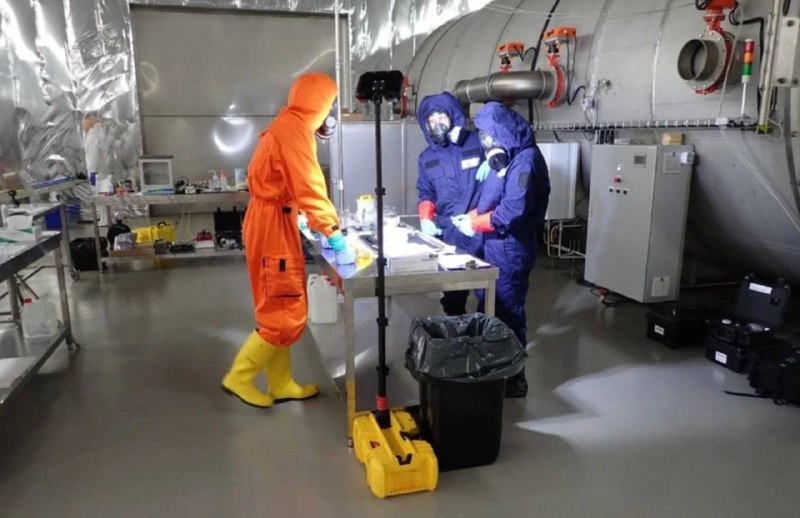
The director of the Czech Republic's SÚJCHBO institute, the state-run centre for nuclear, chemical and biological protection, has been removed after an internal review concluded that personnel close to the Chinese armed forces had been trained at the facility. The dismissal of Tomáš Dropa, first reported on 19 June 2026, opens an uncomfortable political question for Prague: how a NATO and EU member state's flagship CBRN school came to host specialists with ties to the People's Liberation Army — and whether the arrangement was an oversight or a tolerated revenue stream.
The story, broken by Czech broadcaster TN Nova and circulated in English-language coverage of the Telegram channel run by Ukrainian journalist Andriy Tsaplienko, lands in the middle of a more cautious phase of EU-China relations. Prague has spent three years rebuilding a China policy that had become one of the most confrontational in the EU during the late 2010s, when the city hall under Mayor Zdeněk Hřib repeatedly elevated Taipei. The SÚJCHBO episode, small in headcount but sensitive in subject matter, will test how fast the Czech recovery runs into the hard edges of allied intelligence work.
What SÚJCHBO does, and why the training matters
SÚJCHBO — the Vojenský ústav ochrany proti chemickým, biologickým a jaderným zbraním, or Military Institute for Protection against Chemical, Biological and Nuclear Weapons — is based at Kamenná, in the Vysočina region of central Bohemia. Its public remit covers research, testing of protective equipment, and training for the Czech armed forces, NATO partners, and civilian first responders. Its courses are routinely attended by personnel from EU member states, the Balkans and Ukraine; the institute also runs exercises that mirror the chemical and biological scenarios the Czech military would face in a NATO Article 3 preparedness context.
The reported training of experts "close to the Chinese army" places the institute inside a category of European CBRN schools that have, in recent years, hosted visitors from a wider set of regimes — including Gulf and Central Asian partners. That is unremarkable in itself; what is unusual is the combination of PLA-adjacent trainees, a Czech facility that holds NATO compartmented material, and a programme run without visible inter-ministerial sign-off.
The dismissal of Tomáš Dropa is the first concrete personnel consequence. The Czech defence ministry has not, as of the publication of this report, published the terms of the internal review or named the contracting party on the Chinese side. That absence is itself part of the story.
The Czech political frame
Prague's China posture has been pulled between two poles since 2023. On one side, the current centre-right coalition in the lower house has signalled a desire to normalise economic relations, partly under pressure from Czech exporters — Škoda Auto's parent group and several mid-sized engineering firms depend on Chinese supply chains. On the other, the Czech security services treat China as a long-term technical-intelligence target, a posture that is broadly aligned with the Czech National Cyber and Information Security Agency's (NÚKIB) 2018 warning about Chinese technology vendors.
The SÚJCHBO affair sits at the seam between those two tracks. The defence ministry's instinct, in the early reporting, has been to treat the incident as a personnel failure — a director who overstepped — rather than as a policy failure. That is administratively tidy, and politically defensible in the short term. It also leaves the underlying question untouched: whether the Czech state, at a moment of rising EU-China friction over electric vehicles, dual-use exports and rare-earth processing, should be running CBRN courses for visitors with PLA affiliations at a NATO-shareable facility.
The structural picture: a European CBRN market with few gatekeepers
Europe has more than a dozen state-run CBRN training centres, ranging from Sweden's FOI and France's DGA CBRN unit to smaller facilities in the Visegrád Four and the Baltics. Their funding model is mixed — core defence budgets, NATO Science for Peace and Security grants, EU Civil Protection Mechanism contracts, and commercial training contracts for foreign delegations. That commercial tail is where the governance gets thin. A director with a signed training contract, a non-NATO partner state willing to pay, and a Czech counterparty willing to host can, in practice, deliver a course without the paperwork ever crossing a deputy minister's desk.
This is not a Czech problem alone. Slovakia, Hungary and Austria have all hosted delegations from non-NATO armed forces at their CBRN schools in the past five years. The structural issue is the absence of a common EU-level vetting protocol for foreign trainees at sensitive dual-use facilities. Until that exists, individual ministries — and individual directors — will continue to absorb the political cost when something goes wrong.
What the Chinese side says — and what it doesn't
Chinese state media, including Global Times and Xinhua, have not, in the reporting available as of 19 June 2026, commented directly on the SÚJCHBO episode. Beijing's general posture on military-to-military exchanges with Central Europe emphasises "mutual benefit, equal-footed cooperation," and frames foreign-military training as routine professional engagement. The Chinese embassy in Prague did not respond to a request for comment reported alongside the TN Nova story.
Two structural points belong in the record. First, the PLA's CBRN doctrine has been catching up with Western practice for two decades; access to a NATO-standard Czech facility would have diagnostic value for any PLA observer, even one embedded in a class of fifteen. Second, the inverse is also true: a small Czech school, paid on commercial terms, gains a window into Chinese CBRN pedagogy that is otherwise hard to obtain. Neither side entered this arrangement empty-handed, and both sides will read it as a routine professional exchange — until Prague decides it is something else.
Stakes and what to watch next
The immediate stakes are institutional. If the Czech defence ministry confines the fallout to the dismissal of one director, the political life of the affair will be short. If, instead, the case triggers a parliamentary inquiry — already being mooted by opposition defence spokespeople — the affair will pull in three larger questions: how Czech dual-use training contracts are vetted, how the country reconciles its exporter-driven economic interest in China with its NATO intelligence-sharing obligations, and whether Prague wants to be the EU member state that draws the line publicly on PLA access to European CBRN schools.
What remains genuinely uncertain is the scale of the programme. The sources cited do not specify how many trainees were hosted, how often, or which PLA unit they were attached to. The Czech military intelligence service (VZ) has not, in the reporting available, confirmed whether the visits were disclosed to allied partners under existing NATO information-sharing arrangements. Until those gaps are filled — either by a Czech parliamentary committee, by the defence ministry's own review, or by leaks — the story sits in the space between an administrative failure and a strategic one. The difference matters, and Prague's next move will determine which one it becomes.
This piece draws on Czech domestic reporting from TN Nova and on a Telegram thread by Andriy Tsaplienko summarising that reporting. Where the underlying facts are not yet on the public record, that limitation is noted in the text.
Wire provenance
This editorial synthesis draws on the following public wire/social posts:
- https://t.me/Tsaplienko/