The thin line at the Litani: Israel, Hezbollah and the geometry of a ceasefire that isn't one
Israeli officials say a ceasefire is in effect; Hezbollah says the fighting is still on. Both can be true at once, and the Litani riverbank is where the contradiction lives.
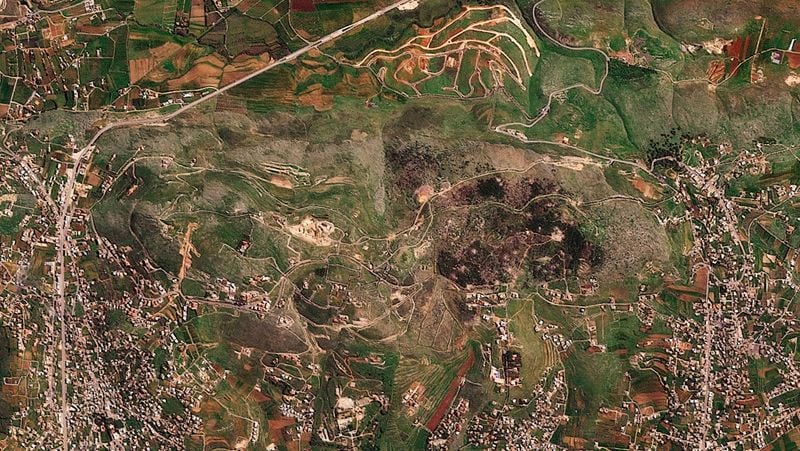
On 19 June 2026, a senior Israeli official told Channel 13 that a ceasefire was in effect — and that if Hezbollah did not attack Israel, "for us it is not wartime." Less than four hours earlier, Yaron Avraham of Israeli Channel 12 had said the same thing, in almost the same words. The statement was carefully constructed: Israel, the official insisted, had entered a ceasefire, was holding its positions in the security zone inside southern Lebanon, and reserved the right to respond if fired upon. The phrasing is now the operating definition of what counts as calm on the Israel-Lebanon border.
The same morning, Hezbollah released footage of killed Israeli soldiers in southern Lebanon, captioned in Hebrew: "If you are going to withdraw anyway, why be the last to die?" The video arrived with an operational claim — a tank crew destroyed in what Hebrew-language media, per The Cradle Media's reporting, described as a "disaster" for the IDF. The contradiction is not a reporting error. It is the situation. Two ceasefire declarations and a strike on the same morning, broadcast in three languages, with no one in the room pretending the two are consistent.
This is not a war that has ended. It is a war that has acquired a vocabulary for describing its own non-end. To read the morning's dispatches is to enter a peculiar diplomatic grammar in which a "ceasefire" coexists with active operations, declared withdrawals collide with entrenched positions, and the public message from each side is addressed less to the other than to its own domestic audience. The Litani river — long the informal line beyond which neither side is meant to concentrate firepower — is once again the geometry of the arrangement. The question is whether the geometry is holding.
A statement that names itself a ceasefire
The Israeli formulation, repeated across Channels 12 and 13 within hours on 19 June 2026, is striking in its conditional structure. A ceasefire is in effect, the official said — but only conditionally. "If we are attacked, we will respond." That is the conventional structure of any ceasefire between adversaries who do not trust each other; it is also a structure that leaves the threshold of "attack" entirely to one party. The Israeli statement does not commit Israel to a particular troop posture, a particular timeline, or a particular withdrawal schedule. It commits Israel to the language of ceasefire, while preserving the operational latitude to define what violates it.
The Israeli channels emphasised two further points. First, that IDF forces "remain in southern Lebanon" — that is, in the security zone north of the border and south of the Litani, the strip that has been the locus of the ground phase of the war. Second, that Israel is "not in wartime" — a domestic-political formulation aimed at the Israeli public, and at reservists and displaced communities whose daily life is calibrated to whether the country is technically at war.
The distinction matters because Israeli and Hezbollah positions are not symmetrical, and never have been. Israel is a state with a recognised military, an international legal personality, a parliamentary opposition, and a domestic press that demands accounting for its soldiers. Hezbollah is a non-state armed organisation nested inside a fragile state, accountable to its own leadership cadre, with its own media apparatus and its own logic of escalation. Each side describes the same moment in language tuned to the audience that will hear it.
The Hezbollah counter-frame
The Cradle Media's midday reporting on 19 June 2026 framed the situation from the other bank of the Litani. According to its coverage, Hezbollah's killing of an Israeli tank crew in southern Lebanon that day prompted "a brutal wave of Israeli" strikes in response — language carefully chosen to emphasise Israeli escalation in the face of what Hezbollah presents as legitimate resistance. The accompanying video, captioned in Hebrew and addressed to Israeli soldiers, is part of a deliberate psychological-operations repertoire Hezbollah has refined over decades. "If you are going to withdraw anyway, why be the last to die?" is not a ceasefire message. It is a message to the IDF's deployed personnel that the war is still on, and that leaving is the rational move.
The asymmetry of media access is part of the story. Israeli officials can speak, by name, on Israeli commercial television, because they have institutional standing and the protection of anonymity they accept on the record. Hezbollah's statements are mediated through outlets aligned with the Axis of Resistance — channels whose editorial line is part of the message. The Cradle's coverage of this episode is itself a Hezbollah-adjacent framing: accurate on the operational claim (a tank crew destroyed), interpretive on the surrounding characterisation ("disaster" attributed to Hebrew media without naming the outlet), and structural on the suggestion that the Israeli response will outrun the provocation. Readers should weigh it as such.
What matters analytically is that Hezbollah is not disputing that a ceasefire language exists. It is disputing who is bound by it, and on whose terms. The organisation has not declared an end to its operations. It has framed the Israeli posture — troops still deployed in southern Lebanon, ongoing strikes in response to ground attacks — as the continuing war, with itself in the role of defender. The two framings share a river but not a vocabulary.
What the geography actually holds
To understand why both sides can say what they are saying without obvious bad faith, it helps to look at the map. The Litani river runs roughly parallel to the Israel-Lebanon border, some 25 to 30 kilometres inland. South of the Litani and north of the Blue Line, the territory has been the scene of repeated Israeli-Hezbollah confrontations since the 1980s. Israeli forces in the strip after the 2024 escalation occupied a "security zone" with the same name and roughly the same geography as the one they held from 1985 to 2000. The phrase "security zone" is itself a historical argument: it carries the memory of an 18-year occupation that ended in a unilateral Israeli withdrawal under Hezbollah pressure.
When the Israeli official says the IDF "remains in southern Lebanon," the phrase refers to that strip. The Israeli message — "we are in a ceasefire, we remain where we are, we will respond if attacked" — is, in effect, a position statement: the ceasefire is being declared from inside the security zone, not from behind the Blue Line. Hezbollah's message — release footage of killed soldiers in southern Lebanon, threaten late-leavers, promise more operations — is being issued from south of the Litani at the Israeli deployment, not from north of the Litani at the border. Each side is addressing the other's most forward troops, not the other's capitals.
This is not unusual in the history of Israel-Hezbollah confrontations. The 2006 ceasefire, brokered by the United Nations under Security Council Resolution 1701, did not end the underlying dispute; it froze it into a structure in which UNIFIL patrolled south of the Litani and Hezbollah was meant to disarm north of it, with neither side fully complying. The arrangement now being described is, in some respects, a less formal version of that pattern: a verbal ceasefire between named spokespeople, with the operational latitude of both sides preserved and the underlying territorial question unresolved.
A ceasefire that names itself by its exceptions
The structural frame, stripped of diplomatic courtesy, is this: a ceasefire announced by its own exceptions. The Israeli statement does not declare peace, does not announce a withdrawal, does not commit to a timeline, does not accept third-party monitoring, and does not concede the principle that its forces are in Lebanon by right rather than by sufferance. The Hezbollah statement does not declare a halt to operations, does not accept the Israeli presence in southern Lebanon, and does not move its own forces away from the confrontation line. The exceptions are the substance.
This is not the same as saying the ceasefire is a fiction. Verbal ceasefires that the parties describe in mutually incompatible terms can hold for months or years — Resolution 1701's case shows that. They hold by procedural inertia, by mutual war-weariness, by the absence of a triggering incident. They collapse when one side judges that the cost of breaking the silence is lower than the cost of staying silent.
What is unusual about the present arrangement is the speed of its declaration. Israel's Channel 12 and Channel 13 statements on the morning of 19 June came in the same news cycle as Hezbollah's video of killed soldiers and the Cradle's report of the tank crew strike. A ceasefire, even a conditional one, declared the same morning as a tank crew is destroyed and a video is released, is being declared into a vacuum the parties themselves have just re-pressurised. The exceptions, in other words, are not future possibilities. They are the events of the morning.
Stakes and trajectory
The stakes of this arrangement are concrete. For Israeli civilians in the north, the question is whether schools reopen, whether the displaced return to border communities, whether the air-raid siren cycle that has punctuated life since October 2023 abates. For Lebanese civilians south of the Litani, the question is whether the village they fled last year is still standing, whether the next Israeli strike follows a tank crew in a field or a Hezbollah launcher on a roof, and whether the international donors who have funded reconstruction will release funds contingent on calm they cannot verify. For Hezbollah, the question is whether the Israeli position in southern Lebanon erodes by deadline or by attrition — and whether the Israeli public, told it is "not in wartime," will accept the slow loss of soldiers in a strip the government says it is not, technically, fighting to hold.
The structural reading is sober. A ceasefire named by its exceptions tends to last only until one of the exceptions is triggered, at which point the parties will dispute which side triggered it. The 19 June dispatches already contain the seeds of that dispute: the Israeli framing reserves the response, the Hezbollah framing reserves the operation, and each side has the evidentiary footage to make its case. The arrangement can persist for weeks or months on procedural goodwill. It can also collapse inside a news cycle, on a morning like this one, if either side concludes that the political return on a new strike exceeds the political cost of breaking the verbal ceasefire it just declared.
The Litani, in the end, holds the geometry. It does not hold the politics. The river does not know what the spokespeople mean when they say "ceasefire." It only knows where the fire falls.
Desk note: Monexus has read this episode against Israeli commercial-television reporting carried on Telegram, alongside coverage from Hezbollah-adjacent outlets. The Western wire has not yet filed its own characterisation of the morning's events; this piece will be updated as that reporting arrives. The Israeli statements are taken at face value as policy language; the Hezbollah-affiliated footage and claims are treated as primary-source material with explicit sourcing caveat.
Wire provenance
This editorial synthesis draws on the following public wire/social posts:
- https://t.me/rnintel
- https://t.me/wfwitness
- https://t.me/thecradlemedia
- https://t.me/TheCradleMedia
- https://t.me/thecradlemedia
- https://t.me/TheCradleMedia
- https://en.wikipedia.org/wiki/United_Nations_Security_Council_Resolution_1701
- https://en.wikipedia.org/wiki/South_Lebanon_conflict_(1985%E2%80%932000)