Israeli strikes batter Nabatieh district in a single afternoon as southern Lebanon ceasefire teeters
Seven Israeli airstrikes in roughly eleven minutes hit the Nabatieh district on 19 June 2026, the most concentrated barrage in southern Lebanon in weeks, and a reminder that the November 2024 ceasefire now exists mostly on paper.
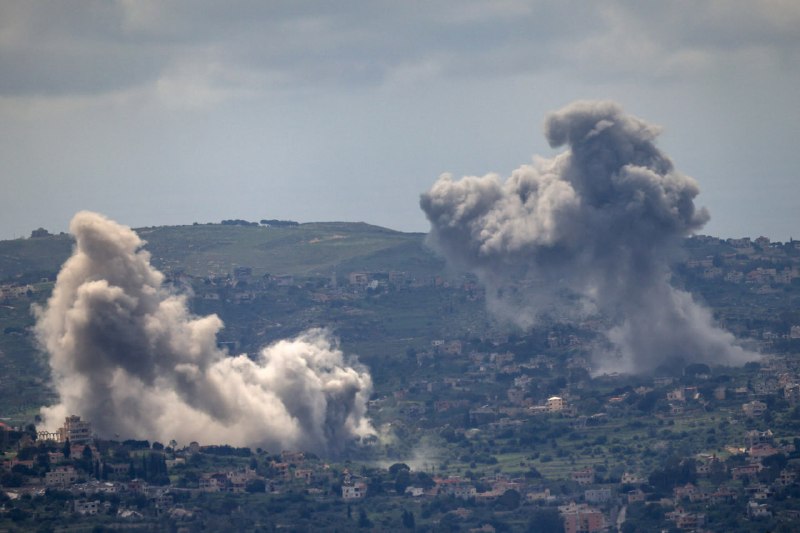
In the space of eleven minutes on the afternoon of 19 June 2026, Israeli warplanes struck the Nabatieh district of southern Lebanon at least seven times. The barrage, beginning at roughly 13:11 UTC and continuing through 13:22 UTC, hit the town of Kfarsir southwest of Nabatieh, the city of Nabatieh proper, and the El-Faouqah neighbourhood just to the southeast, according to Telegram channels documenting the strikes in real time. None of the seven separate reports on the strikes names a specific Hezbollah target, an official Israeli statement of intent, or a casualty count. What the reporting does establish is tempo: this was the most concentrated single-afternoon Israeli bombardment of south Lebanon in several weeks, and it landed on a strip of territory that, on paper, has been off-limits to Israeli airpower since the ceasefire of late November 2024.
The November 2024 arrangement ended a year of open cross-border war between Israel and Hezbollah, an Iranian-aligned Shia movement that had spent the previous twelve months firing rockets, drones and anti-tank munitions into northern Israel in solidarity with Hamas following the 7 October 2023 attacks. The deal's central bargain was simple: Hezbollah would withdraw its fighters north of the Litani River, and Israel would halt offensive operations in Lebanese airspace. The arrangement was never a formal treaty; it rested on United States and French guarantees, was monitored by a United States-brokered mechanism, and was always described by Israeli officials as contingent on the absence of Hezbollah re-mobilisation south of the Litani. Eighteen months on, both sides have been chipping at it.
What the afternoon's reporting actually shows
The Telegram channels carrying the strike reports — rnintel, AMK_Mapping, and wfwitness — all belong to a category of open-source intelligence accounts that follow Israeli and Hezbollah military movements across the Lebanon border. Their reporting is granular, near-instantaneous, and raw. The first item in the cluster, at 13:11 UTC, announces an Israeli airstrike on Nabatieh El-Faouqah, the district's southeastern edge. Two minutes later, the same channel posts an identical line, then a third at 13:16 UTC adding that Kfarsir, southwest of the city, has been struck. At 13:20, AMK_Mapping reports "new Israeli airstrikes on the Nabatieh area," without specifying which settlement. The 13:22 UTC update from rnintel returns to El-Faouqah and Nabatieh proper, with imagery. wfwitness, at 13:12 UTC, corroborates the Kfarsir strike independently.
What the reporting does not contain is the part of the story that readers most need. There is no Israeli Defense Forces (IDF) statement, no Hezbollah claim of responsibility for any precursor rocket fire, no casualty tally from the Lebanese Ministry of Public Health, no identification of the structures hit (the absence of the word "civilian" or "military" is itself notable), and no timeline explaining what triggered the first strike at 13:11. The cluster describes consequences without causes, in the way that an earthquake feed describes shaking without naming the fault.
That asymmetry is itself part of the story. In any given week, Israeli airstrikes on south Lebanon are now reported in southern-Lebanese and pan-Arab media, occasionally picked up by the Reuters and AFP wires, and almost never given a dedicated IDF briefing. The dominant frame on the ground is the absence of a frame.
The ceasefire that exists mostly on paper
The November 2024 arrangement has been fraying on both sides for most of 2025 and 2026. Israeli jets have continued to fly over south Lebanon; the IDF has publicly stated that it reserves the right to strike what it calls Hezbollah "reconnaissance and infrastructure" sites south of the Litani. Hezbollah, for its part, has been observed by United Nations Interim Force in Lebanon (UNIFIL) patrols re-entering villages from which it was supposed to have withdrawn, though UNIFIL's public statements on this have been more cautious than the Israeli ones.
The Nabatieh district is a strategic — and emotional — centre of gravity in this dispute. Nabatieh is the largest city in south Lebanon after Sidon and Tyre, the historic capital of Jabal Amel, and the city from which much of Hezbollah's social-service network radiates. An Israeli strike on Nabatieh proper, rather than a remote border village, reads as a deliberate escalation of signalling. The choice of targets on 19 June — Kfarsir and El-Faouqah, both small Shia-majority communities tucked into the district's southern fringe — fits the pattern of strikes aimed at what the IDF describes as embedded Hezbollah infrastructure rather than at the visible military compounds north of the Litani that the ceasefire nominally protects.
The structural problem is that "infrastructure" is doing very heavy lifting. The Lebanese state, broke and politically paralysed since at least 2024, has effectively ceded authority over much of south Lebanon to Hezbollah and its allied Shia parties; the Lebanese Armed Forces (LAF) presence in the district is thin. Israel argues that this institutional vacuum means the Hezbollah threat south of the Litani is permanent, and that pre-emptive airpower is therefore permanent. Lebanon — through the remnants of its caretaker government in Beirut, through Hezbollah's political wing, and through voices in the country's Sunni and Christian communities — argues that Israeli airpower is the cause of the instability, not the response to it, and that the only durable fix is an Israeli withdrawal from Lebanese airspace and a credible international monitoring force.
The frame the international wire has settled into
Western wire reporting on Israeli operations in south Lebanon has settled into a template. A strike is described, an IDF statement is paraphrased ("the IDF struck Hezbollah infrastructure in response to [X]"), a Lebanese health ministry figure is cited for casualties, and the piece closes with a line on the November 2024 arrangement. The template performs a useful function — it puts a Hezbollah attack or a Hezbollah "infrastructure" identification at the front of the causal chain — but it relies on a single, Israeli-side account of the predicate event, and that predicate event is often itself the subject of dispute.
Lebanese and pan-Arab outlets, including Al Jazeera's English service, Al Mayadeen, and The Cradle, have consistently told the story in the opposite direction: Israeli airpower as the active variable, Hezbollah's southern posture as a response, and the November 2024 arrangement as a fig leaf. The two framings share almost no common ground, and neither, in the cluster of seven reports under review here, appears in a form that a reader can audit. The Telegram channels are closer to the Lebanese frame; their rapid, image-heavy updates echo the rhythm of Al Mayadeen's breaking-news feed, and they are used as primary sources by several Lebanese journalists. Western wire desks, by contrast, have so far not produced a story on the 19 June afternoon, and there is no indication in the source material that Reuters, AFP, AP, the BBC or the Guardian have filed one.
That silence is not unusual. South-Lebanon airstrikes, unless they produce a mass-casualty event that goes viral on social media, now rarely make the front page of a Western outlet. They have become a part of the background hum of the regional news cycle, like Russian drone strikes on Kherson or Israeli settler attacks in the occupied West Bank: real, ongoing, and largely absent from the bandwidth of an American or European reader's daily news diet.
The structural reality underneath the headlines
What is actually being contested in south Lebanon is a piece of border architecture, and the dispute has three moving parts. First, there is the question of Hezbollah's military presence south of the Litani, which the November 2024 deal was supposed to end and which the IDF argues has resumed, in part or in whole, in villages like Kfarsir and the El-Faouqah neighbourhood. Second, there is the question of Israeli overflights, which Israel frames as defensive intelligence-gathering and Lebanon frames as a continuing violation of sovereignty. Third, there is the question of what counts as a legitimate Hezbollah target — the official Israeli position is that any Hezbollah fighter, weapon, or site south of the Litani qualifies; the Lebanese position is that civilians and civilian infrastructure are being struck, and that the IDF is not distinguishing between the two.
Each of these questions is, in turn, shaped by a larger structural fact: south Lebanon sits on the seam between a state (Israel) that has the most powerful air force in the region, and a non-state armed actor (Hezbollah) that has the largest rocket and missile arsenal of any non-state actor in the world. The November 2024 arrangement was designed to put a lid on that asymmetry; the 19 June strikes suggest the lid is rusting through.
What remains uncertain
The single most important thing about the 19 June afternoon is what triggered it. The Telegram cluster contains no precursor event — no Hezbollah rocket launch, no anti-tank missile, no drone incursion into Israeli airspace, no Israeli casualty, no Lebanese civilian casualty count, no IDF after-action report. The reporting is what the data-protection community would call a one-sided ledger: it records the kinetic activity in detail, but it does not record the diplomatic or intelligence context that the IDF would, in a fuller report, cite as justification.
For the reader, three things follow. First, treat the seven strikes as confirmed kinetic events but not as a confirmed narrative — the IDF may, in the next 24 to 48 hours, publish a statement with the predicate event; Lebanon's caretaker authorities may issue a casualty count. Until then, the afternoon is a hole in the record, not a story. Second, watch for the wire pickup. If Reuters, AFP, AP or the BBC file a story on the strikes within 24 hours, expect the Israeli predicate event to be in the lede; if they do not, expect the story to remain in the Telegram-to-Lebanese-media channel that has been the default route for south-Lebanon news for the better part of a year. Third, watch the diplomatic temperature. France and the United States, the two guarantor states of the November 2024 arrangement, have been increasingly quiet in public about south Lebanon; a public statement from either would be a meaningful indicator that the framework is being treated as live. Their continued silence, in turn, is itself an indicator that it is not.
The Monexus desk framed this article as a structural read of a single afternoon's airstrikes, not a casualty dispatch. Where wire reporting has not yet caught up to the Telegram feed, this publication has named the gap rather than guessing across it.
Wire provenance
This editorial synthesis draws on the following public wire/social posts:
- https://t.me/rnintel
- https://t.me/rnintel
- https://t.me/rnintel
- https://t.me/AMK_Mapping
- https://t.me/wfwitness
- https://en.wikipedia.org/wiki/November_2024_Israel%E2%80%93Hezbollah_ceasefire
- https://en.wikipedia.org/wiki/Nabatieh_District
- https://en.wikipedia.org/wiki/Hezbollah
- https://en.wikipedia.org/wiki/Litani_River
- https://en.wikipedia.org/wiki/United_Nations_Interim_Force_in_Lebanon
- https://t.me/rnintel
- https://t.me/rnintel
- https://t.me/rnintel
- https://t.me/AMK_Mapping
- https://t.me/wfwitness
- https://en.wikipedia.org/wiki/November_2024_Israel%E2%80%93Hezbollah_ceasefire
- https://en.wikipedia.org/wiki/Nabatieh_District
- https://en.wikipedia.org/wiki/Hezbollah
- https://en.wikipedia.org/wiki/Litani_River
- https://en.wikipedia.org/wiki/United_Nations_Interim_Force_in_Lebanon