Ali al-Taher and the geometry of a southern Lebanon ground push
A single hill on the Lebanon-Israel frontier has become the focal point of a renewed ground operation — and a test of whether the diplomatic track can keep pace with the field.
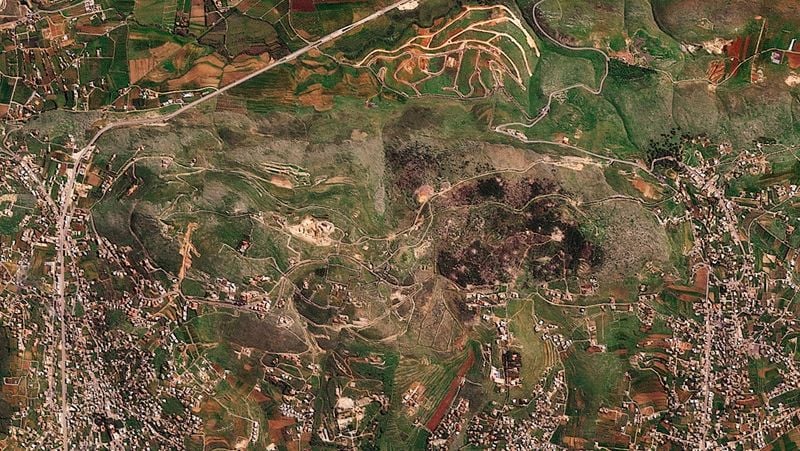
The hill is small. On most maps of the Lebanon-Israel frontier it does not merit a name in 12-point type. But on the evening of 19 June 2026, Ali al-Taher — a scrubby ridgeline inside Lebanese territory that rises opposite the Israeli town of Metula and the cluster of northern settlements that flank it — became the most over-reported patch of ground in the Middle East. Within a four-hour window, three Telegram channels with overlapping editorial lineages carried the same basic claim: that fighters from Hezbollah had destroyed an Israeli tank attempting to advance on the hill, and that a second Israeli armoured push had been beaten back. A fourth channel, quoting Iranian state-television framing, added that "Hezbollah is the shining star of resistance and of humanity." Each of those claims is contested. The geography of what is actually happening, however, is not.
The episode matters because it marks the first sustained, Israeli-led ground manoeuvre on the Lebanese side of the frontier in the current phase of the war — a phase that, until this week, had been defined by airstrike exchanges, by the long shadow of the pager attack, and by a slow-motion attritional artillery war. A ground push, even a limited one, resets the diplomatic variables. It reopens the question of buffer zones, of which villages will be evacuated, of what the United States is willing to tolerate, and of what Iran is willing to underwrite. The Ali al-Taher fight, in other words, is not really about Ali al-Taher. It is about whether the war stays at the altitude its handlers can still manage, or whether it tips back into the kind of broader campaign that every external patron — Israeli, American, Iranian, Saudi, French — has been trying to avoid.
What the wires from the frontier say
The first claim of a destroyed Israeli tank appeared on the Middle East Spectator Telegram channel at 22:27 UTC on 19 June 2026, attributing the strike to Hezbollah near Ali al-Taher hill. Within five minutes the same outlet had escalated the framing, adding that an Israeli armoured convoy had been ambushed, with two vehicles reportedly knocked out. A third channel, wfwitness, described "multiple Hezbollah rocket barrages" hitting IDF forces on the approach, with "clashes reportedly still ongoing." By 22:30 UTC, the intelslava channel — a pro-Russian and Iran-friendly aggregator — was reporting that a second Israeli attempt to push up the hill had "so far failed," with Hezbollah fighters having "successfully repelled the assault."
The clusters cluster in two ways. Geographically, they describe a single piece of terrain, a few hundred metres of elevation south of the Litani. Temporally, they describe a four-hour window in which an Israeli probe appears to have been launched, contested, paused, and re-launched — the rhythm that militaries on both sides of this frontier have come to recognise as the new normal. Iranian academic and commentator Seyed Mohammad Marandi, posting on X at 22:35 UTC, added the political wrapper: "Hezbollah is the shining star of resistance and of humanity." The phrasing, and the timing, are themselves a signal — a reminder that the messaging around the hill, like the hill itself, is contested infrastructure.
The difficulty, as ever in this conflict, is verification. Telegram channels that carry this kind of footage are not neutral observers. Many are openly partisan. Combat footage from a small ridgeline at dusk is easily mis-attributed, and the difference between a tank destroyed, a tank damaged, and a tank temporarily disabled is invisible to most readers. The IDF has not, as of the time of writing, published a public operational readout confirming or denying any specific tank loss near Ali al-Taher. The Israeli press has been more cautious than the Telegram ecosystem, focusing on the broader picture of "targeted ground activity" in southern Lebanon rather than on individual engagements.
What this phase of the war looks like from the southern Lebanese side
Southern Lebanon is one of the most heavily surveilled stretches of land on earth. Israeli drones have flown over its villages, in some estimates, almost continuously since the 1990s. Hezbollah's counter-surveillance has, by most accounts, improved substantially in the past five years — through tunnel networks, hardened command positions, and a layered air-defence architecture that the pager attack of late 2024 was designed in part to expose. The Ali al-Taher terrain, a steep hill with line-of-sight into the Hula Valley, is the kind of feature that a defending force will have pre-registered, pre-ranged, and rehearsed for over many years.
The accounts now circulating, even allowing for exaggeration, point to a fighting geometry that matches what would be expected: a small Israeli force — likely a company or a reinforced platoon — attempting to seize or clear a high point; an entrenched defending force; an exchange of anti-tank missiles and rockets at close range; and a withdrawal or pause that the messaging on each side then claims as victory. The fact that the hill is being contested at all, rather than being bypassed, is itself significant. Israeli ground doctrine in the northern arena has generally preferred standoff fire — airstrikes, drone kills, and artillery — over close manoeuvre. A ground push implies a different operational logic: that someone in the chain of command has decided that the cost of leaving Hezbollah fighters in a dominant observation position outweighs the cost of taking casualties to remove them.
What is being asked of the diplomats
The diplomatic track has, throughout the past nine months, lagged the field track by hours. The same four-hour window in which three Telegram channels reported a tank loss also featured quiet movement in Beirut and in Washington. Lebanese officials have, since the spring, been working a back-channel proposal — reportedly brokered in part by French and Qatari intermediaries — for a partial halt in the cross-border fire in exchange for an Israeli withdrawal from positions taken in the September 2025 air campaign. The Israeli side has, publicly, demanded that any such arrangement include verifiable Hezbollah withdrawal north of the Litani River, in line with UN Security Council Resolution 1701. Hezbollah, formally, still claims the right to keep an armed presence south of the river. The gap between those positions is not a procedural one. It is the war.
The Ali al-Taher fight complicates that arithmetic in two directions. On the Israeli side, every casualty inside Lebanon makes a withdrawal harder to justify politically. On the Lebanese and Hezbollah side, every visible act of resistance is grist for the argument that the armed posture is paying a political dividend. Both calculations are, in turn, consumed by an Iranian system that has signalled — through the Marandi quote and through more formal channels — that it considers the Hezbollah fight to be a load-bearing element of its regional deterrent. A meaningful Israeli ground operation on the Lebanese side, even a limited one, raises the political cost of any eventual ceasefire for Tehran as well as for Beirut.
The structural picture, in plain terms
The pattern is familiar from other frontlines in the same war system. A localised tactical event — a tank knocked out, a convoy ambushed, a single hill retaken — is amplified across a media ecosystem in which official, semi-official, and openly partisan outlets on every side compete to set the frame. The amplification does not require the event itself to be significant. It requires only that the event be legible to the audiences each outlet is trying to reach. Telegram channels that are read in Beirut, in the Shia heartlands of Iraq, and in the south-Lebanese diaspora compress an ambiguous engagement into a clean story of victory. Israeli military correspondents, working under censorship, compress the same event into a clean story of pressure and progress. The wire services, Reuters and the Associated Press among them, write around the gap, reporting both frames and declining to adjudicate.
What all three frames are doing, beneath the surface, is the same work: positioning the next round of negotiations before the next round of fighting begins. The Ali al-Taher hill is small. The signalling around it is not.
What remains genuinely uncertain
Three things are unsettled at the time of writing, and they are the three things that will determine whether this episode becomes a footnote or a turning point. The first is the actual operational status of the Israeli force on the hill. The IDF has not, to this publication's knowledge, released a public confirmation of the loss claimed by Hezbollah-aligned channels. The second is whether the Israeli push represents the start of a sustained ground operation or a one-off probe. The third — and the one with the longest tail — is whether the United States is prepared to push publicly for a halt before the operation expands.
The next forty-eight hours will be clarifying. The Telegram ecosystem is already moving on; new footage is being cut, new framings being assembled, and the Ali al-Taher claim is likely to harden or to be quietly dropped depending on what the IDF says and what emerges from the field. This publication will continue to track the verification trail as it develops, and to read the messaging on each side against the operational reporting from sources that can be checked against primary documents.
This article sits on the long-reads desk. Monexus framed the Ali al-Taher episode as a signalling event inside a continuing frontier war, weighting the Israeli operational record as the primary factual anchor and treating Telegram-channel footage from Hezbollah-aligned sources as material to be reported with explicit provenance rather than as a stand-alone basis for claims about specific equipment losses. The Iranian state's parallel messaging was treated as a counter-frame, not as fact.
Wire provenance
This editorial synthesis draws on the following public wire/social posts:
- https://t.me/Middle_East_Spectator
- https://t.me/wfwitness
- https://t.me/intelslava
- https://x.com/s_m_marandi/status/
- https://t.me/Middle_East_Spectator
- https://en.wikipedia.org/wiki/Ali_al-Taher_hill
- https://en.wikipedia.org/wiki/United_Nations_Security_Council_Resolution_1701
- https://en.wikipedia.org/wiki/2024_Lebanon_pager_explosion
- https://t.me/Middle_East_Spectator
- https://t.me/wfwitness
- https://t.me/intelslava
- https://x.com/s_m_marandi/status/
- https://t.me/Middle_East_Spectator
- https://en.wikipedia.org/wiki/Ali_al-Taher_hill
- https://en.wikipedia.org/wiki/United_Nations_Security_Council_Resolution_1701
- https://en.wikipedia.org/wiki/2024_Lebanon_pager_explosion