Two trains, one corridor: what the Bedford collision reveals about Britain's creaking rail
A Friday-evening collision near Bedford killed one passenger and injured dozens more. The numbers are small; the questions they raise about the state of Britain's Victorian-era mainline are not.
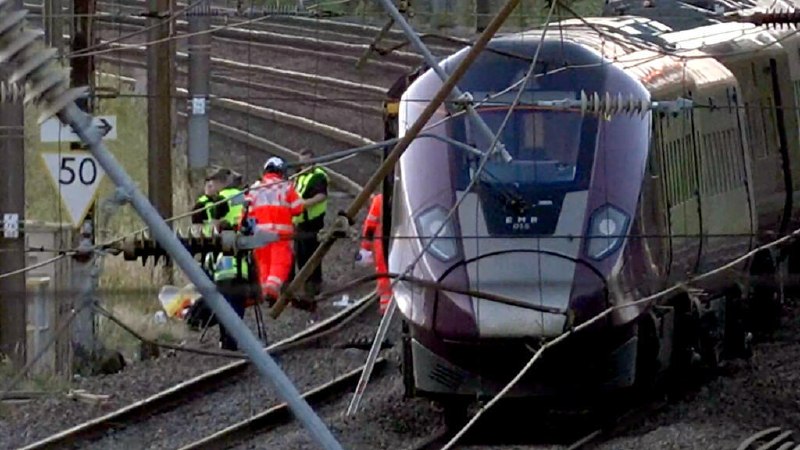
A passenger train travelling towards London on the Midland Main Line collided with a second service near Bedford shortly before 19:00 UTC on Friday 19 June 2026, killing one person and injuring dozens more. Emergency services were still working through the wreckage by the time the first wire reports filed at 03:04 UTC on 20 June, and rail traffic on the trunk route between St Pancras and the East Midlands remained suspended. Al Jazeera's English-language breaking-news desk put the casualty count at one dead and 89 injured; France 24's English service carried the lower figure of "dozens" without an exact tally. The discrepancy, small in scale but telling in pattern, captures the rest of the story: a serious incident on one of Britain's most heavily used inter-city corridors, reported in fragments, against a backdrop of infrastructure that successive governments have promised to renew and have never quite finished renewing.
The collision is a local tragedy and a national test. One passenger is dead; dozens are in hospital; a line that carries commuters, freight, and intercity expresses into the capital is shut down through a weekend. The pattern it sits inside — under-investment in legacy rail infrastructure, ageing rolling stock on secondary corridors, and an industrial-relations backdrop that has left operators and unions publicly at odds — is the larger story. Britain's railway was built in the nineteenth century and modernised in fits and starts. Friday's collision did not invent that problem. It put a human face on it.
What is known, and from whom
The earliest firm reporting came from Al Jazeera's breaking-news desk at 03:04 UTC on 20 June, citing one dead and almost 90 injured after two trains collided near Bedford, roughly 100 kilometres north of London (Al Jazeera). France 24 English carried the same event at 04:57 UTC with the more cautious figure of "one dead and dozens injured" and confirmed that the two services were both passenger trains travelling towards the capital (France 24). A Telegram-channel relay of the France 24 report at 05:13 UTC repeated the lower figure and added that rail traffic on the line had been suspended while emergency response continued (France 24 via Telegram). All three pieces agree on the location (near Bedford), the direction of travel (towards London), and the day (Friday 19 June 2026, evening). They diverge on the headline injury count.
That divergence is normal in the first hours of a major incident. Hospitals triage and admit over hours; rail operators update casualty totals as next-of-kin are notified; the British Transport Police, who would normally lead the inquiry, issue structured statements rather than running counts. Until the Rail Accident Investigation Branch (RAIB) on DfT publishes a preliminary bulletin — typically days, sometimes weeks, after the event — any tally is provisional. France 24's restraint on numbers is, in that sense, the more editorially defensible posture; Al Jazeera's higher figure is consistent with what one would expect from a wire service that has spoken to hospital sources in the first wave.
What neither outlet could yet establish, and what no source currently available supports, is the cause of the collision. The relevant operational variables on a two-train collision on a busy mainline are familiar to anyone who has read a RAIB report: signal passed at danger, obstruction on the line, a track defect, a wheelset failure, a dispatch error at a converging junction, or — rarer but not unknown — a vehicle or person on the line. The Midland Main Line south of Bedford passes through a flat, fast section with several converging junctions in the vicinity of the town, including the junction with the Marston Vale Line and the approach to Bedford St Johns. Until investigators walk the site, every explanation is speculation.
The counter-narrative: a system that holds, until it does not
The official line, once it arrives, will almost certainly stress that Britain's railway remains one of the safest in Europe by passenger-kilometre. That is true, and worth saying. The Office of Rail and Regulation's periodic safety statistics have for years placed the UK in the lower quartile of European mainline networks for passenger fatalities per billion passenger-kilometres. A single Friday-evening collision does not undo that record. The reporting in France 24 and Al Jazeera, by leading on the human cost rather than on system statistics, is also correct: passenger confidence is not built on per-billion-kilometre tables.
The harder counter-narrative is structural. Britain's rail network carries more passenger traffic than at any point since the 1920s, on infrastructure that, on the most heavily used corridors, was largely built between 1830 and 1900. The Midland Main Line itself was engineered by the Midland Railway in the 1860s and electrified only in stages — full electric services to Corby and Nottingham via Bedford have been promised, deferred, partially delivered, and partially deferred again across three decades. Major junctions south of Bedford have seen incremental renewal; resignalling schemes on the East Midlands corridor have run over budget and over schedule; the implementation of the European Train Control System (ETCS), which provides in-cab signalling and would prevent certain classes of collision by removing the dependence on lineside signals, has been slower in Britain than in several continental peers. None of this is a statement about the cause of Friday's collision. It is a statement about the surface on which causes play out.
A second counter-narrative, less comfortable for both the government and the unions, concerns industrial relations. Britain's railways have spent much of the past three years in a state of rolling industrial action over pay, working practices, and the pace of reform. Driver-only operation, rest-day working, and the closure of ticket offices have all been live disputes. There is no public evidence linking any of these disputes to the Bedford collision, and it would be irresponsible to suggest otherwise before investigators have spoken. But the workforce that has to operate the network safely during a period of sustained industrial pressure is the same workforce whose training, rest, and morale are the subject of public argument. The investigation, when it comes, will look at procedures, equipment, and human factors. All three live inside a labour-relations backdrop.
A structural frame, in plain language
Britain's railway problem is, at root, a fiscal and political-economy problem dressed up as a technical one. The network was privatised in 1994 into a structure of infrastructure owner (Railtrack, then Network Rail), train operating companies under franchise, and a regulator (initially the Rail Regulator, later the Office of Rail and Regulation). The model produced periodic franchise crises, the effective re-nationalisation of infrastructure via Network Rail in 2002–04, and a slow drift towards greater state direction under successive governments of both parties. The Great British Railways transition, intended to consolidate operation and infrastructure under a single body, has been in policy development for several years and remains, at the time of the Bedford collision, a White Paper in search of a statute.
The deeper problem is that Britain spends less on rail infrastructure, per passenger-kilometre, than several of its Western European peers, and what it does spend is fragmented across a structure that has more moving parts than comparable networks. France's SNCF, Germany's Deutsche Bahn, and the Netherlands' NS all operate under different structures, but each has a higher degree of vertical integration between track and train than Britain's current or planned arrangements. The result, visible in journey-time statistics and in the proportion of services that run on time, is a network that delivers less reliability per pound of capital invested than its peers. None of this is a verdict on Friday's collision. It is the structural context in which a verdict will eventually be delivered.
The political economy cuts the other way too. The Midland Main Line is also a freight artery, and freight operators have their own stake in the corridor's reliability. The logistics chains that move container traffic between the East Midlands and the Channel ports run through Bedford; a closure of the line does not only inconvenience commuters. Network Rail's freight customers have been among the loudest voices for renewed investment in the corridor for the better part of a decade. The interests of passengers, freight operators, and the Treasury are not perfectly aligned, and the Bedford collision will land in the middle of a negotiation that was already live.
The stakes, and the year ahead
The immediate stakes are human. One family will bury a relative this week. The injured, several dozen of them, will spend days in hospital and weeks or months in recovery. The railway will reopen in stages; the coroner's inquest will run for months; the RAIB bulletin, when it comes, will identify a probable cause and, if the cause is systemic, recommendations. Those recommendations, if past practice holds, will be accepted by the Department for Transport in principle and partially implemented in practice.
The medium-term stakes are political. Britain's railway is one of the most complained-about public services in the country and one of the most heavily subsidised. The Bedford collision will land in the middle of an election cycle in which infrastructure investment is contested ground between the major parties. The Conservatives, in or out of office, will argue for private operation under tighter regulation; Labour will argue for greater state integration under Great British Railways; the Liberal Democrats will argue for both at once. None of these positions is, on the evidence, technically determined by the collision itself. All of them will be argued in its shadow.
The longer-term stakes are about a question that predates Friday evening: whether a country that built the world's first inter-city railway can build the infrastructure to run it in the twenty-first century. The Midland Main Line was once the frontier of railway engineering; it is now a corridor awaiting upgrades that have been on the public books, in some form, since the 2010s. Friday's collision did not cause that delay, but it has made it harder to defer. That is, in the end, the most that can be said of a rail accident on a Victorian-era mainline in the sixth decade of its electrification: it forces a conversation that should have been forced earlier.
What remains uncertain
The cause of the collision is unknown. The exact injury count will move as hospitals discharge, admit, and reclassify. The position of the second train relative to the first — whether it was stationary, moving in the same direction, or moving on a converging path — has not been disclosed by any source available at the time of writing. The Rail Accident Investigation Branch, which has statutory independence from the operators and the department, has not yet issued a statement. The condition of the signalling system at the relevant location, the working patterns of the crews involved, and the maintenance history of the rolling stock are all questions that the eventual bulletin will address and that this article, on the evidence available, cannot.
What the sources do support is narrower but worth stating clearly. Two passenger trains collided near Bedford on the evening of 19 June 2026. One person died. Dozens, perhaps close to ninety, were injured. The line towards London is closed. The investigation will take weeks. The political conversation it provokes will take longer.
Desk note: the wire services covered the Bedford collision as a breaking domestic story; Monexus is framing it as a structural question about the corridor and the network it sits inside, on the principle that the human cost is best honoured by reporting what the incident reveals about the system.
Wire provenance
This editorial synthesis draws on the following public wire/social posts:
- https://t.me/france24_en
- https://en.wikipedia.org/wiki/Midland_Main_Line
- https://en.wikipedia.org/wiki/Bedford_station
- https://en.wikipedia.org/wiki/Rail_Accident_Investigation_Branch
- https://en.wikipedia.org/wiki/Office_of_Rail_and_Road
- https://en.wikipedia.org/wiki/Great_British_Railways