A Photo, A Tantrum, And A Transatlantic Alliance Reading Its Own Obituary
A G7 photo-op has detonated into a public row between Washington and Rome, exposing how casually a US president can disfigure a relationship with a major European ally — and how little incentive either side has to repair it before the next crisis.
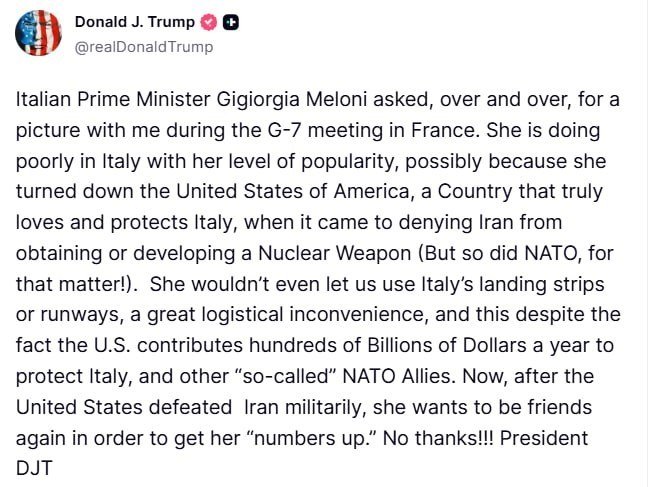
On the evening of 19 June 2026, Italy's Prime Minister Giorgia Meloni told reporters she was "astonished" by an account given publicly by the President of the United States. Donald Trump had claimed, in remarks reported earlier the same day, that Meloni had "begged" him for a photograph together at the G7 summit in Kananaskis, Alberta — an assertion the Italian Prime Minister rejected in unusually direct terms, declaring that Italy does not beg. By the early hours of 20 June, Italy's foreign minister had cancelled a planned visit to Washington, and a routine transatlantic handshake had become the latest tabloid-grade rupture between two governments whose interests, on paper, align on most of the consequential questions of the day.
The quarrel is small. The implications are not. A sitting US president publicly humiliating a G7 host — Italy assumed the rotating presidency in 2024 and remains a central actor in Mediterranean policy, Libya, migration management, and the European energy reorientation after Russia's invasion of Ukraine — exposes how thin the institutional fabric of the Western alliance has become. It also illustrates a pattern this publication has tracked for months: that personal provocation, once treated as the cost of doing business with an unconventional White House, is now treated by European partners as the substance of the business itself.
The chronology
Polymarket's news wire flagged the exchange in three dispatches on 19 June, beginning at 13:13 UTC with Trump's claim that Meloni had begged him for a photo at the G7. Meloni's response followed at 16:13 UTC, with the prime minister expressing astonishment at the framing and a refusal to accept the characterisation. A Polish-language account circulated via @ekonomat_pl at 14:01 UTC captured Meloni's reaction as: "Me and Italy never beg for anything!" The Polish framing added that the dispute centred on a remark Trump reportedly made — that he had felt sorry for Meloni and granted the photograph on those terms — though the wire text did not specify whether that second remark was on the record or a paraphrase. By 20:19 UTC, Polymarket reported that Italy's top diplomat had cancelled an upcoming visit to the United States in response. By 23:04 UTC the same day, the dispute sat alongside two other unrelated Trump-administration moves — an easing of restrictions on testosterone therapy and a separate Japanese growth strategy — that together sketch the texture of a presidency that treats foreign allies, domestic regulation, and industrial rivals with the same improvisational register.
What the wire accounts do not specify, and what readers should treat with appropriate caution, is the precise setting in which Trump made the original remark — whether on camera, on the White House lawn, or to a reporter off the cuff. The escalation, however, is unambiguous: a planned ministerial visit has been withdrawn, and no rescheduling has been announced.
Why this is not just a personality story
The temptation, especially in European commentary, is to file the episode under "Trump being Trump" — a category that flatters the analyst by implying that the underlying relationship is otherwise healthy. That reading deserves scrutiny. Italy is the third-largest economy in the eurozone, a frontline state on Mediterranean migration routes, and a NATO member that has consistently aligned with Washington on Ukraine, on Iran sanctions enforcement, and on the post-2022 European energy architecture. Meloni herself, despite her coalition's domestic politics, has been among the more Atlanticist voices in Rome since taking office. For a US president to publicly bait that partner on a photo-op is not eccentricity. It is a signal about priority.
Two readings are plausible, and this publication finds the second more consistent with the available evidence. The first reading treats the remark as a one-off indiscretion, soon to be smoothed over by a phone call and a joint press availability — the traditional transatlantic repair kit. The second reading treats the remark as part of a sustained pattern in which the White House calibrates its public language toward allied leaders to maximise domestic media value, with repair costs borne by the ally. The pattern is now long enough, and the allied responses varied enough, that the second reading carries more weight. Italy is not Canada; Rome does not have an integrated continental economy that can absorb a US tariff tantrum and shrug. Nor is Italy France, with its nuclear deterrent and its permanent Security Council seat. Italy's leverage is real but narrower: a coalition-builder inside the European Council, a migration partner, a Mediterranean navy. That leverage is precisely what a transactional White House would test.
What the structural frame shows
Look past the photograph and the underlying question is whether the post-1945 Western alliance can still function when its principal power treats allied leaders as material for cable-news content. The architecture of NATO, the G7, and the EU-US trade relationship was built on a presumption of basic decorum between heads of government. That presumption has been degrading for years. The Kananaskis episode is not a break with the past so much as the past's logical conclusion: a system that tolerated informal contempt between allies has arrived at formal contempt, on the record, with a cancelled ministerial visit as the immediate fallout.
The counter-narrative, advanced by defenders of the administration, is that the president's rhetorical style is a deliberate negotiating tactic — that keeping allies off-balance produces better terms on burden-sharing, defence spending, and trade. There is something to this: European defence budgets have risen, and several NATO members have moved closer to the long-promised two-percent-of-GDP floor. But that framing assumes the cost of the tactic is bounded. It is not. Allies that are publicly humiliated do not quietly raise their contributions; they hedge. The recent Japanese growth strategy — a $2.3 trillion public-private investment programme targeting AI, semiconductors, and space by 2040, announced separately on 20 June — is exactly the kind of autonomous industrial policy move that emerges when a US ally decides its exposure to Washington cannot be the organising principle of its long-term planning. Tokyo's calculus, like Rome's, is increasingly about resilience against US volatility, not alignment with US preference.
Stakes
The losers, in the short term, are the diplomats whose calendars have been emptied and the officials now tasked with writing a joint communiqué that papers over the photo-op remark. The longer-term losers are the institutions. NATO's deterrent credibility depends on allied governments trusting that Washington will treat public disagreements privately. The G7's relevance depends on its communiqués being negotiated, not performed. The EU-US trade relationship depends on both sides believing that contractual commitments will be honoured. Each of those dependencies has been weakened by a remark that, in a calmer political environment, would have been retracted within hours.
The winners are the actors who benefit from a fragmented Western front — and the domestic political constituencies, on both sides of the Atlantic, who treat allied humiliation as entertainment rather than cost. Neither category is small.
What remains genuinely uncertain is whether Rome will treat this as an isolated incident or as a turning point. The cancelled ministerial visit is a signal that, at least for now, the Italian government intends to defend its dignity in public. Whether that defence hardens into a more lasting recalibration of Italy's posture toward Washington, or fades once the photo cycle moves on, is the question the next two weeks will answer.
This publication treats the Trump-Meloni episode as a stress test of an alliance already under visible strain — not as a curiosity.
Wire provenance
This editorial synthesis draws on the following public wire/social posts:
- https://x.com/Polymarket/status/
- https://x.com/Polymarket/status/
- https://x.com/ekonomat_pl/status/
- https://x.com/Polymarket/status/
- https://x.com/Polymarket/status/