A photo, a grievance, and the strange theatre of the Trump-Meloni rift
A supposed G7 snapshot has escalated into a cancelled diplomatic visit and a public airing of grievances between Washington and Rome — a row that exposes how personal the transatlantic relationship has become.
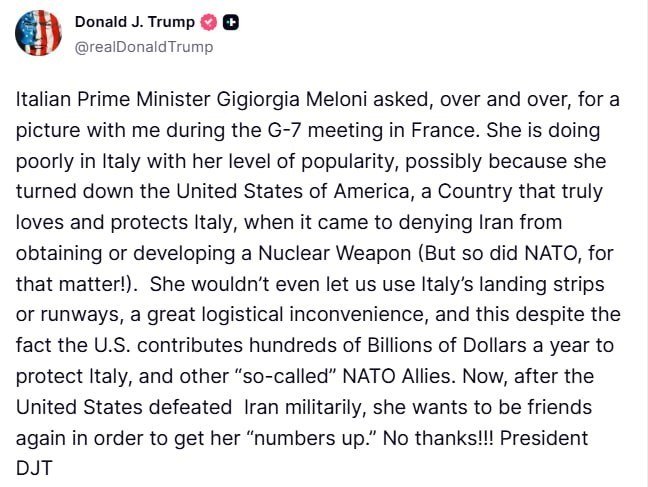
It began, as so many of this era's diplomatic rows do, with a photograph that may or may not have happened. On 19 June 2026, Polymarket's news desk posted that Donald Trump had claimed Italian Prime Minister Giorgia Meloni "begged" him for a photo together at the recent G7 summit. Within hours, Meloni fired back that she was "astonished" by the characterisation, and Italy's top diplomat cancelled an upcoming visit to Washington. By the end of the day, what started as a tabloid-grade anecdote had hardened into the most public rift between Rome and the White House in years.
The incident is small. The optics are not. A head of government being accused of begging a counterpart for a photograph, then publicly rebuking the accusation, is the kind of episode that would once have been smoothed over behind the scenes within hours. It has not been smoothed over. It is being litigated in real time, in English and Italian, across X and across cable news — and the cancellation of the foreign minister's trip suggests Rome intends to register displeasure in a way that travels further than a statement.
What actually happened at the G7
The underlying event is the sort of thing political reporters usually bury in a pool report. At a G7 gathering — almost certainly the June 2026 leaders' summit in Kananaskis, Canada, given the calendar — Trump has alleged that Meloni requested a photo opportunity and that he acceded. The framing in the Polymarket posts is the inflammatory part: not "they took a photo," but "she begged for it," with Trump reportedly adding that he "felt sorry for her and granted" the request. There is no read-out from the Italian prime minister's office confirming the substance of Trump's account, only Meloni's flat denial of the implication. Italian-language coverage of the exchange, surfaced by ekonomat_pl on 19 June 2026, captured Meloni's response — "Me and Italy never beg for anything!" — a line that does the work of both personal rebuttal and national assertion.
The story is unverified in its specific choreography. We do not know what Trump said, in what setting, to whom, nor do we have a transcript of Meloni's remarks beyond their paraphrase. What we do have, repeated across three Polymarket posts and one Polish-wire summary on 19 June 2026, is a consistent shape: a US claim, an Italian denial, a diplomatic cancellation, and a fast-moving public reaction.
Why Rome is taking this seriously
Italy under Meloni has invested heavily in being read as a serious Euro-Atlantic partner — close enough to Washington to be useful, close enough to Brussels to be plausible as an EU insider. The rhetorical cost of being cast as a supplicant is therefore higher than it would be for a leader less invested in that particular posture. A prime minister who is the sitting host of the G7 in 2024, a regular interlocutor at European Council meetings, and a member of the EU's conservative mainstream cannot afford to have her bilateral relationship with the US president narrated as a favour granted to a petitioner.
Cancelling the foreign minister's trip is the cheapest available signal short of a formal summons of the US ambassador. It allows Rome to communicate displeasure without forcing Washington to respond in kind. It also keeps the dispute inside manageable diplomatic channels while letting the public row continue to play out on social media.
The structural problem beneath the theatre
Beneath the personality contest sits an awkward asymmetry. The US president treats bilateral encounters as personal performances — staged, narrated, monetised politically on his own terms. His Italian counterpart, like most European leaders, operates inside a press culture and an institutional setting where a foreign leader is a head of state first and a character second. The two registers collide whenever the cameras are on. The G7 has become the principal venue for that collision because it is the one regular forum where the cast of relevant leaders is gathered, photographed, and quoted in close proximity, without the longer preparatory diplomacy that usually smooths these edges.
It is also true that Trump has spent months cultivating a transactional view of the alliance: tariffs on European steel, open questioning of NATO burden-sharing, and a posture toward the EU that treats Brussels as a counterpart rather than a partner. Against that backdrop, even a trivial-seeming remark about a photograph lands as confirmation of a worldview. The Italian response is not really about a snapshot. It is about refusing to be cast in a scene where Washington is the benefactor and Rome is the grateful recipient.
What is unresolved
The factual core of the dispute — who asked whom, in what words, and with what tone — remains murky. The Polymarket posts relay Trump's claim and Meloni's reaction but do not establish the underlying event against any independent witness account or official read-out. Italian government communications will be the next authoritative source; until they arrive, the row lives in social media and cable-news paraphrase. Whether the foreign minister's visit is rescheduled within days or remains on ice for weeks will be the cleanest indicator of whether this is a serious rupture or a 72-hour news cycle. Either way, the underlying asymmetry — whose story gets told, in whose voice, on whose terms — is now a permanent feature of the transatlantic conversation.
This publication treats the dispute as a case study in the personalisation of allied diplomacy rather than a substantive policy break; the underlying US–Italy cooperation on Ukraine, migration, and Mediterranean security continues regardless of the photo-row's volume.
Wire provenance
This editorial synthesis draws on the following public wire/social posts:
- https://x.com/Polymarket/status/2067970859453603840
- https://x.com/Polymarket/status/2067970606845054976
- https://x.com/Polymarket/status/2067971205830496256
- https://x.com/ekonomat_pl/status/2067938447192715264