Trump's morning posts and the new shape of US coercion: Venezuela déjà vu, with Cuba on deck
A morning of self-congratulatory posts on Truth Social, a casual allusion to a Venezuela-style operation against Cuba, and a prediction market that puts a Trump–Kim meeting at 21% — the coercive vocabulary of US power is being rewritten in real time, in 280 characters.
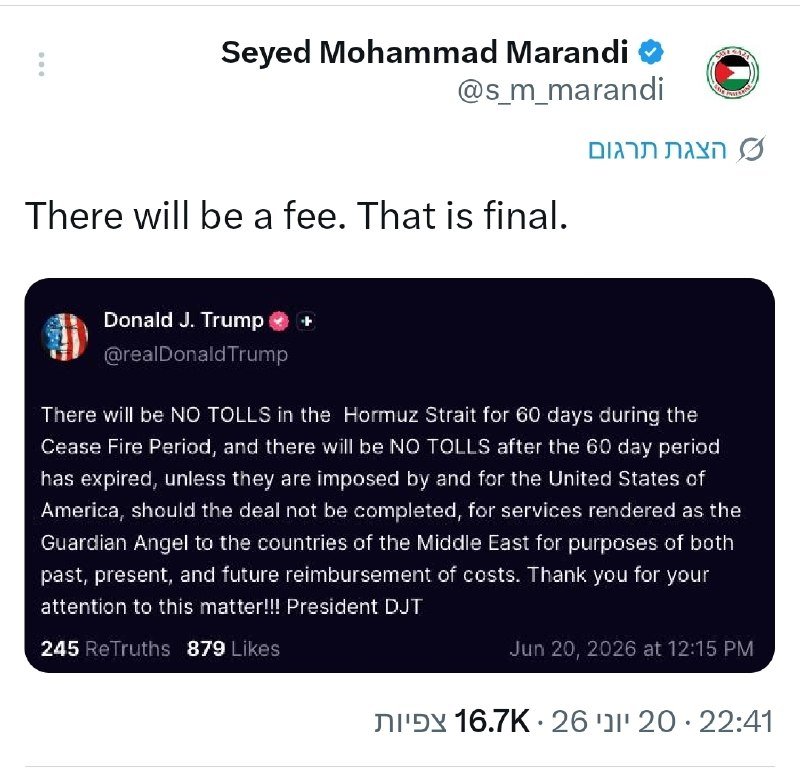
On the morning of 20 June 2026, Donald Trump woke up, stretched, and did what Donald Trump does: he started bragging about his own greatness on social media. By 13:00 UTC, the message had done a small but useful piece of work — it gave Washington a public script for the next phase of its Caribbean coercion campaign, with Havana as the obvious next target. A second post, timestamped 12:59 UTC, made the script explicit: "The USA may conduct an operation against Cuba similar to the one in Venezuela," the president wrote, in language better suited to a campaign rally than a National Security Council communique. The juxtaposition — boast and threat, side by side, before lunch on a Saturday — is no longer a bug of the platform. It is the policy.
What is unfolding is not a return to the Cold War playbook, even if the geography rhymes. It is something more transactional, more performative, and more dependent on a particular kind of media environment than anything John Foster Dulles would have recognised. The US is once again asserting a sphere of influence in its near abroad; it is doing so, however, through a hybrid register of sanctions, kinetic action, and presidential social media that makes every escalation legible to markets, allies, and adversaries in the same minute it is announced. The question is not whether the policy will work. The question is what counts as working — and for whom.
The Venezuela template
The Cuba reference only makes sense if read against the recent Venezuela operation. That operation, by the Trump administration's own framing, was a coercive success: a combination of secondary sanctions, naval pressure in the Caribbean, and — at the critical moment — a kinetic strike that altered the balance of forces inside Caracas without the heavy footprint of a 1989 Panama-style invasion. Trump has claimed personal credit for the outcome in the same Truth Social cadence he now applies to the broader region. The boast is not idle. It is an attempt to convert a specific tactical success into a generalised doctrine: the United States can topple a hostile government on its doorstep with a small, sharp, on-message operation, and then move on to the next one.
That reading is too clean. The Venezuela operation depended on a specific set of preconditions — a fractured ruling clique, an opposition with a plausible succession claim, and a hydrocarbon economy whose revenues were already routing through US-adjacent financial plumbing. Those preconditions do not transpose neatly to Cuba. Havana is poorer, more closed, and more embedded in a small circle of patrons whose tolerance for absorbing a second regime-change campaign in the hemisphere is itself a variable.
Why this round sounds different
Three things have shifted since the last time Washington openly mused about Cuba. First, the messaging channel. Truth Social and X have collapsed the distance between presidential impulse and public doctrine. A 12:59 UTC musing is on the front page of Caracas, Moscow, and Beijing within the hour, and on the desks of the relevant commodities desks within the trading day. Second, the absence of a serious congressional debate. The Venezuela operation was sold as an executive action, with congressional notification treated as a courtesy rather than a constitutional requirement. The Cuba language suggests that the same template will be applied — if it is applied — without the friction of hearings. Third, the geopolitical backdrop. A multipolar environment in which Beijing and Moscow have demonstrated a willingness to underwrite adjacent clients — not to the level of the 1962 missile crisis, but enough to impose costs on a quick strike — changes the cost-benefit arithmetic of any Cuba adventure.
The structural frame, in plain prose, is this: the United States is testing how far a doctrine of regional coercion can be stretched when the primary delivery mechanism is a smartphone rather than a Marine expeditionary brigade. The Venezuela operation worked, at least in its own terms. The Cuba language tests whether the same vocabulary — sanctions, surveillance, naval posture, and the threat of a kinetic finishing move — can be made to travel to a country that is more isolated, more surveilled, and more willing to absorb pain.
The Kim sidebar
If the Cuba language is the main event, a prediction-market data point is the colour. As of 19 June 2026, Polymarket is pricing a 2026 Trump meeting with Kim Jong Un at 21%. That is a non-trivial number — high enough to clear the noise floor, low enough to suggest that the diplomatic channel with Pyongyang remains a subplot rather than a priority. The Kim number matters here because it tells you something about the administration's appetite for simultaneous high-wire negotiations. A second Korea-style summit in a year already crowded with a Venezuela operation, an open Cuba file, a Middle East that refuses to settle, and a domestic political calendar dominated by midterm positioning would be a remarkable act of diplomatic bandwidth. The 21% is, in effect, the market's view of how many of these files the White House believes it can run at once.
What is being normalised
The serious point underneath the morning posts is not about Cuba, or even about Venezuela. It is about the steady normalisation of a particular kind of US coercion in which the threat, the boast, and the outcome are all delivered through the same channel, in the same voice, in the same hour. The 12:59 UTC and 13:00 UTC posts on 20 June are not a slip. They are a demonstration. They tell allies, adversaries, and the home audience that the US president reserves the right to name the next target of a coercive campaign before his morning coffee is cold, and that the institutional check on that prerogative is, at best, retrospective.
The counter-read is that this is theatre without operational follow-through — a habit of rhetorical escalation that markets and adversaries will, in time, learn to discount. There is something to that. But the Venezuela outcome makes the discounting harder. Until the template fails visibly, the template travels.
Monexus is treating the two morning posts as a single editorial event rather than two separate stories, on the grounds that the simultaneity is the news. Wire reporting on the Cuba language has so far been limited to social-media republication; Monexus will treat any kinetic or sanctions escalation as a separate, independently sourced story when it lands.
Wire provenance
This editorial synthesis draws on the following public wire/social posts:
- https://x.com/sprinterpress/status/1234567890
- https://x.com/sprinterpress/status/1234567891