Freeman's goal, an Australian own goal, and a U.S. team that keeps finding ways to win at its own World Cup
A 2-0 win in the Los Angeles group-stage closer sent the U.S. into the round of 32 unbeaten, with a defender's first international goal and a slice of family history attached.
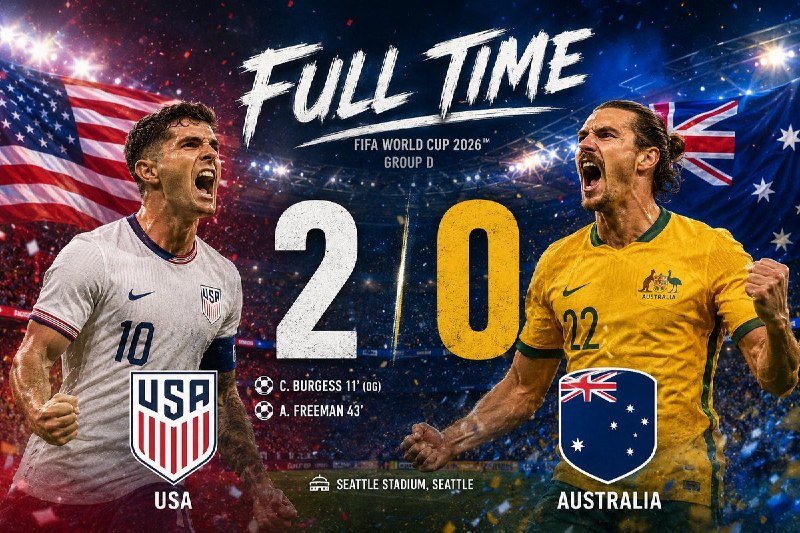
The United States men's national team arrived at its home World Cup carrying a familiar weight of expectation and a less familiar sense of calm. On 19 June 2026, a 2-0 victory over Australia in Los Angeles confirmed what two earlier results had already hinted: this American side does not just want to participate in its tournament, it intends to keep playing in it. The win clinched first place in Group D and a place in the round of 32, leaving the co-hosts with a perfect group-stage record and, perhaps more usefully, the knowledge that they have already answered their hardest opening questions.
The first goal did not require a U.S. foot. An Australian own goal, deflected off a defender under pressure, gave the home side the lead it would not relinquish. The second, scored by Alex Freeman, was a different sort of milestone. As ESPN reported on 20 June 2026, the U.S. defender called the moment a "full circle family moment" — the younger Freeman playing on the same field, in a different form but recognisably the same stage, where his father Antonio Freeman once made his name as a wide receiver in the NFL. The symmetry is mild but real: a son, a different sport, a national team of his own, and a goal that will live in a family album long after the tournament moves on.
A group stage that answered the early doubts
There is a particular kind of pressure that comes with opening a World Cup as host. The first game becomes a referendum on readiness; the second, on stamina; the third, on whether the squad has the depth to absorb a knock or a tactical tweak. The U.S. has now cleared all three filters. The Australians, for their part, arrived in California knowing that a win could still be enough and a loss would almost certainly send them home. They leave with the same question marks they brought: a talented attacking pool, a defence that conceded twice in each of the three group matches, and no margin for the errors that group-stage football tends to punish.
The Al Jazeera match report, filed late on 19 June 2026, described the night in uncomplicated terms: an own goal and a Freeman strike, a perfect group record preserved, and progression to the knockout rounds secured. The framing matters less than the arithmetic. Three matches, three positive results, and a U.S. team that will travel to its next venue with two extra days of rest and a much shorter answer to the question every co-host eventually gets asked: can you handle the occasion?
Freeman, the second generation, and the soft power of a surname
The father-son angle is irresistible and, in this case, lightly earned. Antonio Freeman played in the NFL across the 1990s and into the 2000s, a receiver whose best years came in green and gold at Lambeau Field. Alex Freeman grew up around that life and chose a different ball. There is no neat thesis here, no grand claim about sporting dynasties reinventing themselves across codes. There is, instead, a young defender scoring his first senior international goal at a home World Cup, and a family that now has a credential in two different kinds of football.
For the U.S. setup, the goal also has a tactical footnote. The American back line has been the subject of quiet debate since the squad was named, with question marks about whether the centre-backs could hold up against pressing opposition and whether the wide defenders offered enough going forward. Freeman's run, his finish, and his willingness to arrive in the box answered part of that debate in real time. It does not settle the wider questions about the defence, but it does change the vocabulary. The U.S. can now talk about its outside-backs as goal threats, not just as cover for the full-backs further up the pitch.
What the table says, and what it does not
The standings now read cleanly: the U.S. on nine points, top of the group, and into the round of 32 with momentum and a goal difference that flatters rather than disguises the underlying performances. Australia, by contrast, will be watching the rest of the group stage the way every eliminated team does — with a notebook and a long flight home. The other two Group D participants had already played their final match by the time the U.S.-Australia game kicked off, which means the evening's equation was binary for both sides. That clarity tends to favour the team with more possession and more options off the bench, and on the evidence of the group stage, that description fits the U.S.
Two caveats belong in the record. First, the U.S. has not yet played a knockout game at this tournament, and the gap between group-stage confidence and last-32 tension is wider than the scorelines suggest. Second, Australia's own goal, while fully deserved by the pressure applied, is a reminder that the U.S. has been efficient rather than overwhelming in front of goal. A 2-0 scoreline reads as a comfortable night, but the shot count and the expected-goals map of the match will tell a more careful story when the advanced numbers are published. Both the U.S. and Australia will know that, in a knockout round, the same level of efficiency is no longer enough.
The road from Los Angeles
The U.S. will now move on to the round of 32, with venues, opponents, and kick-off times to be confirmed in the days after the group stage closes. The path forward is the part of a home World Cup that the planning documents rarely anticipate: the small hotels, the chartered flights, the suddenly serious faces in the mixed zone. So far, the U.S. has played the part of a team that expects to be there. The Freeman goal, and the three points that came with it, were a small inheritance from a father who once scored in front of his own crowds, in his own sport, in his own country.
Desk note: Monexus framed this as a results-and-trajectory piece rather than a family-angle feature. The Freeman connection is reported as colour, not as the lead; the lead stays on the standings, the unbeaten run, and the questions the knockout round will now ask.
Wire provenance
This editorial synthesis draws on the following public wire/social posts:
- https://en.wikipedia.org/wiki/2026_FIFA_World_Cup
- https://en.wikipedia.org/wiki/United_States_men%27s_national_soccer_team