Wema Sepetu's long road to motherhood, told in her own words
After years of public grief over repeated miscarriages, the Tanzanian actress and former Miss Tanzania Wema Sepetu tells Saturday Magazine she has finally welcomed a child.
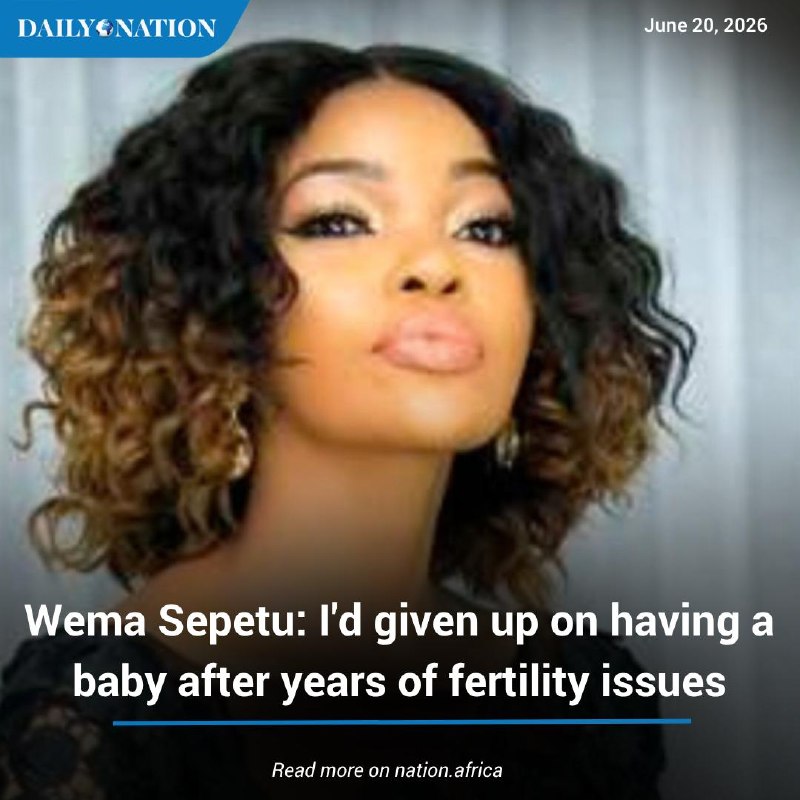
For more than a decade, Wema Sepetu has been one of the most recognisable faces in Tanzanian entertainment: a former Miss Tanzania, a film actress whose career runs through Bongo flava's commercial peak, and a tabloid fixture whose private life has rarely stayed private. On 20 June 2026, the Daily Nation's Saturday Magazine published an interview in which she describes, in unusually direct terms, the years of miscarriages that preceded the arrival of her first child. The framing is hers: she had, she says, given up.
The interview sits in a longer East African conversation about fertility that is increasingly public, increasingly female-voiced, and still mostly unspoken in the region's celebrity press. Sepetu's account matters less for any single revelation than for what it concedes: that a woman whose image has been traded across glossy magazine covers and gossip columns for years was, throughout, navigating a medical and emotional burden that the same press rarely paused to ask about.
What she has said
In the Saturday Magazine piece, Sepetu is quoted as having "given up on having a baby after years of fertility issues". The headline — "Wema Sepetu: I'd given up on having a baby after years of fertility issues" — is a near-direct lift of her own framing, and it does the work of acknowledging both the duration of the struggle and the moment of release. The Daily Nation's lead-in summary, circulated via the publication's Telegram channel at 04:22 UTC on 20 June 2026, says that Sepetu "has longed to become a mother and has openly spoken about the emotional toll the repeated miscarriages have had on her", and notes that she spoke "last week" about the change in her circumstances.
That is the news. The actress whose miscarriages had become, against her wishes, a recurring subject of tabloid speculation is now publicly identifying as a mother. The Daily Nation does not, in the excerpt circulated via Telegram, name a child, give a birth date, or specify the route by which the child arrived. Those details, if they appear at all, sit behind the paywall of the magazine's print and digital editions.
A counterweight the local press rarely applies
East Africa's celebrity press trades in image. Magazines and gossip portals have, for years, run speculative stories about Sepetu's body, her relationships, and the absence of children from her public appearances — without ever quite asking, on the record, what was going on medically. The Saturday Magazine interview is, on that front, a small correction: Sepetu is being asked the question she has clearly wanted to answer, and she is answering it.
But the framing still tilts toward the confessional. The headline leads with resignation ("I'd given up") rather than with the fact of the child. Read that way, the piece risks treating motherhood as the resolution of a personal crisis rather than as a new chapter in a working life. Sepetu has, after all, been publicly productive throughout: film roles, brand work, public appearances. None of that disappears into the pregnancy subplot, and the Daily Nation's framing would have been sharper if it had been able to hold both at once.
The structural read: female fertility in East African public life
Sepetu's interview lands inside a wider, quieter shift. Across Kenya, Tanzania and Uganda, women in public life — politicians, broadcasters, athletes — are increasingly speaking on the record about miscarriages, IVF, endometriosis, and the cost of fertility treatment. The reasons are partly generational: a cohort of women who came of professional age in the 2000s and 2010s now have the platforms and the disposable income to describe what their mothers' generation was expected to absorb in silence. They are also partly structural: fertility care in East Africa is overwhelmingly private, expensive, and concentrated in Nairobi, Dar es Salaam and Kampala, which means that the women who speak publicly about treatment are usually those who could afford to.
That skew matters. Sepetu's account is candid, but it is also a celebrity account: it presumes a level of medical access and privacy that the average Tanzanian woman navigating recurrent pregnancy loss does not have. The Daily Nation's piece does not interrogate that gap, and a more searching version of the same interview might have asked what Sepetu's experience tells readers who cannot fly to South Africa or India for treatment, and what the country's reproductive-health infrastructure actually offers them.
What the sources do — and do not — establish
Two pieces of Saturday Magazine coverage are in circulation as of 20 June 2026: the long-form interview itself, filed under the headline quoted above, and a Telegram-channel summary posted by the Daily Nation at 04:22 UTC that morning. Both treat the announcement as confirmed and recent. Neither names a medical provider, a birth date, a hospital, or the other parent, and the Telegram excerpt does not specify whether the child was carried by Sepetu, born via surrogate, or adopted. Anyone reporting beyond the magazine's own framing is, at this point, working from the magazine's word.
What is established: Sepetu has spoken, on the record, about years of fertility struggle and miscarriages, and she is now publicly identifying as a mother. What remains to be reported: the basic biographical details of the child, and the medical path that brought the family to this point. The Daily Nation appears to have agreed, implicitly, not to press on those questions in this instalment. A follow-up, if it comes, will be more useful than the lead.
Desk note: Monexus framed this as a celebrity-on-the-record interview rather than as a fertility-policy story, on the strength of the Daily Nation's own framing. A second beat — what Sepetu's experience tells readers who lack her access to private reproductive care — is flagged here for future coverage.
Wire provenance
This editorial synthesis draws on the following public wire/social posts:
- https://t.me/DailyNation
- https://t.me/DailyNation