Tehran's Swiss signal: Pezeshkian's office frames Lebanon de-escalation as first ask of new US track
A deputy communications chief in Tehran publishes the negotiating team's opening line — ending the campaign against Lebanon — before cameras, suggesting a deliberate public framing of the channel as primarily regional, not nuclear.
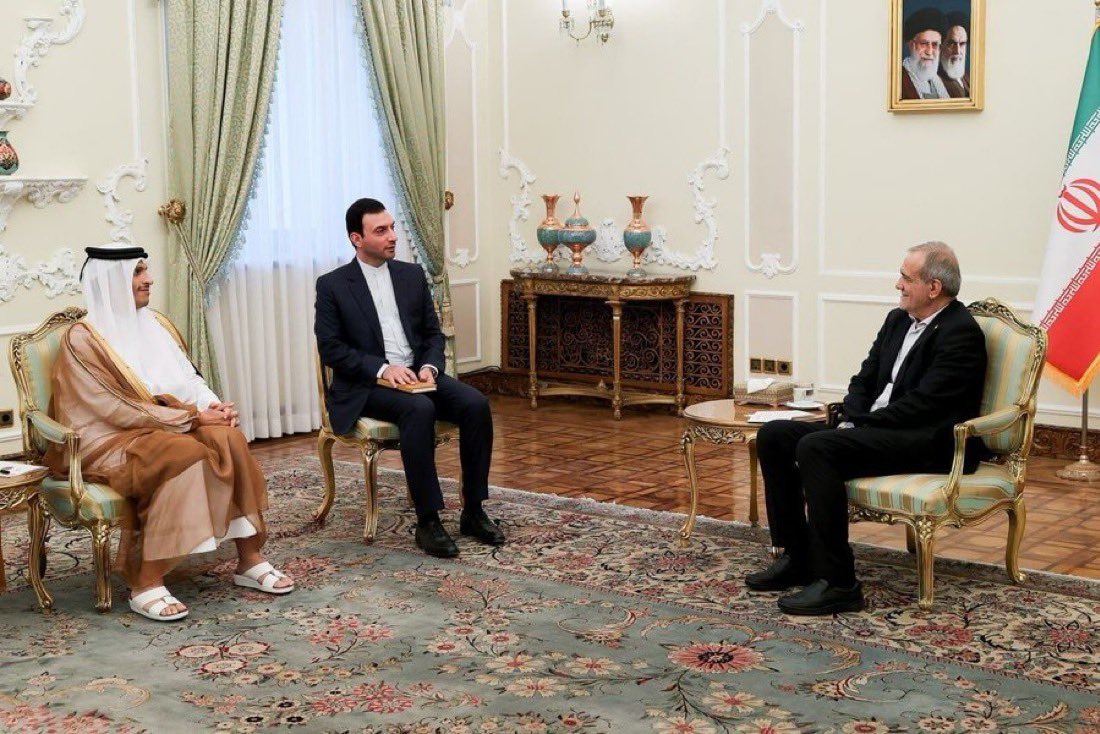
At 10:03 UTC on 21 June 2026, Iran's Tasnim News Agency carried a single declarative line from Seyed Mehdi Tabatabai, the Deputy Director of Communications and Information in President Masoud Pezeshkian's office: the negotiating team travelling to Switzerland would, in its first order of business, press for an end to what Tehran calls "the aggression in Lebanon." Within twelve minutes the same sentence had been echoed by the Al-Alam Arabic channel (at 10:07 UTC and again at 10:09 UTC) and by the English feed of Tasnim (at 10:15 UTC), and republished in Persian by Mehr News (also at 10:15 UTC). The repetition is itself the story: this is not a leak, it is choreography.
The framing matters more than the meeting. For more than a decade, the default Western wire read of any Iran-United States channel has been nuclear — enrichment percentages, centrifuge counts, the Joint Comprehensive Plan of Action as the reference text. By publicly putting "ending the aggression in Lebanon" ahead of the nuclear dossier, Tehran is signalling that the regional file is the precondition for any movement on the technical one. The Pezeshkian government's communication team is not hiding the move; it is broadcasting it.
What was actually said
Tabatabai's posts, as published by the three Iranian-aligned channels, make two related but distinct claims. The first is positional: the Switzerland-bound delegation's "first order" is to end what Iranian state media describes as the Israeli campaign against Lebanon — a reference to the air and ground operations along the southern Lebanese border and against Hezbollah infrastructure that have run intermittently since late 2023 and at higher tempo through 2024 and 2025. The second is procedural: the same statement calls for the "unconditional implementation of the first clause" of an Iranian-American understanding, language that implies a prior written or verbal framework whose existence has not been confirmed by any Western capital in the material reviewed for this article. The clause itself is not named in any of the four Telegram items.
The institutional voice is narrow. Tabatabai is not a cabinet minister, a foreign-policy principal, or a negotiator; he is the communications deputy in the presidential office. The choice of messenger is a familiar one in Iranian political communication: substantive announcements about negotiations are usually carried by Foreign Minister Abbas Araghchi or by the negotiating team's own spokesperson. A communications deputy announcing the agenda suggests the government wants a controlled, low-attribution line in the public domain — defensible if pressed, deniable if necessary.
Why the Lebanon-first frame is being pushed now
The Swiss track is being constructed at a moment when three pressures converge. First, Hezbollah's capacity has been degraded but not destroyed: the group's political wing retains its place in Lebanon's confessional system, while its military wing has been forced to reposition after the 2024 exchanges. Any durable arrangement in the south requires Tehran's buy-in, and Tehran knows it. Second, the Pezeshkian administration came to office arguing for precisely this kind of regional de-escalation as the price of domestic economic stabilisation; the government's survival depends on visible delivery. Third, Washington is recalibrating. The Trump administration's second term has signalled a willingness to engage Tehran on a multi-file basis, but the sequencing of those files — nuclear first, regional second, or the reverse — is the open question, and the answer will determine what a deal actually looks like.
By going public with the Lebanon-first line, Tabatabai is, in effect, testing whether Washington will accept that sequencing. The Western-wire reading of the past fifteen years has been that regional files are bargaining chips to be settled after the nuclear question is closed. The Iranian reading, as expressed through this signal, is the opposite: the regional file is the door, and the nuclear file is the room one enters through it.
What the framing concedes — and what it doesn't
There are limits to the message. Tabatabai's language does not, on the evidence of the four Telegram items, set a deadline, name a counterpart, or commit to a specific verifiable step — no prisoner exchange, no fuel-swap, no IAEA inspector protocol. The phrase "first order of the negotiating team" is directional, not operational. A reader looking for the technical content of a deal will find none in any of the four posts.
What the framing does do is stake out two political claims. The first is that the Iranian government speaks for the regional axis at the negotiating table — that is, that decisions affecting Hezbollah's posture, the Syrian frontier, and the broader "axis of resistance" pass through Tehran. The second is that the Iranian street is being told, in real time, that the government is working on a tangible problem — a Lebanese ceasefire — rather than on the abstractions of enrichment and sanctions relief. Both claims are worth what the eventual negotiation makes of them.
Stakes and what to watch next
If the Swiss track holds, the most immediate consequence is a calibrated reduction in kinetic activity along the Israel-Lebanon border, with Tehran using its leverage over Hezbollah's operational tempo as a deliverable. The downstream prize — sanctions relief, frozen assets, and the political rehabilitation of the Pezeshkian government — depends on the nuclear file moving in parallel, and on whether the Trump administration is willing to accept the sequencing Tehran has now, quietly, insisted on.
The plausible counter-read is that the Lebanon-first line is bargaining theatre: a public position meant to harden Iran's domestic base and shift the burden of compromise onto Washington. Both readings can be true at once, and the source material does not yet let a reader choose between them. What the four Telegram items do establish is the direction of travel — and the unusual fact that the Iranian government is announcing it out loud, in three languages, in twelve minutes.
Desk note: Western wires have, to date, led their Iran-US coverage with the nuclear file; this piece follows Monexus's standing brief to lead with regional and Global-South sources where the substance is regional, and to credit the structural seriousness of the Iranian counter-frame rather than treating it as talking points.
Wire provenance
This editorial synthesis draws on the following public wire/social posts:
- https://t.me/tabatabai_mehdi
- https://t.me/alalamarabic
- https://t.me/tasnimnews_en
Follow the event.
These dated source records provide context. They do not retrospectively verify this archive article.
Separate what the nuclear watchdog reported from what it could not determine after the June 2025 strikes.